-
Merit Badges
- Legend to identify Merit Badges
- 1910 British Merit Badges
- Square 1911 - 33
- Wide Crimped 1934 & 35
-
Narrow Tan Crimped 1936 - 42
- Tan Heavyweight Cloth with Silk Embroidery and Printed Back 1936 - 37
- Tan Heavyweight Cloth with Silk Embroidery and Plain Back 1937 - 38
- Tan Lightweight Cloth with Silk Embroidery and Plain Back 1938 - 39
- Tan Lightweight Cloth with Cotton Continuous Loop Embroidery and Plain Back 1939 - 42
- Tan Lightweight Cloth with Cotton Lockstitch Embroidery and Plain Back 1939 - 42
- Blue Background 1942 - 46
- Wartime 1942 - 46
- Khaki Narrow Crimped 1946 - 59
- Green Twill Gauze Back 1960 - 68
- Fully Embroidered Merrowed Edge 1960 - 72
- Unprinted Plastic Back 1972 - 01
- Printed Plastic Back 2002 - Current
-
Merit Badge Paper
- Merit Badge Applications
- Merit Badge Cards
-
Merit Badge Pamphlets
- Type 1 White Cover - Rectangle Drawing On Cover
- Type 2 White Cover 5-375" x 8" Title at Top
- Type 3A Tan Cover - 200 Fifth Avenue
- Type 3B Tan Cover - 2 line address New York City
- Type 3C Tan Cover - 2 line address New York N.Y.
- Type 3D Tan Cover - 1 line address New York N.Y.
- Type 4 Standing Scout Cover
- Type 5A War Cover
- Type 5B Red and White
- Type 6 Photo-Red Cover
- Type 7 Full Photo Cover or Bulls-eye Cover
- Type 8 Full Photo - Green Stripe Cover
- Type 9 Full Photo - Red Stripe Cover
- Type 10A Blue Stripe - Logo above bottom blue stripe - FDL centered
- Type 10B - Blue Stripe in bottom of photo area. FDL to left of text
- Special Covers
- Boy Craft Helps
- Merit Badge Counselor's Guides
-
Youth Position
- Junior Assistant Scoutmaster
- Senior Patrol Leader
- Assistant Senior Patrol Leader
- Patrol Leader
- Assistant Patrol Leader
- Troop Guide
- Scribe
- Quartermaster
- Instructor
- Chaplain Aide
- Den Chief
- Librarian
- Musician
- Webmaster
- Bugler
- Troop Historian
- Troop Representative
- Unit Representative
- Leadership Corps
- Honor Guard
- Leave No Trace Trainer
- Outdoor Ethics Guide
-
Patrol Medallions
- Patrol Medallions Introduction
- Legend to identify Patrol Medallions
- Patrol Shoulder Knot-Ribbons
- Felt Handmade Patrol Medallions
- Square Felt Patrol Medallions
- Round Broadcloth Patrol Medallions
- Red Twill Patrol Medallions
- Multi-Color Cloth Patrol Medallions
- Tan Cloth Patrol Medallions
- Patrol Medallion Back Patches
- Woodbadge Patrol Medallion
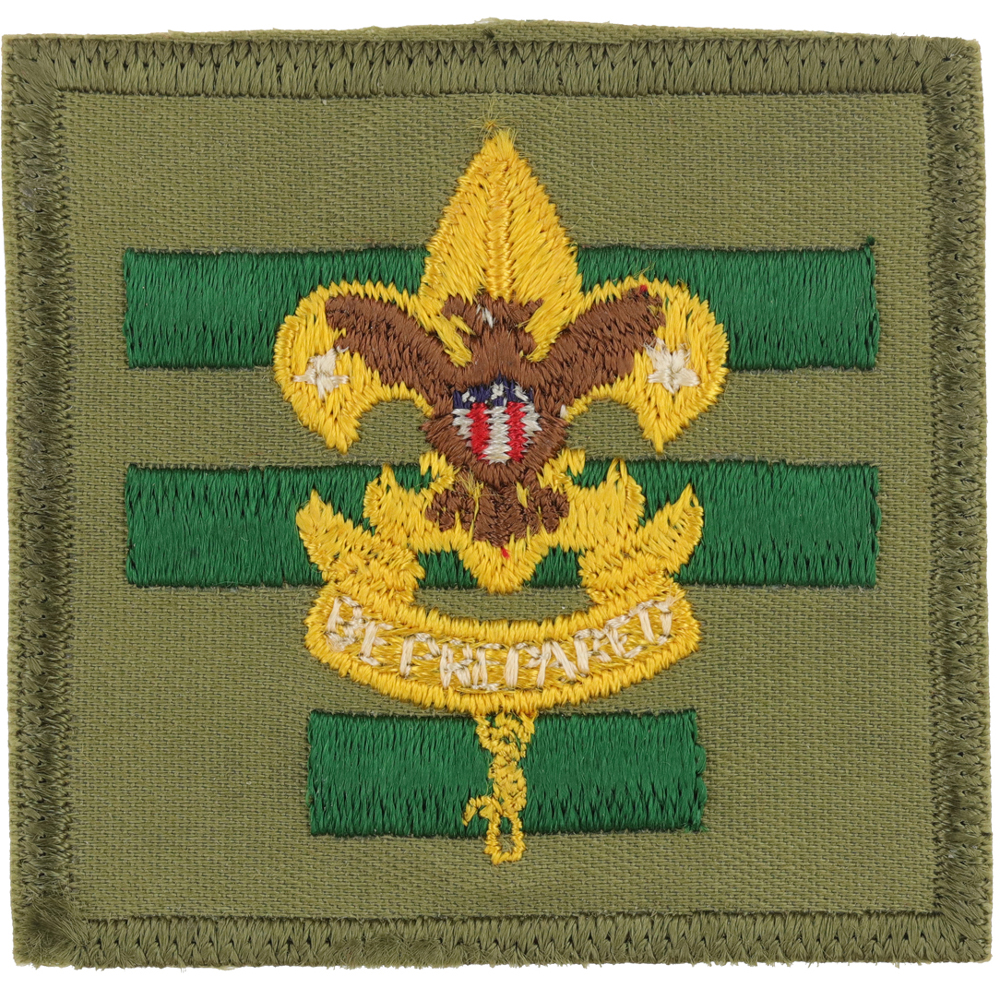
Fig. 1: SPLB-1-6-1-Front
- Size: 64mm x 62mm
- Border: Cut edge khaki
- Cloth: Khaki fine left twill
- Embroidery: Cotton lockstitch
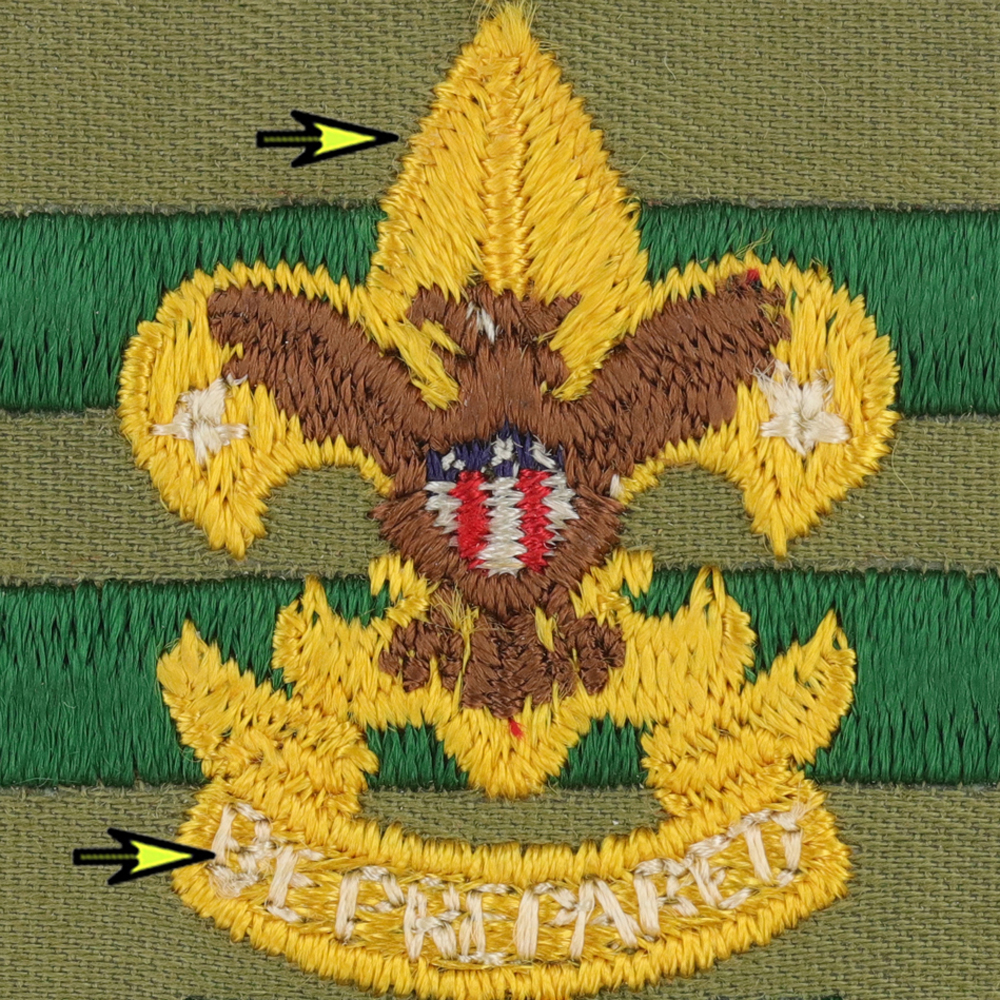
Fig. 2: SPLB-1-6-1-Magnified
- Gold tall crown 1st class with brown eagle, horizontal stitched smile
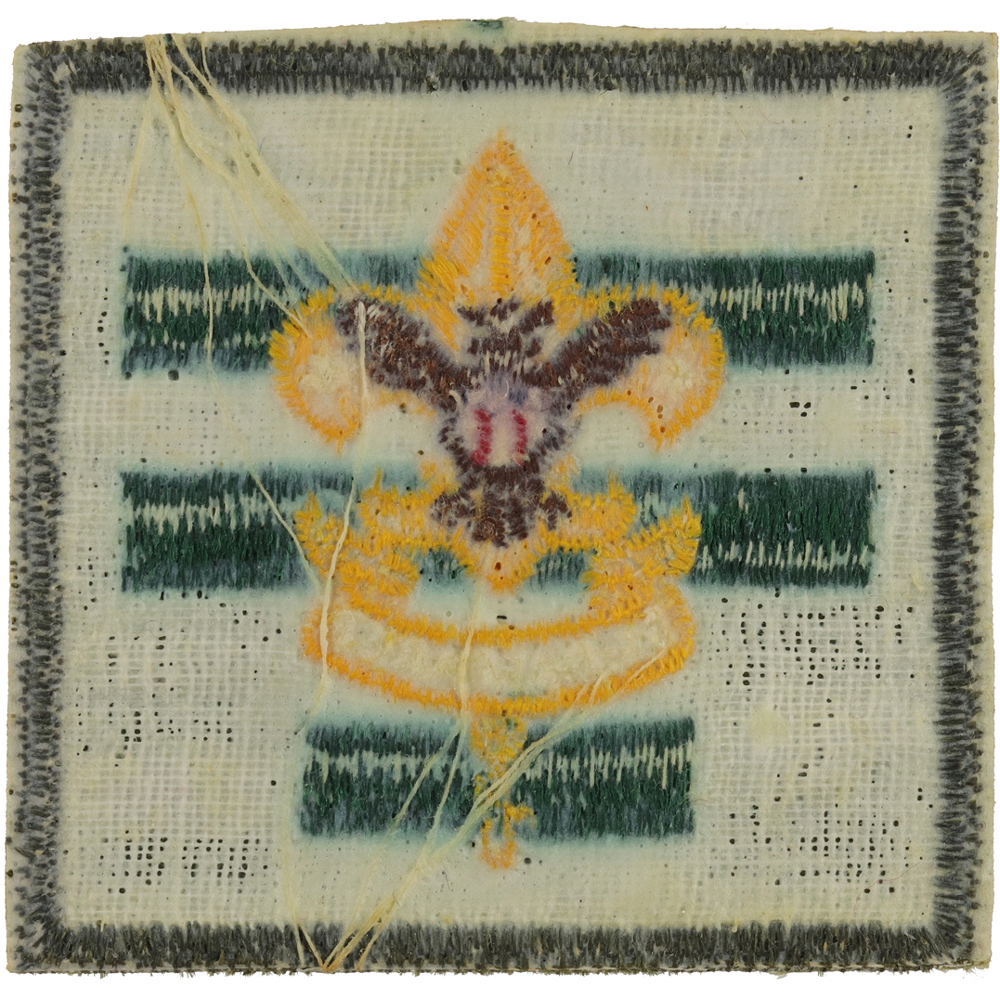
Fig. 3: SPLB-1-6-1-Reverse
- White glue
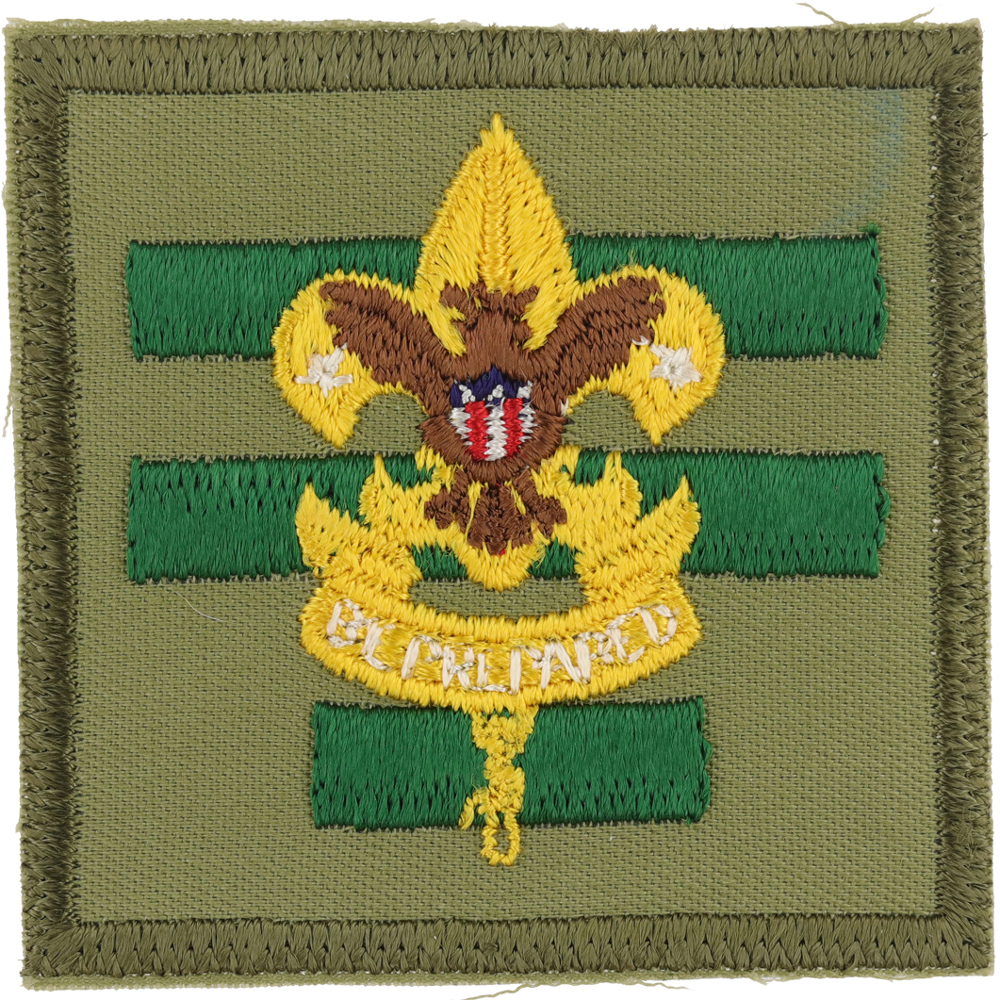
Fig. 4: SPLB-1-6-1-mve1-front
- Gold tall crown 1st class with brown eagle, horizontal stitched smile
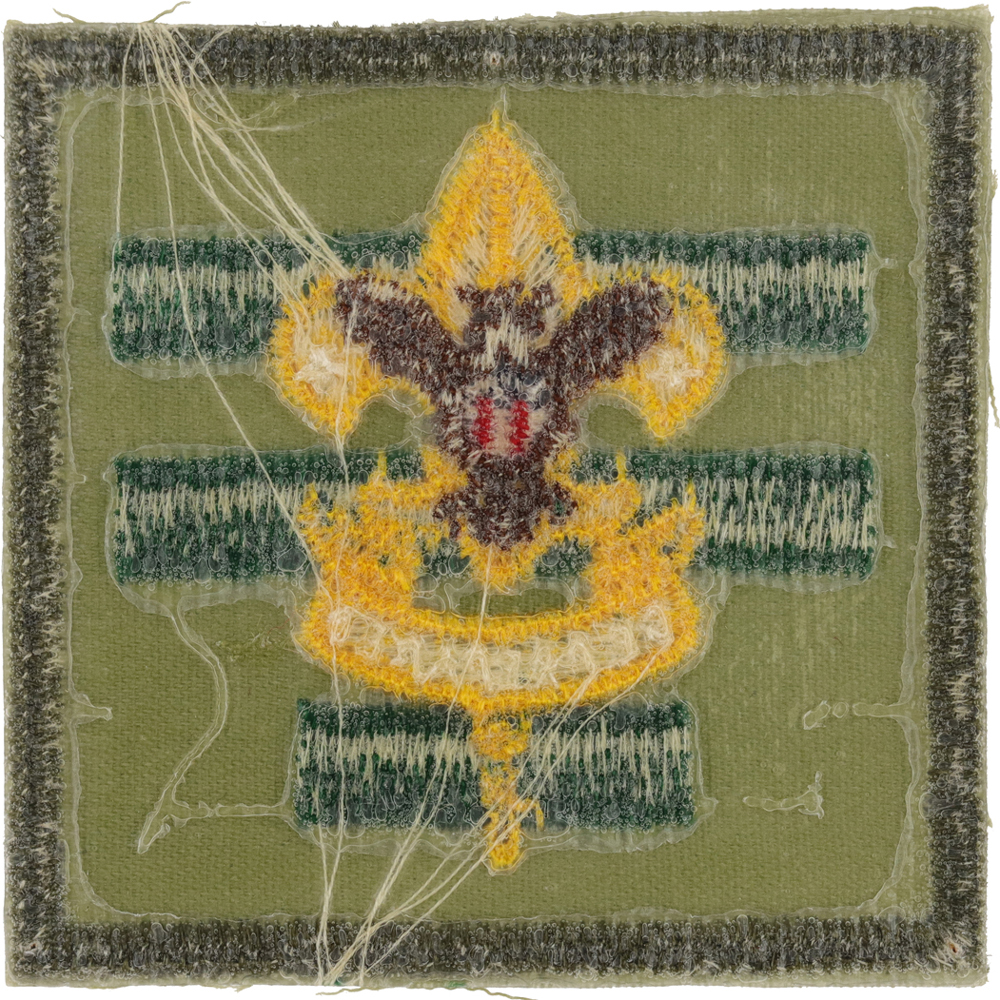
Fig. 5: SPLB-1-6-1-mve1-reverse
- Minor variation: Clear waffle
Item Name: Senior Patrol Leader 1965 - 1971
Item ID: SPLB-1-6-1
Collector Rating: 1
Qualifications and Duties July 1959 until August 1970
The office of senior patrol leader is one of the most important positions of leadership in the troop. It is open to a First Class Scout who has a strong character, is proficient in Scouting, and has marked ability as a leader. Since the patrol leader is expected to work with the patrol leaders and assist them in their jobs, he should know what it means to run a patrol. Generally speaking, a Boy Scout with an outstanding record as a patrol leader makes the best senior patrol leader.
The senior patrol leader is elected by the patrol leaders’ council. His appointment is authorized by the troop committee on the Scoutmaster’s recommendation.
His main duty is to be responsible for the troop program. He is the chairman of the patrol leaders’ council which does the planning. Because he is a boy himself, you can depend on him to see that the program is planned the way the boys want it.
He is in charge of troop meetings, keeping the program moving. He is also responsible for the activities of troop hikes and camps.
The senior patrol leader position is the highest elective office in the troop. Since this is true, the SPL ranks above the junior assistant Scoutmasters in the troop chain of command. He is the executive officer of the troop.
A good Senior Patrol Leader
- Is proficient in Scouting.
- Has marked ability as a leader.
- Has served as a successful patrol leader.
- Serves as chairman of the Patrol leader’s council.
- Looks to his Scoutmaster for advice and training.
- Takes charge of troop meetings.
- Gives leadership to the program on troop hikes, camps, and special activities.
- Works with the patrol leaders directly or through the assistant senior patrol leaders.
- Sets a good example in wearing his uniform.
Qualifications and Dutie August 1970 until June 1972
The office of senior patrol leader is one of the most important positions of leadership in the troop. It is open to a First Class Scout who has a strong character, is proficient in Scouting, and has marked ability as a leader. Since the patrol leader is expected to work with the patrol leaders and assist them in their jobs, he should know what it means to run a patrol. Generally speaking, a Boy Scout with an outstanding record as a patrol leader makes the best senior patrol leader.
The First Class requirement for the position of senior patrol leader need not be a problem in the new troop with no Scouts of that rank. The position is an important one, and the troop should have a Scout carrying out the responsibilities of the job even though it has no First Class Scouts. These troops may appoint an acting senior patrol leader who functions as a full-fledged senior patrol leader.
The acting senior patrol leader should be selected in the same manner as the regular senior patrol leader.
The senior patrol leader’s main duty is to be responsible for the troop program. He is the chairman of the patrol leaders’ council which does the planning. Because he is a boy himself, you can depend on him to see that the program is planned the way the boys want it.
He is in charge of troop meetings, keeping the program moving. He is also responsible for the activities of troop hikes and camps.
The senior patrol leader position is the highest elective office in the troop. Since this is true, the SPL ranks above the junior assistant Scoutmasters in the troop chain of command. He is the executive officer of the troop.
A good Senior Patrol Leader
- Is proficient in Scouting.
- Has marked ability as a leader.
- Has served as a successful patrol leader.
- Serves as chairman of the Patrol leader’s council.
- Looks to his Scoutmaster for advice and training.
- Takes charge of troop meetings.
- Gives leadership to the program on troop hikes, camps, and special activities.
- Works with the patrol leaders directly or through the assistant senior patrol leaders.
- Sets a good example in wearing his uniform.