-
Merit Badges
- Legend to identify Merit Badges
- 1910 British Merit Badges
- Square 1911 - 33
- Wide Crimped 1934 & 35
-
Narrow Tan Crimped 1936 - 42
- Tan Heavyweight Cloth with Silk Embroidery and Printed Back 1936 - 37
- Tan Heavyweight Cloth with Silk Embroidery and Plain Back 1937 - 38
- Tan Lightweight Cloth with Silk Embroidery and Plain Back 1938 - 39
- Tan Lightweight Cloth with Cotton Continuous Loop Embroidery and Plain Back 1939 - 42
- Tan Lightweight Cloth with Cotton Lockstitch Embroidery and Plain Back 1939 - 42
- Blue Background 1942 - 46
- Wartime 1942 - 46
- Khaki Narrow Crimped 1946 - 59
- Green Twill Gauze Back 1960 - 68
- Fully Embroidered Merrowed Edge 1960 - 72
- Unprinted Plastic Back 1972 - 01
- Printed Plastic Back 2002 - Current
-
Merit Badge Paper
- Merit Badge Applications
- Merit Badge Cards
-
Merit Badge Pamphlets
- Type 1 White Cover - Rectangle Drawing On Cover
- Type 2 White Cover 5-375" x 8" Title at Top
- Type 3A Tan Cover - 200 Fifth Avenue
- Type 3B Tan Cover - 2 line address New York City
- Type 3C Tan Cover - 2 line address New York N.Y.
- Type 3D Tan Cover - 1 line address New York N.Y.
- Type 4 Standing Scout Cover
- Type 5A War Cover
- Type 5B Red and White
- Type 6 Photo-Red Cover
- Type 7 Full Photo Cover or Bulls-eye Cover
- Type 8 Full Photo - Green Stripe Cover
- Type 9 Full Photo - Red Stripe Cover
- Type 10A Blue Stripe - Logo above bottom blue stripe - FDL centered
- Type 10B - Blue Stripe in bottom of photo area. FDL to left of text
- Special Covers
- Boy Craft Helps
- Merit Badge Counselor's Guides
-
Youth Position
- Junior Assistant Scoutmaster
- Senior Patrol Leader
- Assistant Senior Patrol Leader
- Patrol Leader
- Assistant Patrol Leader
- Troop Guide
- Scribe
- Quartermaster
- Instructor
- Chaplain Aide
- Den Chief
- Librarian
- Musician
- Webmaster
- Bugler
- Troop Historian
- Troop Representative
- Unit Representative
- Leadership Corps
- Honor Guard
- Leave No Trace Trainer
- Outdoor Ethics Guide
-
Patrol Medallions
- Patrol Medallions Introduction
- Legend to identify Patrol Medallions
- Patrol Shoulder Knot-Ribbons
- Felt Handmade Patrol Medallions
- Square Felt Patrol Medallions
- Round Broadcloth Patrol Medallions
- Red Twill Patrol Medallions
- Multi-Color Cloth Patrol Medallions
- Tan Cloth Patrol Medallions
- Patrol Medallion Back Patches
- Woodbadge Patrol Medallion
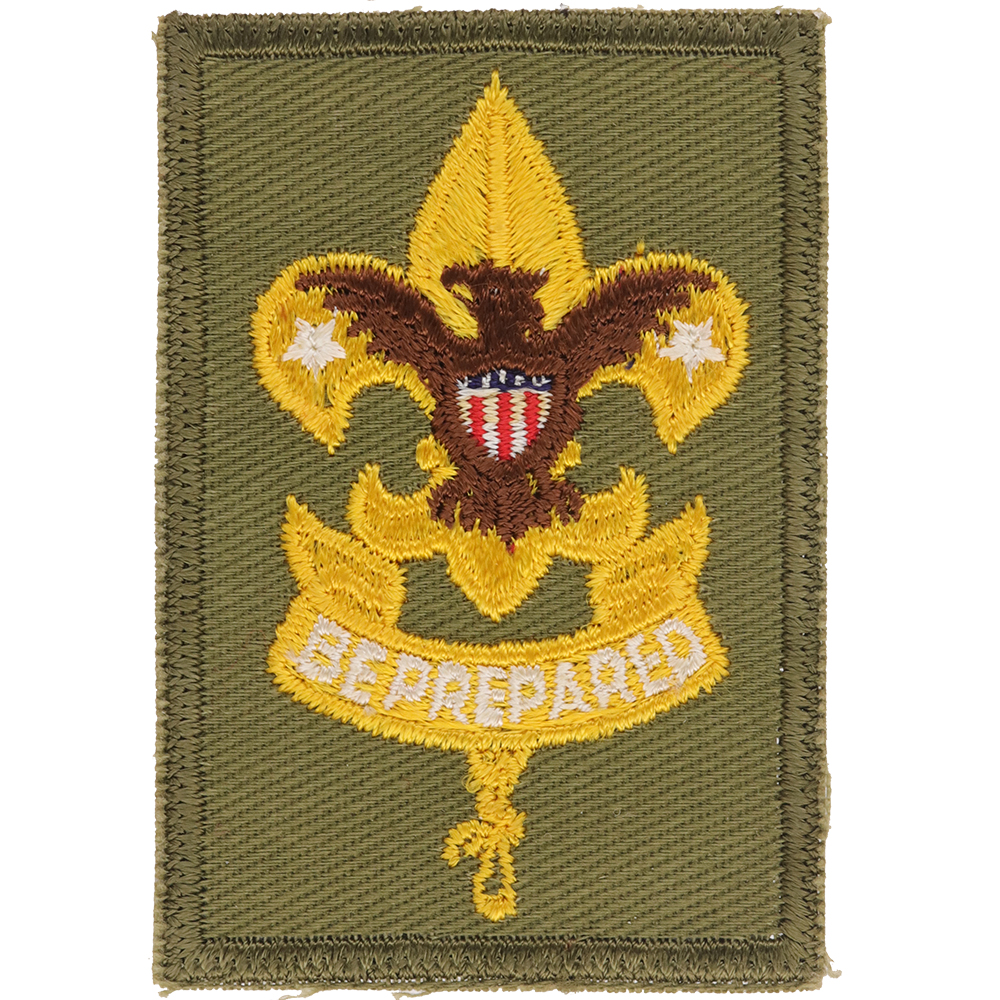
Fig. 1: FCB-1-5-02-Front
- Cloth: Khaki coarse right twill
- Embroidery: Cotton lock stitch
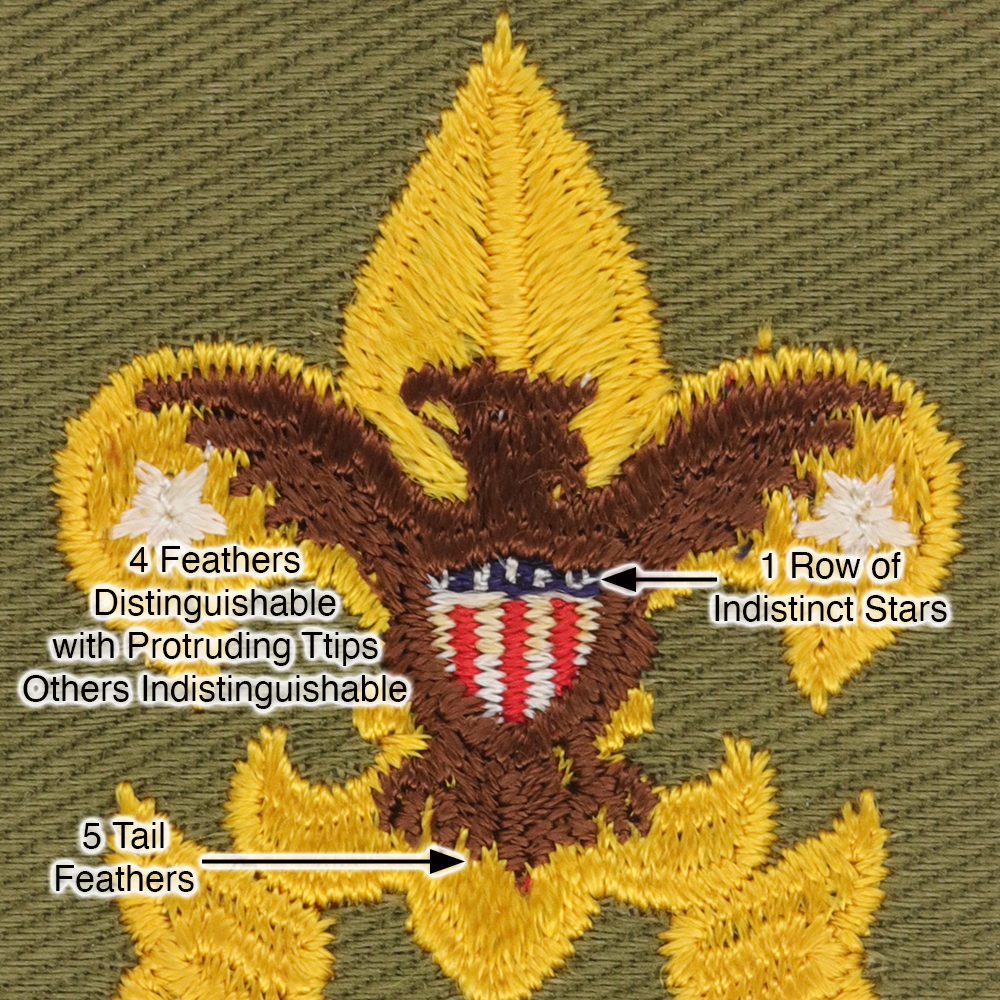
Fig. 2: FCB-1-5-02-Magnified-Eagle
- Crown: Tall
- Head: Faces left with open beak
- Wing Feathers: 4 wing feathers distinguishable protruding tips, the others indistinguishable
- Shield: Single row of 5 dots for stars
- Tail Feathers: 5
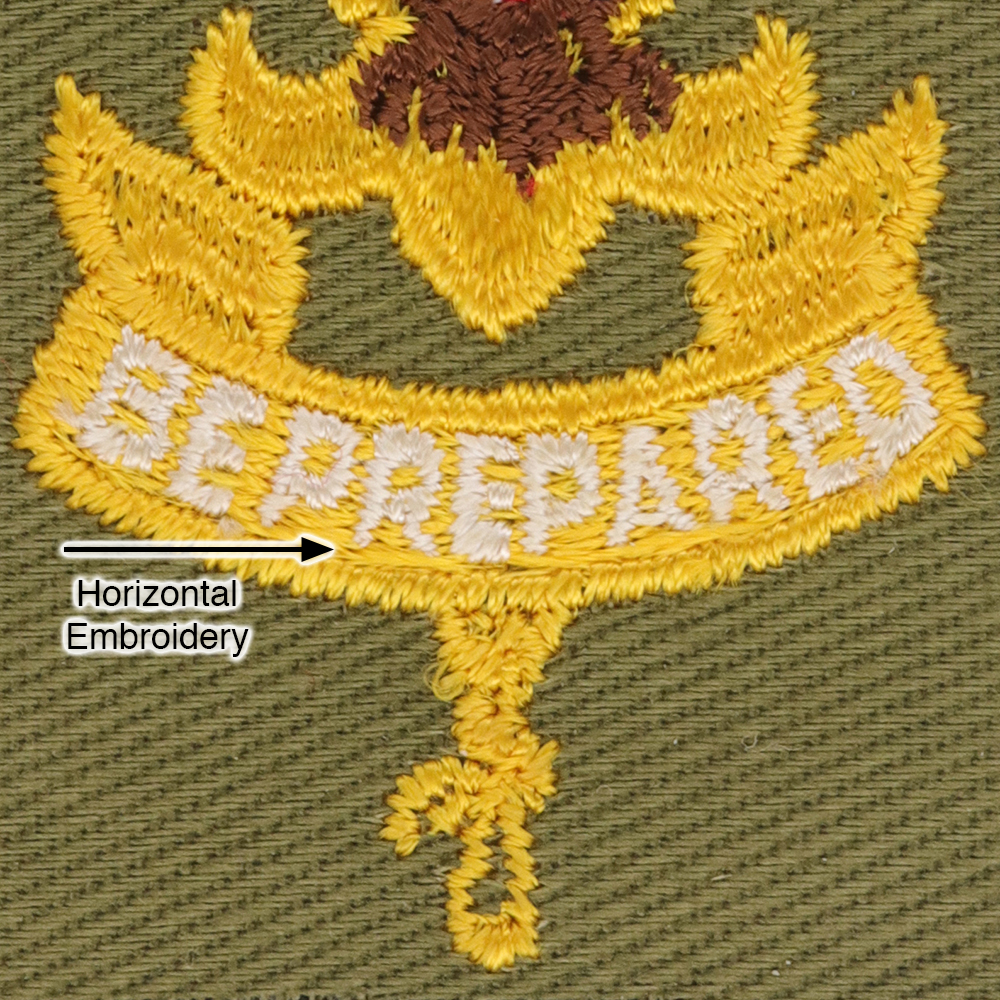
Fig. 3: FCB-1-5-02-Magnified-Scroll
- Scroll Tops: Single curve
- Smile: Horizontal stitched scroll, closed ended
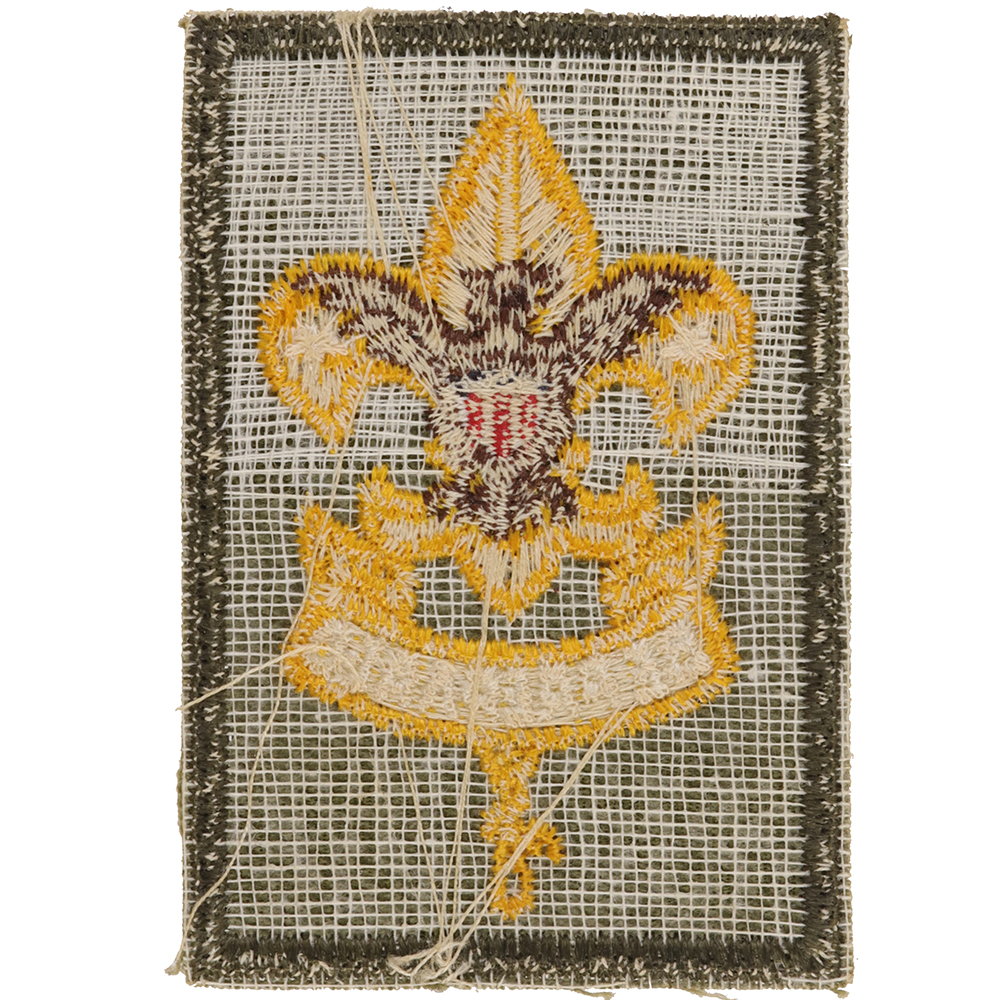
Fig. 4: FCB-1-5-02-Reverse
- Back: Reinforced starched gauze
Item Name: First Class Badge 1955 - 1957
Item ID: FCB-1-5-02
Collector Rating: 3
Requirements June 1948 until November 1959
To become a FIRST CLASS SCOUT, you do the following;
I. Scout Sprit
While a Second Class Scout, satisfy your Scout leaders that you do your best, in your everyday life, to live up to:
- The Scout Oath or Promise
- The Scout Law
- The Scout Motto
- The Scout Slogan
- Scout Participation
II. Scout Participation
While a Second Class Scout, show to the satisfaction of your Scout leaders that you:
- Work actively in Patrol and Troop meetings, outdoor activities and service projects.
- Do your share in helping in your home, your school, your church and your community.
- Take care of things that belong to you, the property of others, and your county’s natural resources.
- Maintain a personal savings plan (such as regular payments into a savings account or into a savings project sponsored by your family or Troop).
III. Scoutcraft
1. Prepare for Scout Camping
- Clothing and Equipment – Present yourself for inspection suitably clothed for the locality, season and the weather, and equipped and packed for an overnight camp.
- Health Protection – Explain methods used in camp for care of food and drinking water, fire protection and waste disposal.
- First Aid – Give artificial respiration for three minutes. Explain danger of taking laxative for pain in stomach. Improvise a sterile dressing. Use triangular bandage for arm sling and as binder for wounds on head, hand, knee and foot. Demonstrate first aid for one problem from each of the following groups (problems to be chosen by your leader after you have trained for all of them):
Arterial bleeding from face, throat, arm, leg.
Shock, heat exhaustion, sunstroke, frostbite, internal poisoning.
Puncture wounds from splinter, nail, fishhook, dog bite, poisonous snake bite.
Fracture of collarbone, upper arm, forearm, lower leg.
Explain under what circumstances a person should or should not be moved. Improvise a stretcher and, with helpers, under your direction, transport a presumably unconscious person.
2. GET THE LAY OF THE LAND
- Directions – Lay out on the ground a true north-south line with the help of a watch and the sun by day and the North Star by night, and a magnetic north-side line using a compass.
- Measuring – With simple means and using your own personal measurements, determine a height you cannot reach (such as a tree) and a width you cannot walk (such as a river or a canyon).
- Map Sketching – Select a site suitable for a Patrol camp and make a map sketch for laying it out. Make a map sketch by which someone unfamiliar with your camp location can find his way to it over a distance of at least two miles.
3. LIVE IN CAMP
- Camp Making – Sharpen an axe and use it for cutting light wood into tent pegs. Locate a tent site and pitch a tent, fastening the guy line with a taut-line hitch. Prepare a comfortable ground bed. Improvise a piece of camp equipment requiring lashings.
- Wood Lore – Find and identify ten different shrubs or trees Tell their uses.
4. COOK YOUR MEALS
- Camp Cookery – Prepare in the open, for yourself and a companion from raw ingredients, a complete breakfast of fruit, hot cereal and bacon-and-eggs (or griddle cakes); and a complete dinner of meat (or fish or poultry), vegetable, dessert, and bread (or biscuits, or a twist baked on a stick).
- Edible Wild Plants – Find and identify four different edible wild greens, roots, or fruits.
5. Go Swimming
Swimming – Tell what precautions must be taken for a safe swim. Jump feet first into water over your head in depth. Swim fifty yards. During the swim, stop, make a sharp turn, level off and resume swimming.
6. Get a Signal Through
Morse Signaling – Morse Signaling – Know the International Morse Code, including necessary procedure signals. Using this code, send and receive, by any suitable means, a message of 20 words (100 letters) over a distance of at least 100 yards.
7. Go Camping
The First Class Camp – After you have done the above, prove yourself a Scout Camper by camping, properly clothed and equipped, on a suitable camp site for not less than twenty-four hours with your Patrol (or, if this is impossible, with at least one companion approved by your Scoutmaster). During this camp, cook at least one hot meal, sleeping in tent or improvised shelter or under the stars, keeping camp clean and safe, and leaving campsite in good condition.