-
Merit Badges
- Legend to identify Merit Badges
- 1910 British Merit Badges
- Square 1911 - 33
- Wide Crimped 1934 & 35
-
Narrow Tan Crimped 1936 - 42
- Tan Heavyweight Cloth with Silk Embroidery and Printed Back 1936 - 37
- Tan Heavyweight Cloth with Silk Embroidery and Plain Back 1937 - 38
- Tan Lightweight Cloth with Silk Embroidery and Plain Back 1938 - 39
- Tan Lightweight Cloth with Cotton Continuous Loop Embroidery and Plain Back 1939 - 42
- Tan Lightweight Cloth with Cotton Lockstitch Embroidery and Plain Back 1939 - 42
- Blue Background 1942 - 46
- Wartime 1942 - 46
- Khaki Narrow Crimped 1946 - 59
- Green Twill Gauze Back 1960 - 68
- Fully Embroidered Merrowed Edge 1960 - 72
- Unprinted Plastic Back 1972 - 01
- Printed Plastic Back 2002 - Current
-
Merit Badge Paper
- Merit Badge Applications
- Merit Badge Cards
-
Merit Badge Pamphlets
- Type 1 White Cover - Rectangle Drawing On Cover
- Type 2 White Cover 5-375" x 8" Title at Top
- Type 3A Tan Cover - 200 Fifth Avenue
- Type 3B Tan Cover - 2 line address New York City
- Type 3C Tan Cover - 2 line address New York N.Y.
- Type 3D Tan Cover - 1 line address New York N.Y.
- Type 4 Standing Scout Cover
- Type 5A War Cover
- Type 5B Red and White
- Type 6 Photo-Red Cover
- Type 7 Full Photo Cover or Bulls-eye Cover
- Type 8 Full Photo - Green Stripe Cover
- Type 9 Full Photo - Red Stripe Cover
- Type 10A Blue Stripe - Logo above bottom blue stripe - FDL centered
- Type 10B - Blue Stripe in bottom of photo area. FDL to left of text
- Special Covers
- Boy Craft Helps
- Merit Badge Counselor's Guides
-
Youth Position
- Junior Assistant Scoutmaster
- Senior Patrol Leader
- Assistant Senior Patrol Leader
- Patrol Leader
- Assistant Patrol Leader
- Troop Guide
- Scribe
- Quartermaster
- Instructor
- Chaplain Aide
- Den Chief
- Librarian
- Musician
- Webmaster
- Bugler
- Troop Historian
- Troop Representative
- Unit Representative
- Leadership Corps
- Honor Guard
- Leave No Trace Trainer
- Outdoor Ethics Guide
-
Patrol Medallions
- Patrol Medallions Introduction
- Legend to identify Patrol Medallions
- Patrol Shoulder Knot-Ribbons
- Felt Handmade Patrol Medallions
- Square Felt Patrol Medallions
- Round Broadcloth Patrol Medallions
- Red Twill Patrol Medallions
- Multi-Color Cloth Patrol Medallions
- Tan Cloth Patrol Medallions
- Patrol Medallion Back Patches
- Woodbadge Patrol Medallion
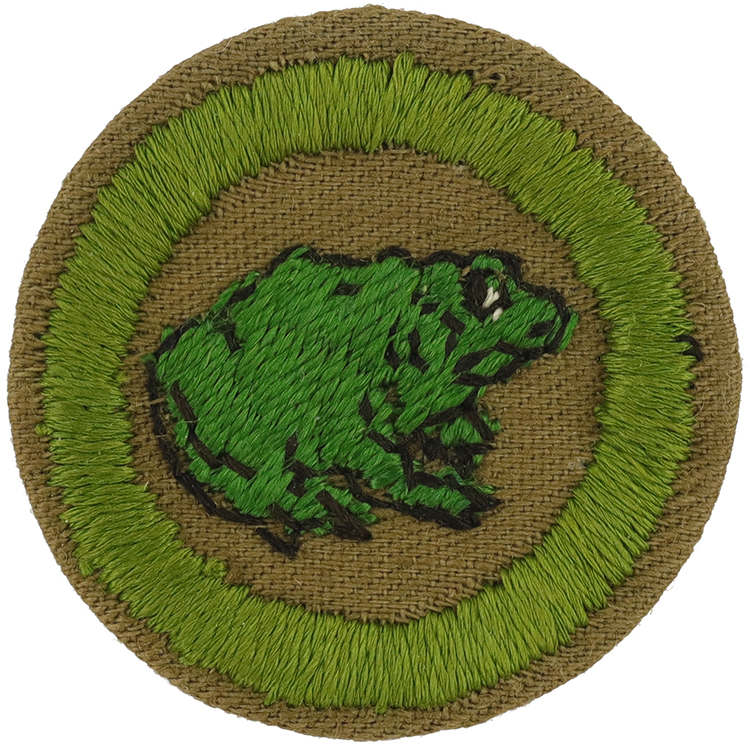
Fig. 1: Zoolog-D1-Front
- Cloth: Fine twill
- Embroidery: Cotton continuous >

Fig. 2: Zoolog-D1-Reverse
- Back: Plain NO imprint with starch
Item Name: Zoology 1942 - 1945
Item ID: Zoolog-D1
Collector Rating: 1
Pamphlets Used to Earn this Badge

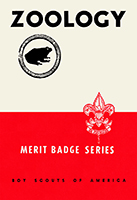
Requirements January 1, 1942 until September 1944. Between December 1940 and January 1, 1942 these requirements were optional
1. Make five field trips of at least two hours each (preferably at different seasons) to observe wild animal life. Keep records of such trips, listing all animals seen, with date, place, nature of locality and observations of animals and their habits. (Photographs, sketches, track casts, etc., will add to the interest of this record.)
2. Using the "keys" of the modern system of classifying animal life, show ability to classify at least five animals of different phyla.
3. Find out the life processes that are common to all animal life (birth, self protection, feeding, breathing, etc.). Keep record from personal observation of the life cycle and habits of at least two animals of different phyla.
4. On a map of his locality (showing such things as forests, plains, streams, marshes, arid areas, etc.) indicate animals found in each habitat. Know what is being done in his State to protect wild animal life.
5. Carry out one of the following projects:
(a) Keep a young animal, (completely weaned from mother) such as a squirrel, white rat, rabbit, or guinea pig for at least three months. Keep a weekly diary of its habits, food requirements, gain in weight, general health, etc.
OR
(b) Maintain an aquarium or "toad pen" for at least three months. Stock from local ponds, streams, or marshes. Watch development from egg on, of frogs, toads, turtles, fish, or whatever animal he has chosen for special observation. Keep record of life cycle and habits.
OR
(c) Submit at least ten photographs or sketches based on his own observation of microscopic animal life in the field for a period of at least three months. Present at least three properly prepared slides of microscopic life.
Note: Animals, in the zoological sense, include all living organisms other than plant life, from amoeba up through man. However, since birds, snakes and insects are covered in other Merit Badge subjects, choose other examples of animal life for these requirements.
Requirements September 1944 until September 1970
1. Make five field trips of at least two hours each (preferably at different seasons) to observe wild animal life. Keep records of such trips, listing all animals seen, with date, place, nature of locality, and observations of animals and their habits. (Photographs, sketches, track casts, etc., will add to the interest of this record.)
2. Using the "keys" of the modern system of classifying animal life, show ability to classify at least five animals of different phyla which you yourself select.
3. Find out the life processes that are common to all animal life (birth, self protection, feeding, breathing, etc.). Keep record from personal observation of the life cycle and habits of at least two animals of different phyla.
4. On a map of your locality (showing such things as forests, plains, streams, marshes, arid areas, etc.) indicate animals found in each habitat. Know what is being done in your state to protect wild animal life.
5. Carry out one of the following projects: (a) Keep a young animal, (completely weaned from mother) such as a squirrel, white rat, rabbit, or guinea pig for at least three months. Keep a weekly diary of its habits, food requirements, gain in weight, general health, etc. or (b) Maintain an aquarium or "toad pen" for at least three months. Stock from local ponds, streams, or marshes. Watch development from egg on, of frogs, toads, turtles, fish, or whatever animal you have chosen for special observation. Keep record of life cycle and habits. or (c) Submit at least ten photographs or sketches based on your own observation of microscopic animal life in the field for a period of at least three months. Present at least three properly prepared slides of microscopic life.
Note: Animals, in the zoological sense, include all living organisms other than plant life, from amoeba up through man. However, since birds, snakes, and insects are covered in other merit badge subjects, choose other examples of animal life for these requirements.