-
Merit Badges
- Legend to identify Merit Badges
- 1910 British Merit Badges
- Square 1911 - 33
- Wide Crimped 1934 & 35
-
Narrow Tan Crimped 1936 - 42
- Tan Heavyweight Cloth with Silk Embroidery and Printed Back 1936 - 37
- Tan Heavyweight Cloth with Silk Embroidery and Plain Back 1937 - 38
- Tan Lightweight Cloth with Silk Embroidery and Plain Back 1938 - 39
- Tan Lightweight Cloth with Cotton Continuous Loop Embroidery and Plain Back 1939 - 42
- Tan Lightweight Cloth with Cotton Lockstitch Embroidery and Plain Back 1939 - 42
- Blue Background 1942 - 46
- Wartime 1942 - 46
- Khaki Narrow Crimped 1946 - 59
- Green Twill Gauze Back 1960 - 68
- Fully Embroidered Merrowed Edge 1960 - 72
- Unprinted Plastic Back 1972 - 01
- Printed Plastic Back 2002 - Current
-
Merit Badge Paper
- Merit Badge Applications
- Merit Badge Cards
-
Merit Badge Pamphlets
- Type 1 White Cover - Rectangle Drawing On Cover
- Type 2 White Cover 5-375" x 8" Title at Top
- Type 3A Tan Cover - 200 Fifth Avenue
- Type 3B Tan Cover - 2 line address New York City
- Type 3C Tan Cover - 2 line address New York N.Y.
- Type 3D Tan Cover - 1 line address New York N.Y.
- Type 4 Standing Scout Cover
- Type 5A War Cover
- Type 5B Red and White
- Type 6 Photo-Red Cover
- Type 7 Full Photo Cover or Bulls-eye Cover
- Type 8 Full Photo - Green Stripe Cover
- Type 9 Full Photo - Red Stripe Cover
- Type 10A Blue Stripe - Logo above bottom blue stripe - FDL centered
- Type 10B - Blue Stripe in bottom of photo area. FDL to left of text
- Special Covers
- Boy Craft Helps
- Merit Badge Counselor's Guides
-
Youth Position
- Junior Assistant Scoutmaster
- Senior Patrol Leader
- Assistant Senior Patrol Leader
- Patrol Leader
- Assistant Patrol Leader
- Troop Guide
- Scribe
- Quartermaster
- Instructor
- Chaplain Aide
- Den Chief
- Librarian
- Musician
- Webmaster
- Bugler
- Troop Historian
- Troop Representative
- Unit Representative
- Leadership Corps
- Honor Guard
- Leave No Trace Trainer
- Outdoor Ethics Guide
-
Patrol Medallions
- Patrol Medallions Introduction
- Legend to identify Patrol Medallions
- Patrol Shoulder Knot-Ribbons
- Felt Handmade Patrol Medallions
- Square Felt Patrol Medallions
- Round Broadcloth Patrol Medallions
- Red Twill Patrol Medallions
- Multi-Color Cloth Patrol Medallions
- Tan Cloth Patrol Medallions
- Patrol Medallion Back Patches
- Woodbadge Patrol Medallion
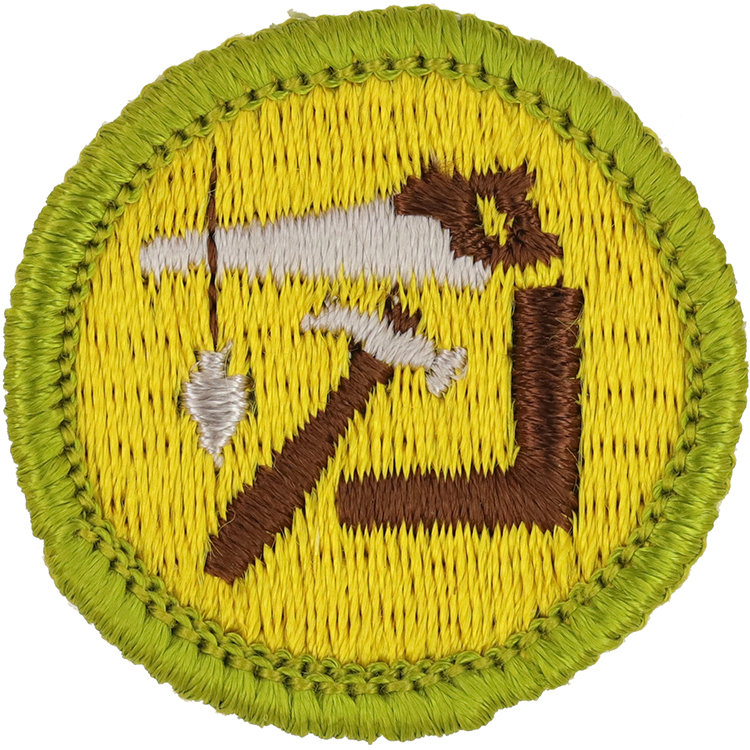
Fig. 1: Woodwo-G-Front
- Embroidery: Cotton thread
- Border: Merrowed
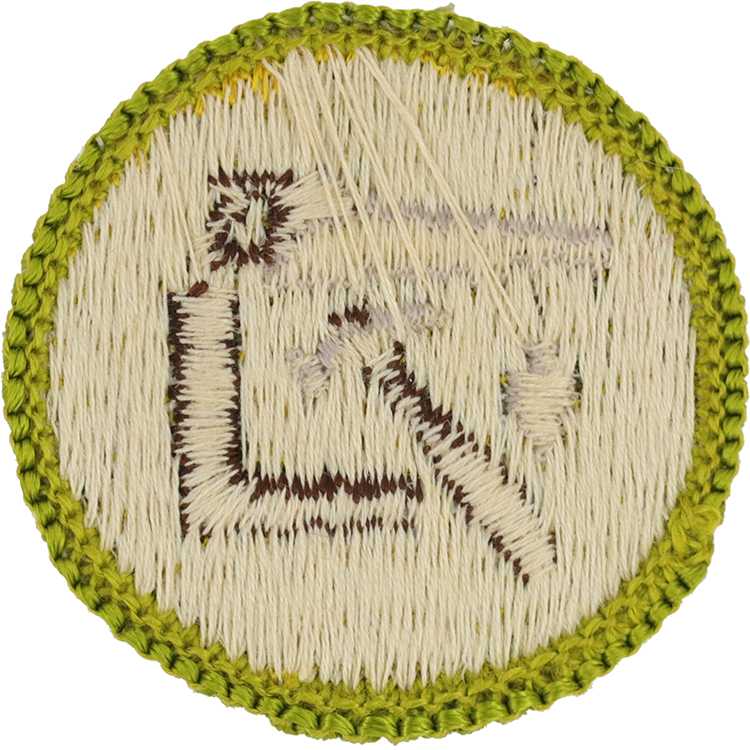
Fig. 2: Woodwo-G-Reverse
- Back: Starched cloth
Item Name: Woodwork 1969 - 1972
Item ID: Woodwo-G
Collector Rating: 1
Pamphlets Used to Earn this Badge


Combines Carpentry, Woodturning and Wood Work
Requirements January 1952 until June 1972
1. (a) Describe briefly how timber is grown, harvested, and milled and how lumber is cured, seasoned, graded, and sized. (b) Collect and label sample blocks of six kinds of wood useful in woodworking; describe the chief qualities and best uses of each.
2. (a) Demonstrate proper care and use of all woodworking tools and equipment which you own or are permitted to use at home or school. (b) Sharpen correctly the cutting edges of two tools.
3. Make a useful article of wood which calls for use of saw, plane, hammer, and brace and bit. Cut parts from lumber which you have measured and squared correctly according to working drawings.
4. (a) Submit, for approval of your counselor, a working sketch of a carpentry project, along with a list of material needed. (b) Complete the project and submit a report of time spent and cost of materials.
5. Do any two of the following projects:
(a) Make working drawings of some article requiring (1) beveled or rounded edges, or curved or incised cutting; and (2) miter, dowel, or mortise and tenon joints. Construct the article.
(b) Make an article for which you have to turn duplicate parts on a lathe.
(c) Make a cabinet, storage box, or some other article with a door or lid attached with inset hinges.
(d) With other members of your patrol or troop, take part in a project of making and repairing wooden toys for needy children; or help carry out a carpentry service project in your community.
(e) Build a miniature, accurate scale model of a house, barn, or other frame structure.
(f) Talk with a skilled cabinetmaker or carpenter and find out what are the employment opportunities and conditions (required training, apprenticeship, work hours, pay rates, union organization, etc.) for woodworking craftsmen in your locality.