-
Merit Badges
- Legend to identify Merit Badges
- 1910 British Merit Badges
- Square 1911 - 33
- Wide Crimped 1934 & 35
-
Narrow Tan Crimped 1936 - 42
- Tan Heavyweight Cloth with Silk Embroidery and Printed Back 1936 - 37
- Tan Heavyweight Cloth with Silk Embroidery and Plain Back 1937 - 38
- Tan Lightweight Cloth with Silk Embroidery and Plain Back 1938 - 39
- Tan Lightweight Cloth with Cotton Continuous Loop Embroidery and Plain Back 1939 - 42
- Tan Lightweight Cloth with Cotton Lockstitch Embroidery and Plain Back 1939 - 42
- Blue Background 1942 - 46
- Wartime 1942 - 46
- Khaki Narrow Crimped 1946 - 59
- Green Twill Gauze Back 1960 - 68
- Fully Embroidered Merrowed Edge 1960 - 72
- Unprinted Plastic Back 1972 - 01
- Printed Plastic Back 2002 - Current
-
Merit Badge Paper
- Merit Badge Applications
- Merit Badge Cards
-
Merit Badge Pamphlets
- Type 1 White Cover - Rectangle Drawing On Cover
- Type 2 White Cover 5-375" x 8" Title at Top
- Type 3A Tan Cover - 200 Fifth Avenue
- Type 3B Tan Cover - 2 line address New York City
- Type 3C Tan Cover - 2 line address New York N.Y.
- Type 3D Tan Cover - 1 line address New York N.Y.
- Type 4 Standing Scout Cover
- Type 5A War Cover
- Type 5B Red and White
- Type 6 Photo-Red Cover
- Type 7 Full Photo Cover or Bulls-eye Cover
- Type 8 Full Photo - Green Stripe Cover
- Type 9 Full Photo - Red Stripe Cover
- Type 10A Blue Stripe - Logo above bottom blue stripe - FDL centered
- Type 10B - Blue Stripe in bottom of photo area. FDL to left of text
- Special Covers
- Boy Craft Helps
- Merit Badge Counselor's Guides
-
Youth Position
- Junior Assistant Scoutmaster
- Senior Patrol Leader
- Assistant Senior Patrol Leader
- Patrol Leader
- Assistant Patrol Leader
- Troop Guide
- Scribe
- Quartermaster
- Instructor
- Chaplain Aide
- Den Chief
- Librarian
- Musician
- Webmaster
- Bugler
- Troop Historian
- Troop Representative
- Unit Representative
- Leadership Corps
- Honor Guard
- Leave No Trace Trainer
- Outdoor Ethics Guide
-
Patrol Medallions
- Patrol Medallions Introduction
- Legend to identify Patrol Medallions
- Patrol Shoulder Knot-Ribbons
- Felt Handmade Patrol Medallions
- Square Felt Patrol Medallions
- Round Broadcloth Patrol Medallions
- Red Twill Patrol Medallions
- Multi-Color Cloth Patrol Medallions
- Tan Cloth Patrol Medallions
- Patrol Medallion Back Patches
- Woodbadge Patrol Medallion
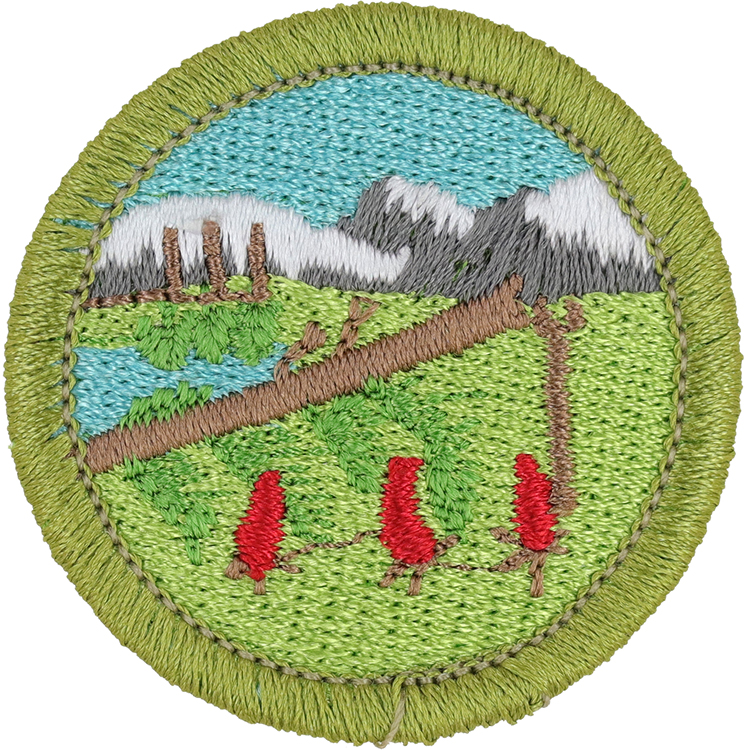
Fig. 1: WilSur-L1-Front
- Embroidery: Rayon thread
- Border: Merrowed
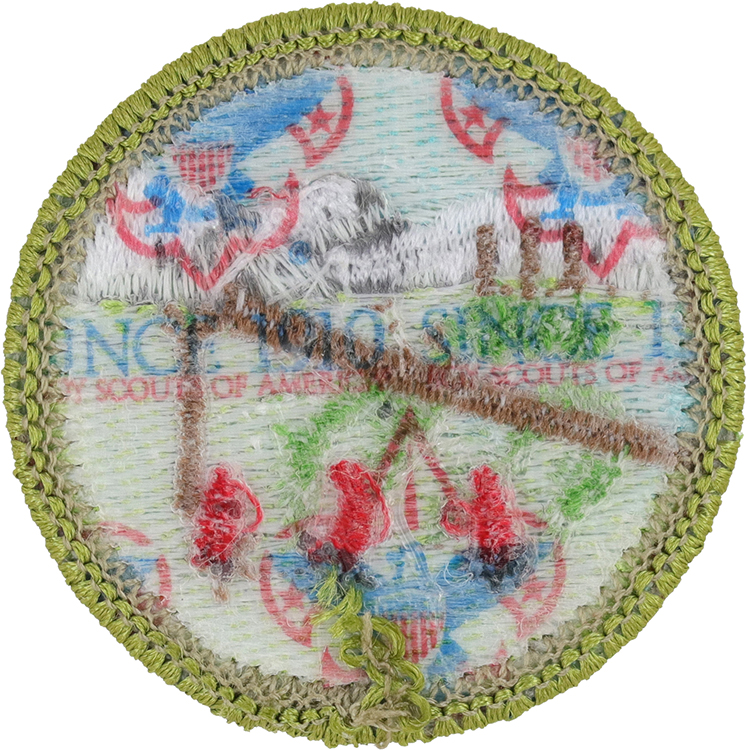
Fig. 2: WilSur-L1-Reverse
- Back: Since 1910 imprint with large Tenderfoot image
Item Name: Wilderness Survival 2014 - Current
Item ID: WilSur-L1
Collector Rating: 1
Pamphlets Used to Earn this Badge

Requirements January 2013 until Current
1. Do the following:
- Explain to your counselor the hazards you are most likely to encounter while participating in wilderness survival activities, and what you should do to anticipate, help prevent, mitigate, or lessen these hazards.
- Show that you know first aid for and how to prevent injuries or illnesses that could occur in backcountry settings, including hypothermia, heat reactions, frostbite, dehydration, blisters, insect stings, tick bites, and snakebites.
2. From memory, list the seven priorities for survival in a backcountry or wilderness location. Explain the importance of each with your counselor.
3. Discuss ways to avoid panic and maintain a high level of morale when lost, and explain why this is important.
4. Describe the steps you would take to survive in the following conditions:
- Cold and Snowy
- Wet (forest)
- Hot and dry (desert)
- When the (mountains or plains)
- Water (ocean, lake, or river)
5. Put together a personal survival kit and explain how each item in it could be useful.
6. Using three different methods (other than matches), build and light three fires.
7. Do the following:
- Show five different ways to attract attention when lost.
- Demonstrate how to use a signal mirror.
- Describe from memory five ground-to-air signals and tell what they mean.
8. Improvise a natural shelter. For the purpose of this demonstration, use techniques and have little negative impact on the environment. Spend a night in your shelter
9. Explain how to protect yourself from insects, reptiles, and bears.
10. Demonstrate three ways to treat water found in the out-of-doors to prepare it for drinking.
11. Show that you know the proper clothing to wear in your area on an overnight in extremely hot weather and an extremely cold weather.
12. Explain why it usually is not wise to eat edible wild plants or wildlife in a wilderness survival situation.