-
Merit Badges
- Legend to identify Merit Badges
- 1910 British Merit Badges
- Square 1911 - 33
- Wide Crimped 1934 & 35
-
Narrow Tan Crimped 1936 - 42
- Tan Heavyweight Cloth with Silk Embroidery and Printed Back 1936 - 37
- Tan Heavyweight Cloth with Silk Embroidery and Plain Back 1937 - 38
- Tan Lightweight Cloth with Silk Embroidery and Plain Back 1938 - 39
- Tan Lightweight Cloth with Cotton Continuous Loop Embroidery and Plain Back 1939 - 42
- Tan Lightweight Cloth with Cotton Lockstitch Embroidery and Plain Back 1939 - 42
- Blue Background 1942 - 46
- Wartime 1942 - 46
- Khaki Narrow Crimped 1946 - 59
- Green Twill Gauze Back 1960 - 68
- Fully Embroidered Merrowed Edge 1960 - 72
- Unprinted Plastic Back 1972 - 01
- Printed Plastic Back 2002 - Current
-
Merit Badge Paper
- Merit Badge Applications
- Merit Badge Cards
-
Merit Badge Pamphlets
- Type 1 White Cover - Rectangle Drawing On Cover
- Type 2 White Cover 5-375" x 8" Title at Top
- Type 3A Tan Cover - 200 Fifth Avenue
- Type 3B Tan Cover - 2 line address New York City
- Type 3C Tan Cover - 2 line address New York N.Y.
- Type 3D Tan Cover - 1 line address New York N.Y.
- Type 4 Standing Scout Cover
- Type 5A War Cover
- Type 5B Red and White
- Type 6 Photo-Red Cover
- Type 7 Full Photo Cover or Bulls-eye Cover
- Type 8 Full Photo - Green Stripe Cover
- Type 9 Full Photo - Red Stripe Cover
- Type 10A Blue Stripe - Logo above bottom blue stripe - FDL centered
- Type 10B - Blue Stripe in bottom of photo area. FDL to left of text
- Special Covers
- Boy Craft Helps
- Merit Badge Counselor's Guides
-
Youth Position
- Junior Assistant Scoutmaster
- Senior Patrol Leader
- Assistant Senior Patrol Leader
- Patrol Leader
- Assistant Patrol Leader
- Troop Guide
- Scribe
- Quartermaster
- Instructor
- Chaplain Aide
- Den Chief
- Librarian
- Musician
- Webmaster
- Bugler
- Troop Historian
- Troop Representative
- Unit Representative
- Leadership Corps
- Honor Guard
- Leave No Trace Trainer
- Outdoor Ethics Guide
-
Patrol Medallions
- Patrol Medallions Introduction
- Legend to identify Patrol Medallions
- Patrol Shoulder Knot-Ribbons
- Felt Handmade Patrol Medallions
- Square Felt Patrol Medallions
- Round Broadcloth Patrol Medallions
- Red Twill Patrol Medallions
- Multi-Color Cloth Patrol Medallions
- Tan Cloth Patrol Medallions
- Patrol Medallion Back Patches
- Woodbadge Patrol Medallion
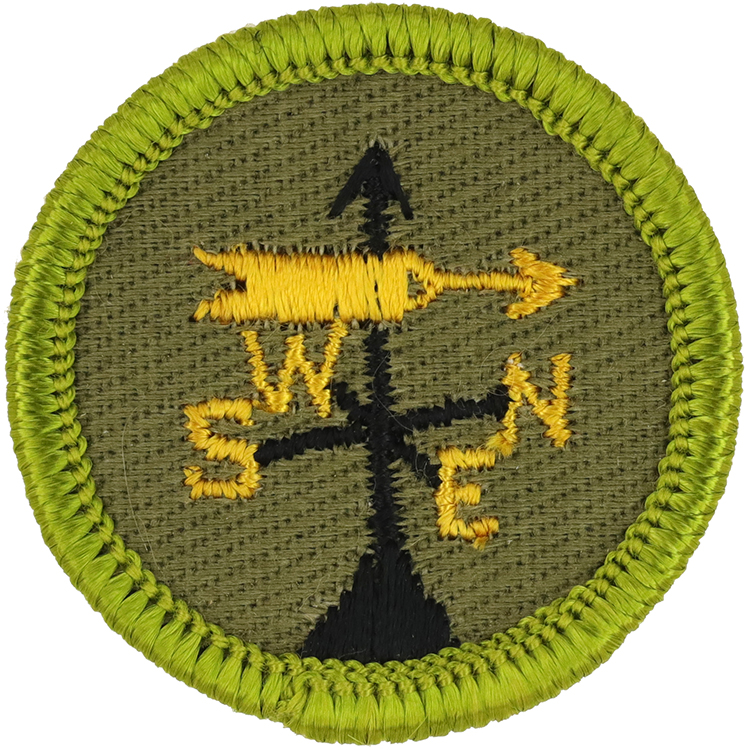
Fig. 1: Weathe-F-Front
- Cloth: Green right twill
- Border: Merrowed
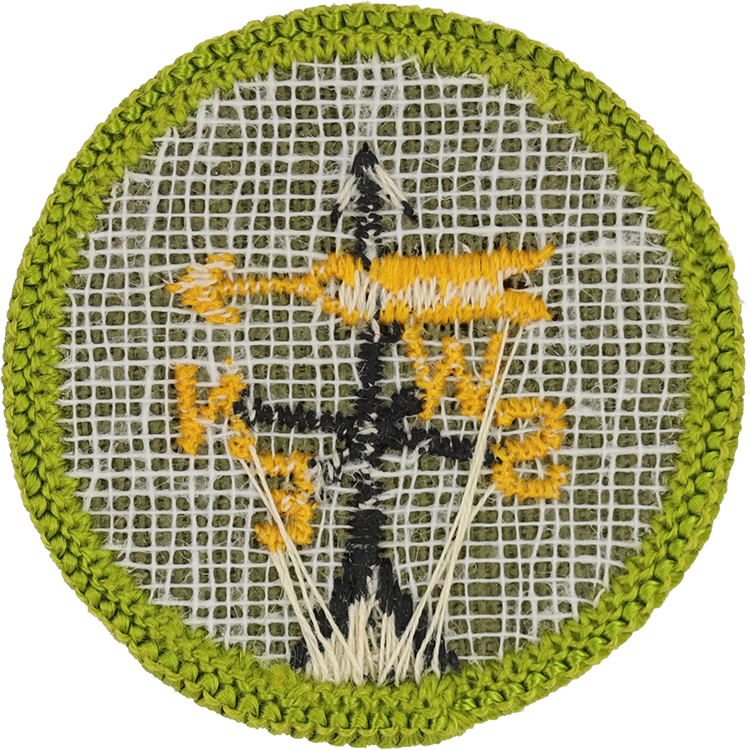
Fig. 2: Weathe-F-Reverse
- Back: Gauze reinforced starched
Item Name: Weather 1961 - 1968
Item ID: Weathe-F
Collector Rating: 1
Pamphlets Used to Earn this Badge

Requirements March 1927 until September 1962
1. Have a general knowledge of the composition of air, referring to both constant and variable elements of the air and what function each performs.
2. Develop quite broadly the subjects moisture, fog, hail, rain, and snow.
3. Explain points connected with electrical and optical phenomena in the air, i.e., have a knowledge of the following: rainbow, mirages, looming, halos, northern lights, St. Elmo's fire, lightning and thunder. Describe as many of the above as you have seen.
4. Have a knowledge of the use and construction of and demonstrate your ability to read a barometer, thermometer, anemometer, psychrometer, and rain gauge. Have constructed a weather vane. Know the weather signals or storm signals.
5. Outline in writing a simple statement of the climate of the United States and of your own state.
6. Explain the value of weather prediction. Write a brief account of the United States Weather Bureau, stating what daily, weekly, and monthly publications are sent out by this bureau. Be able to interpret the charts and graphs contained in their publications.
7. Keep a daily record for a month of the following: dew or frost in the morning; at a specific hour each day (this hour must be the same every day), the direction of the wind, the temperature, kind of clouds (if any) in the sky. (State if it rains or snows at this hour.)
8. Name some places where, during severe thunder storms, the danger from lightning is great, some places where the danger is small.
Requirements December 1962 until June 1972
1. Obtain information about the climate (maximum and minimum temperatures, humidity, rainfall, wind) in your locality and discuss its influence on industry, agriculture, clothing, transportation, housing, and recreation.
2. Do the following:
(a) Tell what meteorology is. Visit a weather bureau station. Explain the methods and devices that are used in taking observations. Describe the following instruments and tell how they are used in weather measurement: wind vane, anemometer, barometer, thermometer, hygrometer, rain gauge.
(b) Tell how radar, satellites, and electronic devices are used in meteorology.
(c) Make a list of the radio and television stations in your area showing the times they broadcast weather forecasts. Tell when and how severe weather warnings are given.
(d) Read a weather map. Describe high-pressure system, low-pressure system, cold front, warm front, jet stream, isobar, and isotherm.
3. Do the following:
(a) Draw a cross section of the atmosphere showing its three main layers.
(b) Describe and distinguish between hurricanes, tornadoes, cyclones, squall lines, and blizzards. Know the safety precautions for thunderstorms and other severe weather. Know what types of storms affect your area.
(c) Estimate wind direction and velocity by its effect upon trees, flags, or like objects.
4. Do the following:
(a) Make a drawing showing the hydrologic cycle.
(b) Identify clouds according to form and height. Tell the differences between fair-weather cumulus and cumulonimbus; stratus, altostratus, and cirrostratus; stratocumulus and altocumulus.
(c) Distinguish between drizzle, rain, freezing rain, sleet, hail, and snow.
5. Do the following:
(a) Make a simple wind vane, rain gauge, anemometer, hair hygrometer, and nephoscope.
(b) Make a chart of the daily record for a month of the following: dew or frost in the morning; and at the same hour each day, wind direction, temperature, types of clouds, and precipitation.
(c) On the same chart for a month, list the United States Weather Bureau forecast obtained from radio or television at the same time each day; also, on the same chart, give a brief description of how the weather actually turned out. Count the number of times the last two entries are in agreement.