-
Merit Badges
- Legend to identify Merit Badges
- 1910 British Merit Badges
- Square 1911 - 33
- Wide Crimped 1934 & 35
-
Narrow Tan Crimped 1936 - 42
- Tan Heavyweight Cloth with Silk Embroidery and Printed Back 1936 - 37
- Tan Heavyweight Cloth with Silk Embroidery and Plain Back 1937 - 38
- Tan Lightweight Cloth with Silk Embroidery and Plain Back 1938 - 39
- Tan Lightweight Cloth with Cotton Continuous Loop Embroidery and Plain Back 1939 - 42
- Tan Lightweight Cloth with Cotton Lockstitch Embroidery and Plain Back 1939 - 42
- Blue Background 1942 - 46
- Wartime 1942 - 46
- Khaki Narrow Crimped 1946 - 59
- Green Twill Gauze Back 1960 - 68
- Fully Embroidered Merrowed Edge 1960 - 72
- Unprinted Plastic Back 1972 - 01
- Printed Plastic Back 2002 - Current
-
Merit Badge Paper
- Merit Badge Applications
- Merit Badge Cards
-
Merit Badge Pamphlets
- Type 1 White Cover - Rectangle Drawing On Cover
- Type 2 White Cover 5-375" x 8" Title at Top
- Type 3A Tan Cover - 200 Fifth Avenue
- Type 3B Tan Cover - 2 line address New York City
- Type 3C Tan Cover - 2 line address New York N.Y.
- Type 3D Tan Cover - 1 line address New York N.Y.
- Type 4 Standing Scout Cover
- Type 5A War Cover
- Type 5B Red and White
- Type 6 Photo-Red Cover
- Type 7 Full Photo Cover or Bulls-eye Cover
- Type 8 Full Photo - Green Stripe Cover
- Type 9 Full Photo - Red Stripe Cover
- Type 10A Blue Stripe - Logo above bottom blue stripe - FDL centered
- Type 10B - Blue Stripe in bottom of photo area. FDL to left of text
- Special Covers
- Boy Craft Helps
- Merit Badge Counselor's Guides
-
Youth Position
- Junior Assistant Scoutmaster
- Senior Patrol Leader
- Assistant Senior Patrol Leader
- Patrol Leader
- Assistant Patrol Leader
- Troop Guide
- Scribe
- Quartermaster
- Instructor
- Chaplain Aide
- Den Chief
- Librarian
- Musician
- Webmaster
- Bugler
- Troop Historian
- Troop Representative
- Unit Representative
- Leadership Corps
- Honor Guard
- Leave No Trace Trainer
- Outdoor Ethics Guide
-
Patrol Medallions
- Patrol Medallions Introduction
- Legend to identify Patrol Medallions
- Patrol Shoulder Knot-Ribbons
- Felt Handmade Patrol Medallions
- Square Felt Patrol Medallions
- Round Broadcloth Patrol Medallions
- Red Twill Patrol Medallions
- Multi-Color Cloth Patrol Medallions
- Tan Cloth Patrol Medallions
- Patrol Medallion Back Patches
- Woodbadge Patrol Medallion
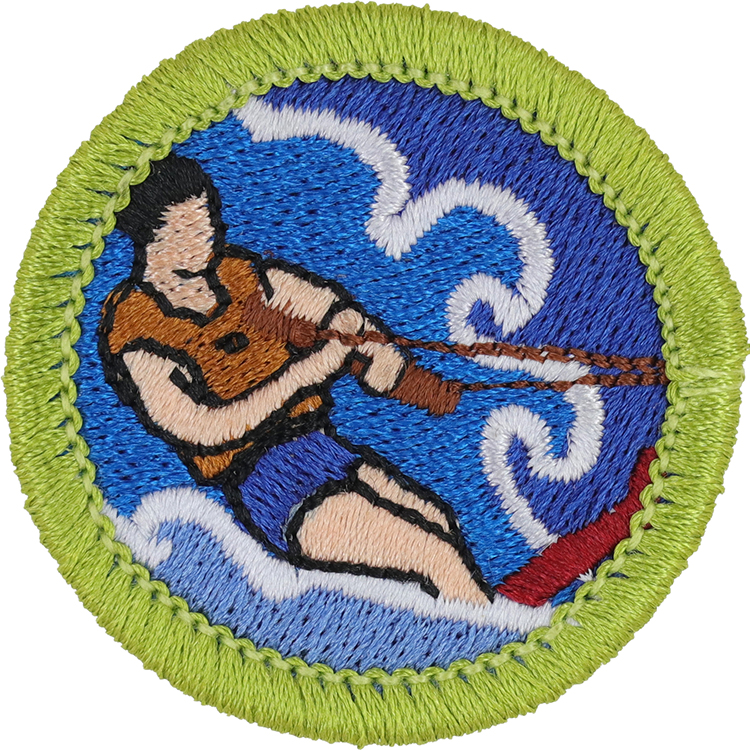
Fig. 1: WatSpo-L1-Front
- Embroidery: Rayon thread
- Border: Merrowed
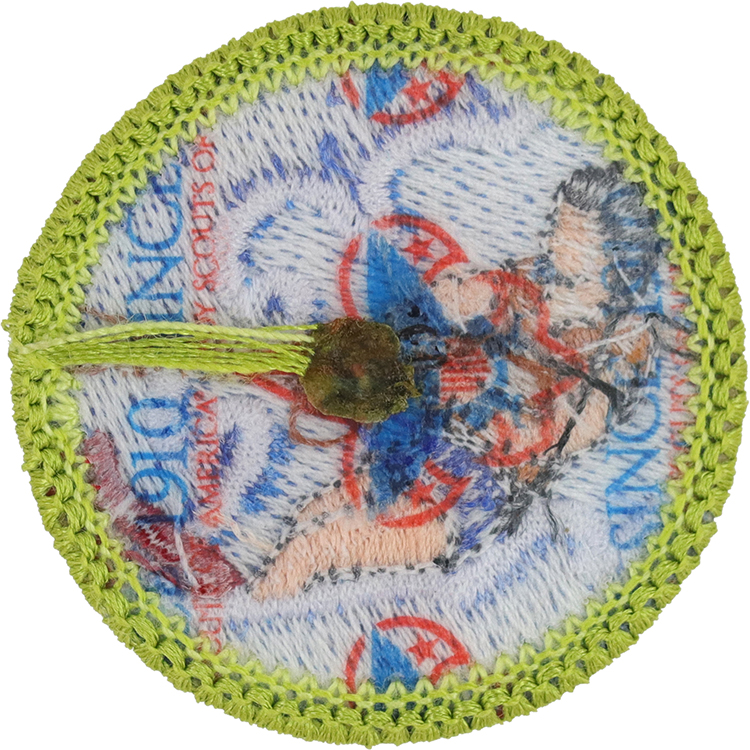
Fig. 2: WatSpo-L1-Reverse
- Back: Since 1910 imprint with large Tenderfoot image
Item Name: Water Sports 2014 - Current
Item ID: WatSpo-L1
Collector Rating: 1
Pamphlets Used to Earn this Badge

Requirements January 2008 until January 2015
1. Show that you know first aid for injuries or illnesses that could occur while participating water sports, including hypothermia, heat exhaustion, heatstroke, dehydration, sunburn, minor cuts and bruises, and blisters.
2. Do the following:
- Identify the conditions that must exist before performing CPR on a person. Explain how such conditions are recognized.
- Demonstrate proper technique for performing CPR using a training device approved by your counselor.
3. Before doing the following requirements, successfully complete the BSA swimmer test.
4. Do the following:
- Discuss the BSA’s Safety Afloat policy. Tell how it applies to water sports.
- Name the different types of personal flotation devices (PFDs), and explain when each type should be used. Show how to choose them properly fit a PFD.
- Know the Water Sports Safety Code. Promise that you will live up to it and follow it in all water work for this badge. Know the safety precautions that must be used by the boat operator in pulling the water-skiers and wakeborders.
5. Capture the following skier signals to the safety observer in the boat: skier safe, faster, slower, turns, back to dock, cut motor, skier in water.
6. Showing reasonable control while using two skis, one ski, or a wakeboard, do each of the following:
- Show how to enter the water from the boat and make a deepwater start without help.
- Show you can cross both wakes four times and returned to the center of the wake each time, without falling.
- Show you can fall properly to avoid an obstacle. Also show that you can drop handle and coast to a stop without losing your balance.
7. While on shore, show that you know how to properly adjust the bindings of your ski(s) or wakeboard to fit yourself. Then, in deep water, show you can adjust bindings to fit. Recover and put on your ski(s) or wakeboard that has come off during a fall.
Requirements January 2015 until Current
1.Do the following:
- Explain to your counselor the most likely hazards you may encounter while participating in water sports activities and what you should do to anticipate, help prevent, mitigate, and respond to these hazards.
- Review prevention, symptoms, and first-aid treatement for the following injuries or illnesses that could occur while participating in water sports: blisters, cold-water shock and hypothermia, dehydration, heat-related illnesses, sunburn, sprains, strains, minor cuts and bruises, spinal injury, and concussions and head trauma.
- Review the BSA Safety Afloat policy. Tell how it applies to water sports.
2. Do the following:
- Discuss with your counselor the characteristics of life jackets most appropriate for water sports, and tell why one must always be worn while waterskiing or wakeboarding. THen demonstrate how to select and fit a life jacket for water sports activities.
- Review and discuss the Water Sports Safety Code with your counselor. Promise that you will live up to it and follow it in all water work for this merit badge. Review the safety percautions that must be used by the boat operator in pulling waterskiers and wakeboarders.
3. Before doing requirements 4 through 6, successfully complete the BSA swimmer test: Jump feetfirst into water over the head in depth. Level off and swim 75 yards in a strong manner using one or more of the following strokes: sidestroke, breaststroke, trudgen, or crawl; the swin 25 yards using an easy, resting backstroke. THe 100 yards must be completed in one swim without stops and must include at least one sharp turn. After completing the swim, rest by floating.
4. Show the following skier signals to the safety observer in the boat: skier safe, faster, slower, turns, back to dock, cut motor, skier in water.
5. Showing reasonable control while using two skis, one ski, or a wakeboard, do EACH of the following:
- Show how to enter the water from the boat and make a deepwater start without help.
- Starting from outside the wake, show you can cross both wakes four times and return to the center of the wake each time, without falling.
- Show you can fall properly to avoid an obstacle. Also show that you can drop handle and coast to a stop without losing your balance.
6. While on shore, show that you know how to properly adjust the bindings of your ski(s) or wakeboard to fit yourself. Then, in deep water, show you can adjust bindings to fit. Recover and put on your ski(s) or wakeboard that has come off during a fall.