-
Merit Badges
- Legend to identify Merit Badges
- 1910 British Merit Badges
- Square 1911 - 33
- Wide Crimped 1934 & 35
-
Narrow Tan Crimped 1936 - 42
- Tan Heavyweight Cloth with Silk Embroidery and Printed Back 1936 - 37
- Tan Heavyweight Cloth with Silk Embroidery and Plain Back 1937 - 38
- Tan Lightweight Cloth with Silk Embroidery and Plain Back 1938 - 39
- Tan Lightweight Cloth with Cotton Continuous Loop Embroidery and Plain Back 1939 - 42
- Tan Lightweight Cloth with Cotton Lockstitch Embroidery and Plain Back 1939 - 42
- Blue Background 1942 - 46
- Wartime 1942 - 46
- Khaki Narrow Crimped 1946 - 59
- Green Twill Gauze Back 1960 - 68
- Fully Embroidered Merrowed Edge 1960 - 72
- Unprinted Plastic Back 1972 - 01
- Printed Plastic Back 2002 - Current
-
Merit Badge Paper
- Merit Badge Applications
- Merit Badge Cards
-
Merit Badge Pamphlets
- Type 1 White Cover - Rectangle Drawing On Cover
- Type 2 White Cover 5-375" x 8" Title at Top
- Type 3A Tan Cover - 200 Fifth Avenue
- Type 3B Tan Cover - 2 line address New York City
- Type 3C Tan Cover - 2 line address New York N.Y.
- Type 3D Tan Cover - 1 line address New York N.Y.
- Type 4 Standing Scout Cover
- Type 5A War Cover
- Type 5B Red and White
- Type 6 Photo-Red Cover
- Type 7 Full Photo Cover or Bulls-eye Cover
- Type 8 Full Photo - Green Stripe Cover
- Type 9 Full Photo - Red Stripe Cover
- Type 10A Blue Stripe - Logo above bottom blue stripe - FDL centered
- Type 10B - Blue Stripe in bottom of photo area. FDL to left of text
- Special Covers
- Boy Craft Helps
- Merit Badge Counselor's Guides
-
Youth Position
- Junior Assistant Scoutmaster
- Senior Patrol Leader
- Assistant Senior Patrol Leader
- Patrol Leader
- Assistant Patrol Leader
- Troop Guide
- Scribe
- Quartermaster
- Instructor
- Chaplain Aide
- Den Chief
- Librarian
- Musician
- Webmaster
- Bugler
- Troop Historian
- Troop Representative
- Unit Representative
- Leadership Corps
- Honor Guard
- Leave No Trace Trainer
- Outdoor Ethics Guide
-
Patrol Medallions
- Patrol Medallions Introduction
- Legend to identify Patrol Medallions
- Patrol Shoulder Knot-Ribbons
- Felt Handmade Patrol Medallions
- Square Felt Patrol Medallions
- Round Broadcloth Patrol Medallions
- Red Twill Patrol Medallions
- Multi-Color Cloth Patrol Medallions
- Tan Cloth Patrol Medallions
- Patrol Medallion Back Patches
- Woodbadge Patrol Medallion
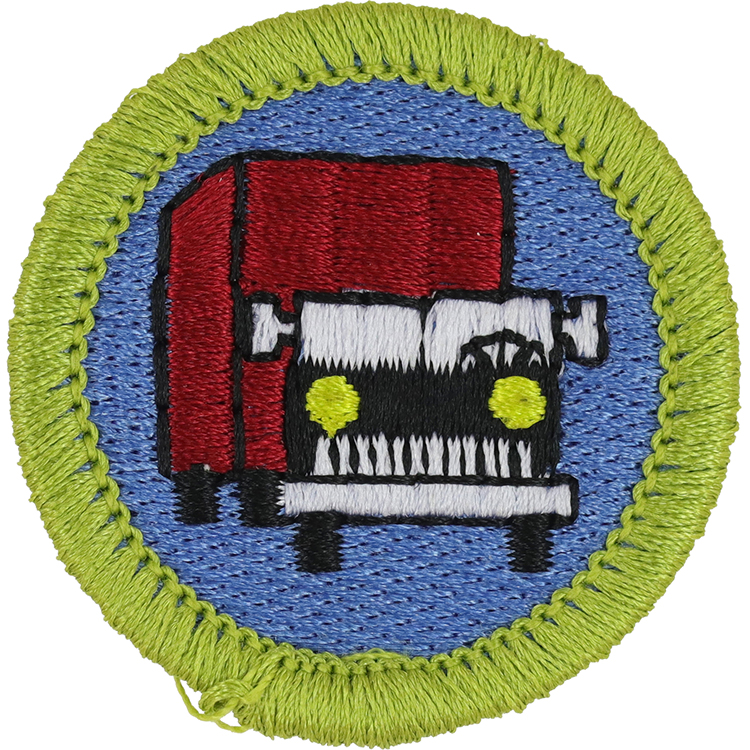
Fig. 1: TruTra-L1-Front
- Embroidery: Rayon thread
- Border: Merrowed
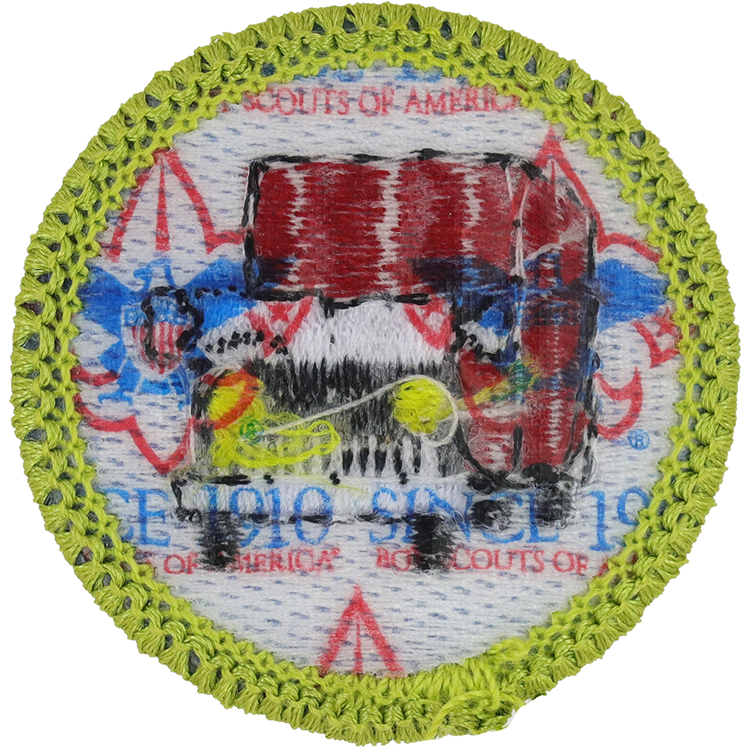
Fig. 2: TruTra-L1-Reverse
- Back: Since 1910 imprint with large Tenderfoot image
Item Name: Truck Transportation 2014 - Current
Item ID: TruTra-L1
Collector Rating: 1
Pamphlets Used to Earn this Badge

Requirements January 2006 until Current
1. List the major truck lines serving your town.
2. Do the following:
- Describe the role of truck transportation within commerce (the movement of goods, funds, and information).
- Describe how trucks fit into a company’s supply chain. This could be a manufacturer, importer, wholesaler, or retailer.
- On paper, map out how goods that are manufactured overseas are transported to a retailer in this country.
3. Describe the difference between the gasoline engine and the diesel engine that power trucks. List the advantages of each.
4. Visit a truck terminal and complete items 4a through 4e. After your visit, share what you have learned with your counselor.
- Find out what kind of maintenance program the company follows to help keep its fleet, drivers, and the roadway safe.
- Find out how dispatchers maintain communication with drivers on the road.
- Talk with a professional truck driver about safety. Learn about the truck driver’s rules of the road for safe driving. List five safe-driving rules every professional truck driver must follow.
- Review the driver’s log and find out what kind of information the log contains.
- Learn about important federal regulations that help ensure public safety.
5. Do the following:
- Outline the general organization of a trucking company. Describe what each department does.
- List five positions with trucking companies and describe each one.
6. Name five government agencies that work closely with the trucking industry. Describe their role.
7. List five different kinds of trucks. Tell the service each provides.
8. Assume that you are going to ship by truck 500 pounds of goods (freight class 65) from your town to another town 500 miles away. Your shipment must arrive within three days. Explain in writing:
- How to prepare the shipment
- How to compare at least three carries for time in transit and rates
- How to choose which carrier to use
- How to insure the shipment for damages
9. Define the following terms: bill of lading, ETA, logbook, intermodal, containers, tariff, shippers, carrier, consignee, drayage, cartage.
10. Learn about opportunities in the field of truck transportation. Choose one career in which you are interested and discuss with your counselor the major responsibilities of that position and the qualifications, education, and training such a position requires.