-
Merit Badges
- Legend to identify Merit Badges
- 1910 British Merit Badges
- Square 1911 - 33
- Wide Crimped 1934 & 35
-
Narrow Tan Crimped 1936 - 42
- Tan Heavyweight Cloth with Silk Embroidery and Printed Back 1936 - 37
- Tan Heavyweight Cloth with Silk Embroidery and Plain Back 1937 - 38
- Tan Lightweight Cloth with Silk Embroidery and Plain Back 1938 - 39
- Tan Lightweight Cloth with Cotton Continuous Loop Embroidery and Plain Back 1939 - 42
- Tan Lightweight Cloth with Cotton Lockstitch Embroidery and Plain Back 1939 - 42
- Blue Background 1942 - 46
- Wartime 1942 - 46
- Khaki Narrow Crimped 1946 - 59
- Green Twill Gauze Back 1960 - 68
- Fully Embroidered Merrowed Edge 1960 - 72
- Unprinted Plastic Back 1972 - 01
- Printed Plastic Back 2002 - Current
-
Merit Badge Paper
- Merit Badge Applications
- Merit Badge Cards
-
Merit Badge Pamphlets
- Type 1 White Cover - Rectangle Drawing On Cover
- Type 2 White Cover 5-375" x 8" Title at Top
- Type 3A Tan Cover - 200 Fifth Avenue
- Type 3B Tan Cover - 2 line address New York City
- Type 3C Tan Cover - 2 line address New York N.Y.
- Type 3D Tan Cover - 1 line address New York N.Y.
- Type 4 Standing Scout Cover
- Type 5A War Cover
- Type 5B Red and White
- Type 6 Photo-Red Cover
- Type 7 Full Photo Cover or Bulls-eye Cover
- Type 8 Full Photo - Green Stripe Cover
- Type 9 Full Photo - Red Stripe Cover
- Type 10A Blue Stripe - Logo above bottom blue stripe - FDL centered
- Type 10B - Blue Stripe in bottom of photo area. FDL to left of text
- Special Covers
- Boy Craft Helps
- Merit Badge Counselor's Guides
-
Youth Position
- Junior Assistant Scoutmaster
- Senior Patrol Leader
- Assistant Senior Patrol Leader
- Patrol Leader
- Assistant Patrol Leader
- Troop Guide
- Scribe
- Quartermaster
- Instructor
- Chaplain Aide
- Den Chief
- Librarian
- Musician
- Webmaster
- Bugler
- Troop Historian
- Troop Representative
- Unit Representative
- Leadership Corps
- Honor Guard
- Leave No Trace Trainer
- Outdoor Ethics Guide
-
Patrol Medallions
- Patrol Medallions Introduction
- Legend to identify Patrol Medallions
- Patrol Shoulder Knot-Ribbons
- Felt Handmade Patrol Medallions
- Square Felt Patrol Medallions
- Round Broadcloth Patrol Medallions
- Red Twill Patrol Medallions
- Multi-Color Cloth Patrol Medallions
- Tan Cloth Patrol Medallions
- Patrol Medallion Back Patches
- Woodbadge Patrol Medallion
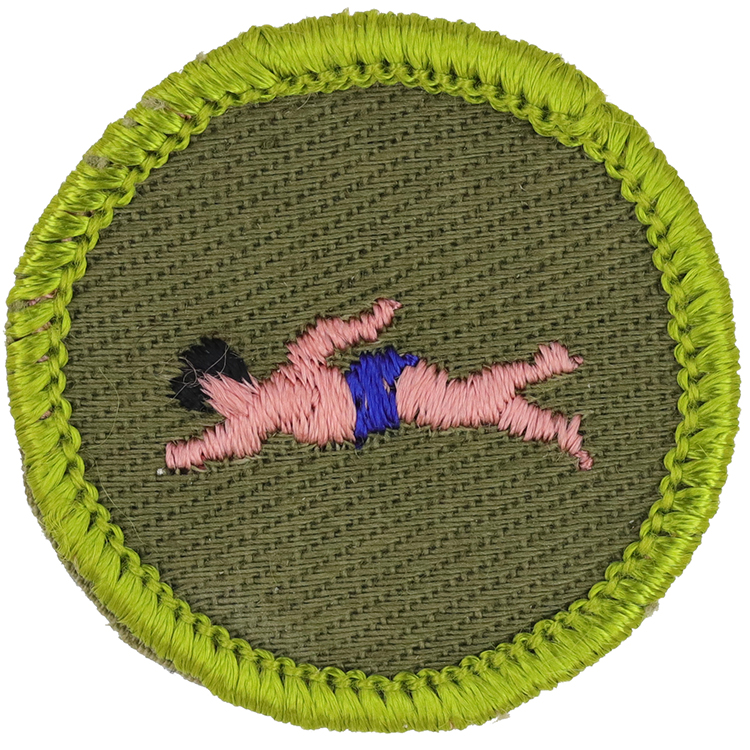
Fig. 1: Swimmi-F-Front
- Cloth: Green right twill
- Border: Merrowed
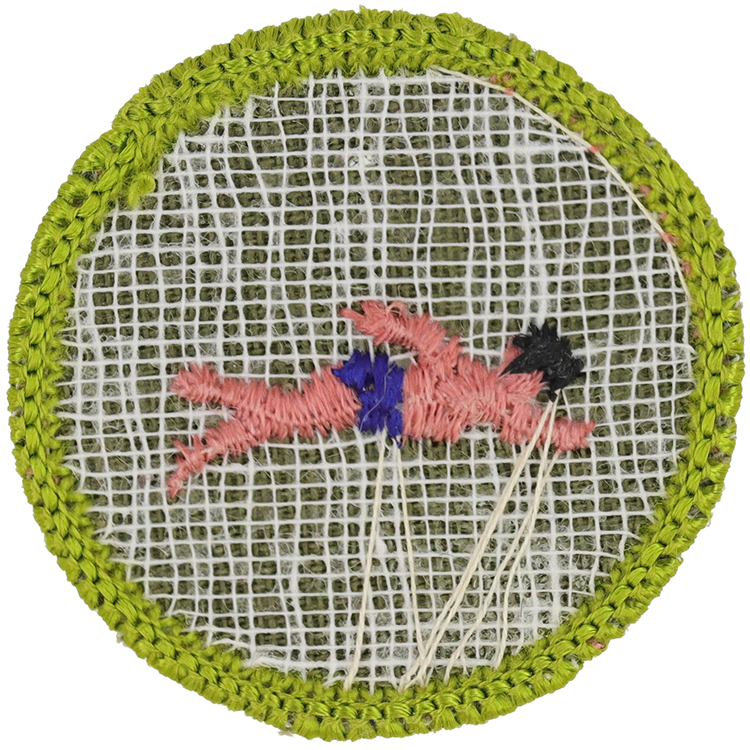
Fig. 2: Swimmi-F-Reverse
- Back: Gauze reinforced starched
Item Name: Swimming 1961 - 1968
Item ID: Swimmi-F
Collector Rating: 1
Pamphlets Used to Earn this Badge
Requirements September 1961 until June 1972
1. Review swimming safety precautions required for First Class Scout rank and explain how swimming should be conducted safely for a group such as a troop or family.
2. Swim 150 yards using the following strokes in good form: side stroke for 50 yards; elementary backstroke for 50 yards; and any one of the following strokes for the remaining 50 yards: overarm side, trudgen, trudgen crawl, American crawl, back crawl, or breast.
3. Surface dive head first into 6 feet of water and recover an object on the bottom. Repeat using feet first method.
4. In an approved diving area, demonstrate a plain front dive from a low board. Demonstrate a head-first dive from a dock or pier and a racing start.
5. In water 6 feet or more deep while dressed in cotton shirt and cotton trousers: (a) Inflate shirt and demonstrate floating technique using it. (b) Remove trousers, tie overhand knot in the bottom of each leg, inflate trousers, and float motionless for one minute using them for support.
6. Demonstrate the following elementary rescue methods: (a) Rescue a subject needing assistance within reaching distance, using either an arm or leg "reach" or a nearby object (branch, oar, or paddle) as a rescue implement. (b) Disrobe on shore, enter water feet first (jump or run) carrying outside shirt in teeth or hand, swim 30 feet, swing one end of shirt to the hands of presumably drowning person and tow him to shore.
7. Demonstrate survival swimming ability by doing all of the following: (a) Enter water without sound, swim silently for 50 feet (using breast stroke or dog paddle). Submerge quietly and swim three strokes underwater before quietly surfacing; leave the water without sound. (b) Float face up in a resting position, as nearly motionless as possible, for one minute. (c) Demonstrate floating face down in a relaxed position ("downproofing" or "bobbing jellyfish" float), using minimum movement of arms and legs to raise head for breathing and to keep body afloat for ten minutes or longer.
2nd class scout must first complete this 1st class requirements.
5. GO SWIMMING
SWIMMING*--Tell what precautions must be taken for a safe swim. Jump feet first into water over your head in depth. Swim 50 yards. During the swim, stop, make a sharp turn, level off and resume swimming.