-
Merit Badges
- Legend to identify Merit Badges
- 1910 British Merit Badges
- Square 1911 - 33
- Wide Crimped 1934 & 35
-
Narrow Tan Crimped 1936 - 42
- Tan Heavyweight Cloth with Silk Embroidery and Printed Back 1936 - 37
- Tan Heavyweight Cloth with Silk Embroidery and Plain Back 1937 - 38
- Tan Lightweight Cloth with Silk Embroidery and Plain Back 1938 - 39
- Tan Lightweight Cloth with Cotton Continuous Loop Embroidery and Plain Back 1939 - 42
- Tan Lightweight Cloth with Cotton Lockstitch Embroidery and Plain Back 1939 - 42
- Blue Background 1942 - 46
- Wartime 1942 - 46
- Khaki Narrow Crimped 1946 - 59
- Green Twill Gauze Back 1960 - 68
- Fully Embroidered Merrowed Edge 1960 - 72
- Unprinted Plastic Back 1972 - 01
- Printed Plastic Back 2002 - Current
-
Merit Badge Paper
- Merit Badge Applications
- Merit Badge Cards
-
Merit Badge Pamphlets
- Type 1 White Cover - Rectangle Drawing On Cover
- Type 2 White Cover 5-375" x 8" Title at Top
- Type 3A Tan Cover - 200 Fifth Avenue
- Type 3B Tan Cover - 2 line address New York City
- Type 3C Tan Cover - 2 line address New York N.Y.
- Type 3D Tan Cover - 1 line address New York N.Y.
- Type 4 Standing Scout Cover
- Type 5A War Cover
- Type 5B Red and White
- Type 6 Photo-Red Cover
- Type 7 Full Photo Cover or Bulls-eye Cover
- Type 8 Full Photo - Green Stripe Cover
- Type 9 Full Photo - Red Stripe Cover
- Type 10A Blue Stripe - Logo above bottom blue stripe - FDL centered
- Type 10B - Blue Stripe in bottom of photo area. FDL to left of text
- Special Covers
- Boy Craft Helps
- Merit Badge Counselor's Guides
-
Youth Position
- Junior Assistant Scoutmaster
- Senior Patrol Leader
- Assistant Senior Patrol Leader
- Patrol Leader
- Assistant Patrol Leader
- Troop Guide
- Scribe
- Quartermaster
- Instructor
- Chaplain Aide
- Den Chief
- Librarian
- Musician
- Webmaster
- Bugler
- Troop Historian
- Troop Representative
- Unit Representative
- Leadership Corps
- Honor Guard
- Leave No Trace Trainer
- Outdoor Ethics Guide
-
Patrol Medallions
- Patrol Medallions Introduction
- Legend to identify Patrol Medallions
- Patrol Shoulder Knot-Ribbons
- Felt Handmade Patrol Medallions
- Square Felt Patrol Medallions
- Round Broadcloth Patrol Medallions
- Red Twill Patrol Medallions
- Multi-Color Cloth Patrol Medallions
- Tan Cloth Patrol Medallions
- Patrol Medallion Back Patches
- Woodbadge Patrol Medallion
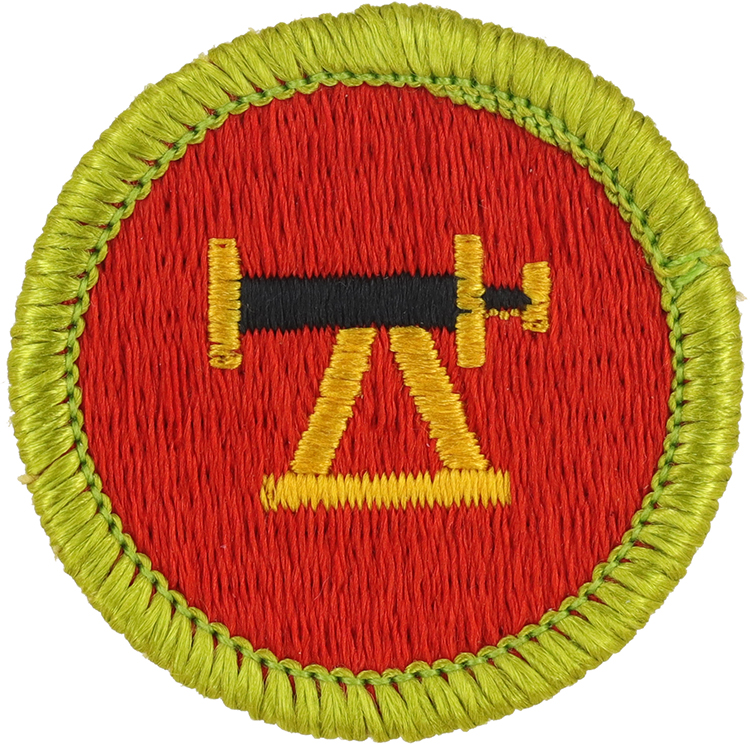
Fig. 1: Survey-J2-Front
- Embroidery: Rayon thread
- Border: Merrowed
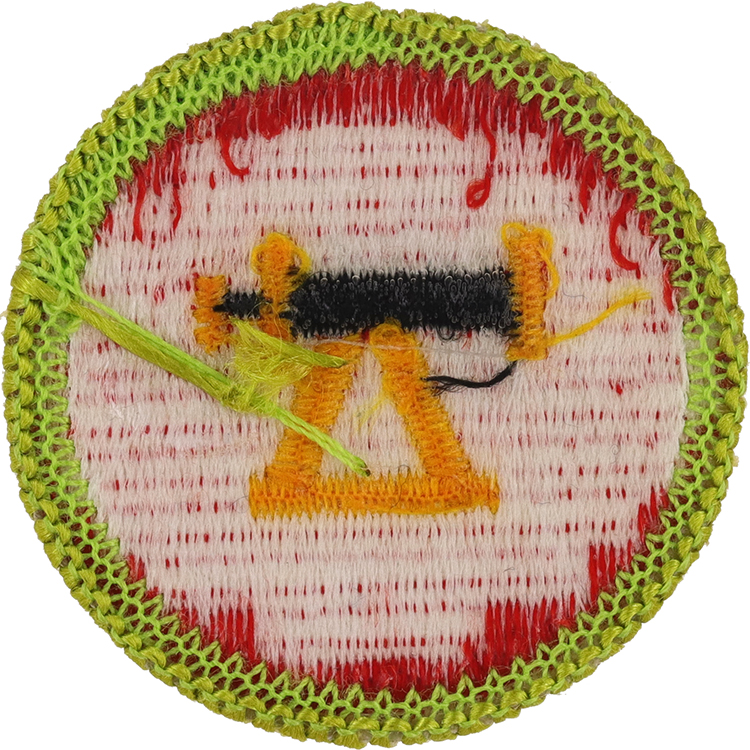
Fig. 2: Survey-J2-Reverse
- Back: Smooth clear NO Scout Stuff imprint Bisphenol A (BPA) free plastic
Item Name: Surveying 2009 - 2010
Item ID: Survey-J2
Collector Rating: 1
Pamphlets Used to Earn this Badge

Requirements January 2005 until Current
1. Show that you know first aid for the types of injuries that could occur while surveying, including cuts, scratches, snakebite, insect stings, tick bites, heat and cold reactions, and dehydration. Explain to your counselor why a surveyor should be able to identify the poisonous plants and poisonous animals that are found in your area.
2. Find and mark the corners of a five-sided lot that has been laid out by your counselor to fit the land available. Set an instrument over each of the corners and record the angle turned between each line and the distance measured between each corner. With the assistance of the counselor, compute the error of closure from the recorded notes. The error of closure must not be more than 5 feet. From the corners, take compass readings or turn angles to trees, shrubs, and rocks, and measure to them. All measurements should be made using instruments, methods, and accuracies consistent with current technology.
3. From the field notes gathered for requirement 2, draw to scale a map of your survey. Submit a neatly drawn copy.
4. Write a metes and bounds description for the five-sided lot in requirement 2.
5. Use one of the corner markers from requirement 2 as a benchmark with an assumed elevation of 100 feet. Using a level and rod, determine the elevation of the other four corner markers.
6. Get a copy of the deed to your property, or a piece of property assigned by your counselor, from the local courthouse or title agency.
7. Tell what GPS is; discuss with your counselor the importance of GPS and how it is changing the field of surveying.
8. Discuss the importance of surveying with a licensed surveyor. Also discuss the various types of surveying and mapping, and applications of surveying technology to other fields. Discuss career opportunities in surveying and related fields. Discuss the qualifications and preparation for such a career.