-
Merit Badges
- Legend to identify Merit Badges
- 1910 British Merit Badges
- Square 1911 - 33
- Wide Crimped 1934 & 35
-
Narrow Tan Crimped 1936 - 42
- Tan Heavyweight Cloth with Silk Embroidery and Printed Back 1936 - 37
- Tan Heavyweight Cloth with Silk Embroidery and Plain Back 1937 - 38
- Tan Lightweight Cloth with Silk Embroidery and Plain Back 1938 - 39
- Tan Lightweight Cloth with Cotton Continuous Loop Embroidery and Plain Back 1939 - 42
- Tan Lightweight Cloth with Cotton Lockstitch Embroidery and Plain Back 1939 - 42
- Blue Background 1942 - 46
- Wartime 1942 - 46
- Khaki Narrow Crimped 1946 - 59
- Green Twill Gauze Back 1960 - 68
- Fully Embroidered Merrowed Edge 1960 - 72
- Unprinted Plastic Back 1972 - 01
- Printed Plastic Back 2002 - Current
-
Merit Badge Paper
- Merit Badge Applications
- Merit Badge Cards
-
Merit Badge Pamphlets
- Type 1 White Cover - Rectangle Drawing On Cover
- Type 2 White Cover 5-375" x 8" Title at Top
- Type 3A Tan Cover - 200 Fifth Avenue
- Type 3B Tan Cover - 2 line address New York City
- Type 3C Tan Cover - 2 line address New York N.Y.
- Type 3D Tan Cover - 1 line address New York N.Y.
- Type 4 Standing Scout Cover
- Type 5A War Cover
- Type 5B Red and White
- Type 6 Photo-Red Cover
- Type 7 Full Photo Cover or Bulls-eye Cover
- Type 8 Full Photo - Green Stripe Cover
- Type 9 Full Photo - Red Stripe Cover
- Type 10A Blue Stripe - Logo above bottom blue stripe - FDL centered
- Type 10B - Blue Stripe in bottom of photo area. FDL to left of text
- Special Covers
- Boy Craft Helps
- Merit Badge Counselor's Guides
-
Youth Position
- Junior Assistant Scoutmaster
- Senior Patrol Leader
- Assistant Senior Patrol Leader
- Patrol Leader
- Assistant Patrol Leader
- Troop Guide
- Scribe
- Quartermaster
- Instructor
- Chaplain Aide
- Den Chief
- Librarian
- Musician
- Webmaster
- Bugler
- Troop Historian
- Troop Representative
- Unit Representative
- Leadership Corps
- Honor Guard
- Leave No Trace Trainer
- Outdoor Ethics Guide
-
Patrol Medallions
- Patrol Medallions Introduction
- Legend to identify Patrol Medallions
- Patrol Shoulder Knot-Ribbons
- Felt Handmade Patrol Medallions
- Square Felt Patrol Medallions
- Round Broadcloth Patrol Medallions
- Red Twill Patrol Medallions
- Multi-Color Cloth Patrol Medallions
- Tan Cloth Patrol Medallions
- Patrol Medallion Back Patches
- Woodbadge Patrol Medallion
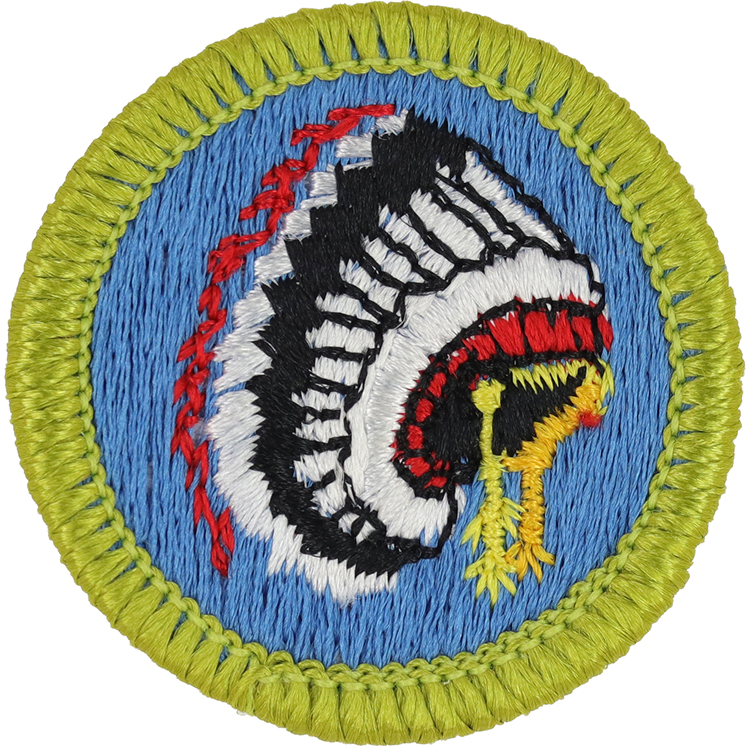
Fig. 1: IndLor-H5-Front
- Embroidery: Rayon thread
- Border: Merrowed
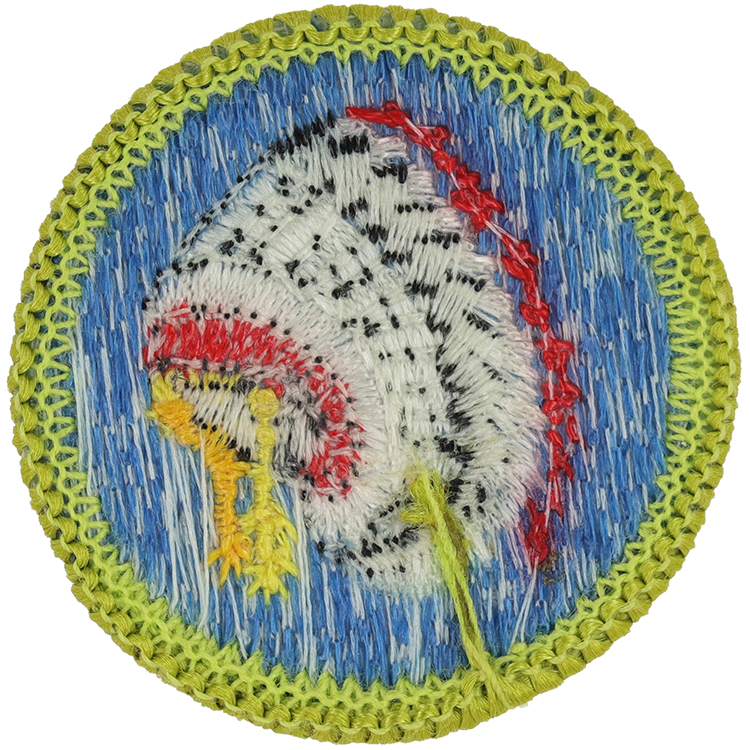
Fig. 2: IndLor-H5-Reverse
- Back: Molded plastic
Item Name: Indian Lore 1990 - 2002
Item ID: IndLor-H5
Collector Rating: 1
Pamphlets Used to Earn this Badge
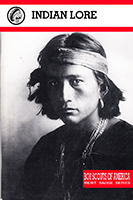
Requirements December 1977 until September 1995
1. Give the history of one Indian tribe, group, or nation. This should be one that lives or has lived near your home. Visit it, if possible. Tell about the following: dwellings, food preparation, dress, religious beliefs, kind of life, language, war, means of getting around, where the members, if any, now live and how they now live.
2. Do TWO of the following:
(a) Make a full authentic Indian costume.
(b) Make and decorate authentically three Indian articles approved by your counselor.
(c) Make an authentic model of an Indian dwelling used by any Indian tribe, group, or nation.
(d) Visit a museum to see Indian artifacts. Talk about them with your counselor. Identify at least 10 artifacts by shape, size and use.
3. Do ONE of the following:
(a) Learn three Indian games. Teach and lead on game with a Scout group.
(b) Learn and show Indian-style cooking. Cook three things.
(c) Show the Indian way of hunting, fishing, or trapping.
4. Do ONE of the following:
(a) Take part in an Indian show in which dances and songs, based on authentic Indian themes, are used.
(b) Sing two Indian songs in Indian dialect. Explain their meaning.
(c) Plan and take part in an Indian campfire ceremony based on an Indian theme.
(d) Learn in Indian dialect at least 25 common terms and their meaning.
(e) Know at least 25 signs in Indian sign language, including those that will help you ask for water, food, and where the trail or road leads.
(f) Learn in English at least one Indian saga of not less than 300 words, or any number of shorter ones totaling at least 300 words. Relate the saga to a group around a campfire or at a troop or post meeting.
(g) Write or tell about eight items adopted by the white man from the Indian. Such items might include food, clothing, medicines, crafts, games, cooking techniques, etc.
(h) Learn 25 Indian place names. Tell their origin and meaning.
(i) Name five well-known Indian chiefs. Give their tribes. Describe their relationship to history.
Requirements September 1995 until Setpember 1998
1. Give the history of one Americian Indian tribe, group, or nation that lived near you. Visit it, if possible. Tell about dwellings, kind of life, tribal government, religious beliefs, family and clan relationships, language, dress, food preparation, means of getting around, how they played, if they were warlike or peaceful, where descendants of the group now live, and how they live.
2. Do TWO of the following. Use information about a specific group or tribe to complete the requirements:
(a) Make an item of clothing worn by members of the tribe.
(b) Make and decorate three items approved by your counselor used by the tribe.
(c) Make an authentic model of a dwelling used by any Indian tribe, group, or nation.
(d) Visit a museum to see Indian artifacts. Talk about them with your counselor. Identify at least ten artifacts by tribe or nation, their shape, size and use.
3. Do ONE of the following:
(a) Learn three games played by a group or tribe. Teach and lead on game with a Scout group.
(b) Learn and show how a tribe cooked or prepared food. Make three food items.
(c) Give a demonstration showing how a specific Indian group hunted, fished, or trapped.
4. Do ONE of the following:
(a) Write or briefly describe how life would have been different for the European settlers if there had been no Indians to meet them when they came to this continent.
(b) Sing two Indian songs in Indian language. Explain their meaning.
(c) Learn in Indian language at least twenty-five common terms and their meaning.
(d) Show twenty-five signs in Indian sign language. Include those that will help you ask for water, food, and where the trail or road leads.
(e) Learn in English an Indian story of not less than three hundred words, or any number of shorter ones totaling up to three hundred word. Tell the story or stories at a Scout meeting or campfire.
(f) Write or tell about eight items adopted others from the Indian.
(g) Learn twenty-five Indian place names. Tell their origin and meaning.
(h) Name five well-known American Indian leaders, either from past or people who are alive today. Give their tribes or nations. Describe what they did or do now that makes them notable
(i)Learn about the Iroquois Confederacy, including how and why it was formed. Tell about its governing system, and its importance to the framers of our constitution.
Requirements September 1998 until January 2009
1. Give the history of one American Indian tribe, group, or nation that lives or has lived near you. Visit it, if possible. Tell about traditional dwellings, way of life, tribal government, religious beliefs, family and clan relationships, language, clothing styles, arts and crafts, food preparation, means of getting around, games, customs in warfare, where members of the group now live, and how they live.
2. Do TWO of the following. Focus on a specific group or tribe:
(a) Make an item of clothing worn by members of the tribe.
(b) Make and decorate three items approved by your counselor used by the tribe.
(c) Make an authentic model of a dwelling used by any Indian tribe, group, or nation.
(d) Visit a museum to see Indian artifacts. Discuss them with your counselor. Identify at least 10 artifacts by tribe or nation, their shape, size and use.
3. Do ONE of the following:
(a) Learn three games played by a group or tribe. Teach and lead on game with a Scout group.
(b) Learn and show how a tribe traditionally cooked or prepared food. Make three food items.
(c) Give a demonstration showing how a specific Indian group traditionally hunted, fished, or trapped.
4. Do ONE of the following:
(a) Write or briefly describe how life might have been different for the European settlers if there had been no native Americans to meet them when they came to this continent.
(b) Sing two songs in an Indian language. Explain their meaning.
(c) Learn in an Indian language at least 25 common terms and their meanings.
(d) Show 25 signs in Indian sign language. Include those that will help you ask for water, food, and where the path or road leads.
(e) Learn in English (or the language you commonly speak at home or in the troop) an Indian story of at least 300 words, or any number of shorter ones adding up to 300 words. Tell the story or stories at a Scout meeting or campfire.
(f) Write or tell about eight items adopted others from American Indians.
(g) Learn twenty-five Indian place names. Tell their origins and meanings.
(h) Name five well-known American Indian leaders, either from past or people of today. Give their tribes or nations. Describe what they did or do now that makes them notable.
(i) Learn about the Iroquois Confederacy, including how and why it was formed. Tell about its governing system, and its importance to the framers of the Constitution of the United States.