-
Merit Badges
- Legend to identify Merit Badges
- 1910 British Merit Badges
- Square 1911 - 33
- Wide Crimped 1934 & 35
-
Narrow Tan Crimped 1936 - 42
- Tan Heavyweight Cloth with Silk Embroidery and Printed Back 1936 - 37
- Tan Heavyweight Cloth with Silk Embroidery and Plain Back 1937 - 38
- Tan Lightweight Cloth with Silk Embroidery and Plain Back 1938 - 39
- Tan Lightweight Cloth with Cotton Continuous Loop Embroidery and Plain Back 1939 - 42
- Tan Lightweight Cloth with Cotton Lockstitch Embroidery and Plain Back 1939 - 42
- Blue Background 1942 - 46
- Wartime 1942 - 46
- Khaki Narrow Crimped 1946 - 59
- Green Twill Gauze Back 1960 - 68
- Fully Embroidered Merrowed Edge 1960 - 72
- Unprinted Plastic Back 1972 - 01
- Printed Plastic Back 2002 - Current
-
Merit Badge Paper
- Merit Badge Applications
- Merit Badge Cards
-
Merit Badge Pamphlets
- Type 1 White Cover - Rectangle Drawing On Cover
- Type 2 White Cover 5-375" x 8" Title at Top
- Type 3A Tan Cover - 200 Fifth Avenue
- Type 3B Tan Cover - 2 line address New York City
- Type 3C Tan Cover - 2 line address New York N.Y.
- Type 3D Tan Cover - 1 line address New York N.Y.
- Type 4 Standing Scout Cover
- Type 5A War Cover
- Type 5B Red and White
- Type 6 Photo-Red Cover
- Type 7 Full Photo Cover or Bulls-eye Cover
- Type 8 Full Photo - Green Stripe Cover
- Type 9 Full Photo - Red Stripe Cover
- Type 10A Blue Stripe - Logo above bottom blue stripe - FDL centered
- Type 10B - Blue Stripe in bottom of photo area. FDL to left of text
- Special Covers
- Boy Craft Helps
- Merit Badge Counselor's Guides
-
Youth Position
- Junior Assistant Scoutmaster
- Senior Patrol Leader
- Assistant Senior Patrol Leader
- Patrol Leader
- Assistant Patrol Leader
- Troop Guide
- Scribe
- Quartermaster
- Instructor
- Chaplain Aide
- Den Chief
- Librarian
- Musician
- Webmaster
- Bugler
- Troop Historian
- Troop Representative
- Unit Representative
- Leadership Corps
- Honor Guard
- Leave No Trace Trainer
- Outdoor Ethics Guide
-
Patrol Medallions
- Patrol Medallions Introduction
- Legend to identify Patrol Medallions
- Patrol Shoulder Knot-Ribbons
- Felt Handmade Patrol Medallions
- Square Felt Patrol Medallions
- Round Broadcloth Patrol Medallions
- Red Twill Patrol Medallions
- Multi-Color Cloth Patrol Medallions
- Tan Cloth Patrol Medallions
- Patrol Medallion Back Patches
- Woodbadge Patrol Medallion
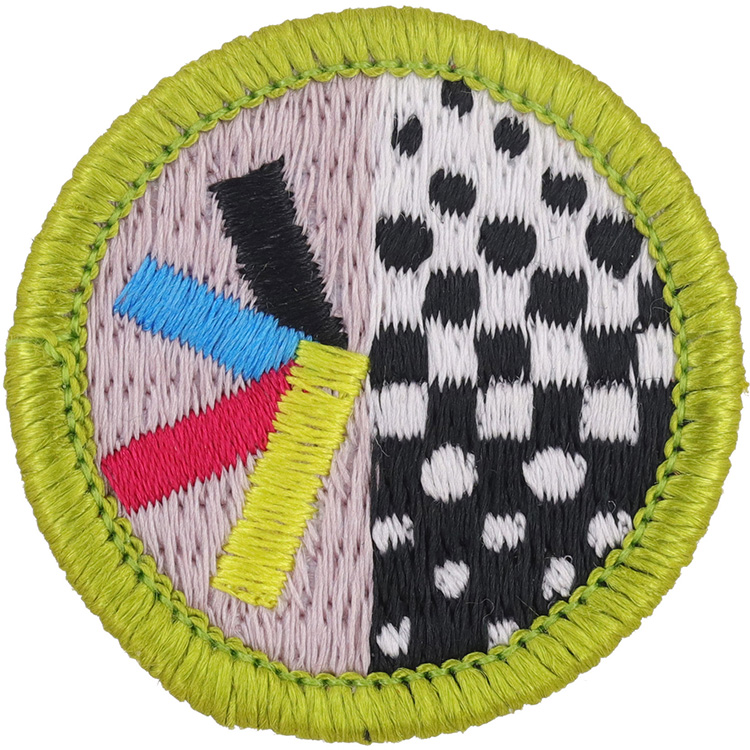
Fig. 1: GraArt-J1b-Front
- Embroidery: Rayon thread
- Design: Vertical white embroidery
- Border: /strong> Merrowed
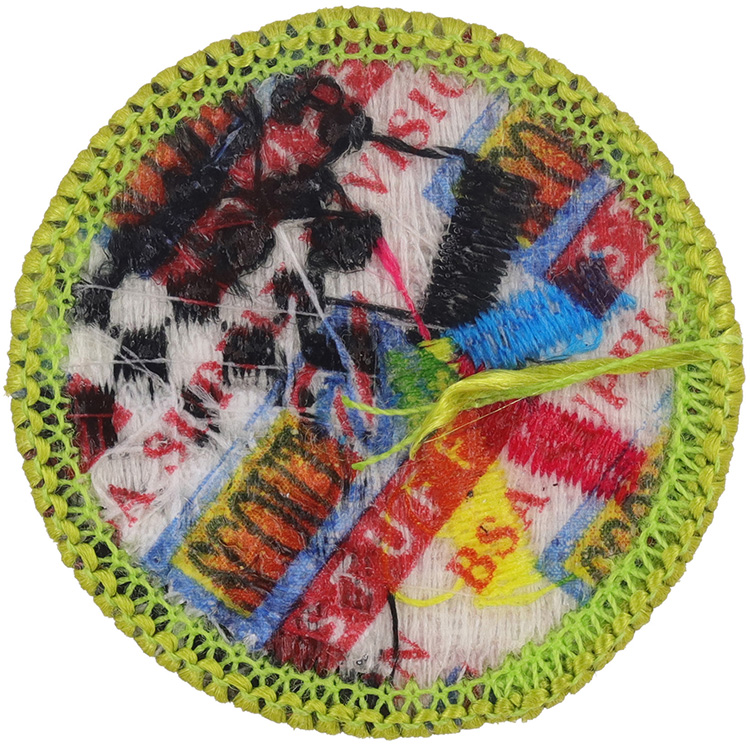
Fig. 2: GraArt-J1b-Reverse
- Back: Scout Stuff imprint
Item Name: Graphic Arts 2002 - 2009
Item ID: GraArt-J1b
Collector Rating: 1
Pamphlets Used to Earn this Badge

Requirements April 1999 until January 2010
1. Review with your counselor the processes for producing printed communications: offset lithography, screen process printing, electronic/digital, relief, and gravure. You may show samples or draw diagrams to help with your description.
2. Explain the difference between continuous-tone, line, and halftone artwork. Describe how it can be created and/or stored in a computer.
3. Design a printed piece (flier, T-shirt, program, form, etc.) and produce it. Explain your decisions for the typeface or typefaces you use and the way you arrange the elements in your design. Explain which printing process is best suited for printing your design. If desktop publishing hardware and software are available, identify what hardware and software would be appropriate for outputting your design.
4. Produce the design you created for requirement 3 using one of the following printing processes:
(a) Offset lithography
Make a layout and then produce a plate using a process approved by your counselor. Run the plate and print 50 copies.
(b) Screen process printing
Make a hand-cut or photographic stencil and attach it to a screen that you have prepared. Make the screen and print at least 20 copies.
(c) Electronic/digital printing
Make a layout in electronic form, download it to the press or printer, and run 50 copies. If no electronic interface to the press or printer is available, you may print and scan a paper copy of the layout.
(d) Relief printing
Prepare a layout or set the necessary type. Male a plate or lock-up the form. Use this to print 50 copies.
5. Review the following postpress operations with your counselor:
(a) Discuss the finishing operations of padding, drilling, cutting, and trimming.
(b) Collect, describe, or identify examples of the following types of binding: perfect, spiral, plastic comb, saddle stitched, and case
6. Identify three career opportunities in graphic arts and tell how you can prepare for them.
7. Do one of the following and then describe the highlights of your visit:
(a) Visit a newspaper printing plant: Follow a story from the editor to the press.
(b) Visit a commercial or in-plant printing facility: Follow a job from beginning to end.
(c) Visit a school’s graphic arts program: Find out what courses are available and what the prerequisites are.
(d) Visit three Web sites on the internet that belong to graphic arts professional organizations and/or printing-related companies (suppliers, manufactures, printers): Download product or service information from two of the sites.