-
Merit Badges
- Legend to identify Merit Badges
- 1910 British Merit Badges
- Square 1911 - 33
- Wide Crimped 1934 & 35
-
Narrow Tan Crimped 1936 - 42
- Tan Heavyweight Cloth with Silk Embroidery and Printed Back 1936 - 37
- Tan Heavyweight Cloth with Silk Embroidery and Plain Back 1937 - 38
- Tan Lightweight Cloth with Silk Embroidery and Plain Back 1938 - 39
- Tan Lightweight Cloth with Cotton Continuous Loop Embroidery and Plain Back 1939 - 42
- Tan Lightweight Cloth with Cotton Lockstitch Embroidery and Plain Back 1939 - 42
- Blue Background 1942 - 46
- Wartime 1942 - 46
- Khaki Narrow Crimped 1946 - 59
- Green Twill Gauze Back 1960 - 68
- Fully Embroidered Merrowed Edge 1960 - 72
- Unprinted Plastic Back 1972 - 01
- Printed Plastic Back 2002 - Current
-
Merit Badge Paper
- Merit Badge Applications
- Merit Badge Cards
-
Merit Badge Pamphlets
- Type 1 White Cover - Rectangle Drawing On Cover
- Type 2 White Cover 5-375" x 8" Title at Top
- Type 3A Tan Cover - 200 Fifth Avenue
- Type 3B Tan Cover - 2 line address New York City
- Type 3C Tan Cover - 2 line address New York N.Y.
- Type 3D Tan Cover - 1 line address New York N.Y.
- Type 4 Standing Scout Cover
- Type 5A War Cover
- Type 5B Red and White
- Type 6 Photo-Red Cover
- Type 7 Full Photo Cover or Bulls-eye Cover
- Type 8 Full Photo - Green Stripe Cover
- Type 9 Full Photo - Red Stripe Cover
- Type 10A Blue Stripe - Logo above bottom blue stripe - FDL centered
- Type 10B - Blue Stripe in bottom of photo area. FDL to left of text
- Special Covers
- Boy Craft Helps
- Merit Badge Counselor's Guides
-
Youth Position
- Junior Assistant Scoutmaster
- Senior Patrol Leader
- Assistant Senior Patrol Leader
- Patrol Leader
- Assistant Patrol Leader
- Troop Guide
- Scribe
- Quartermaster
- Instructor
- Chaplain Aide
- Den Chief
- Librarian
- Musician
- Webmaster
- Bugler
- Troop Historian
- Troop Representative
- Unit Representative
- Leadership Corps
- Honor Guard
- Leave No Trace Trainer
- Outdoor Ethics Guide
-
Patrol Medallions
- Patrol Medallions Introduction
- Legend to identify Patrol Medallions
- Patrol Shoulder Knot-Ribbons
- Felt Handmade Patrol Medallions
- Square Felt Patrol Medallions
- Round Broadcloth Patrol Medallions
- Red Twill Patrol Medallions
- Multi-Color Cloth Patrol Medallions
- Tan Cloth Patrol Medallions
- Patrol Medallion Back Patches
- Woodbadge Patrol Medallion
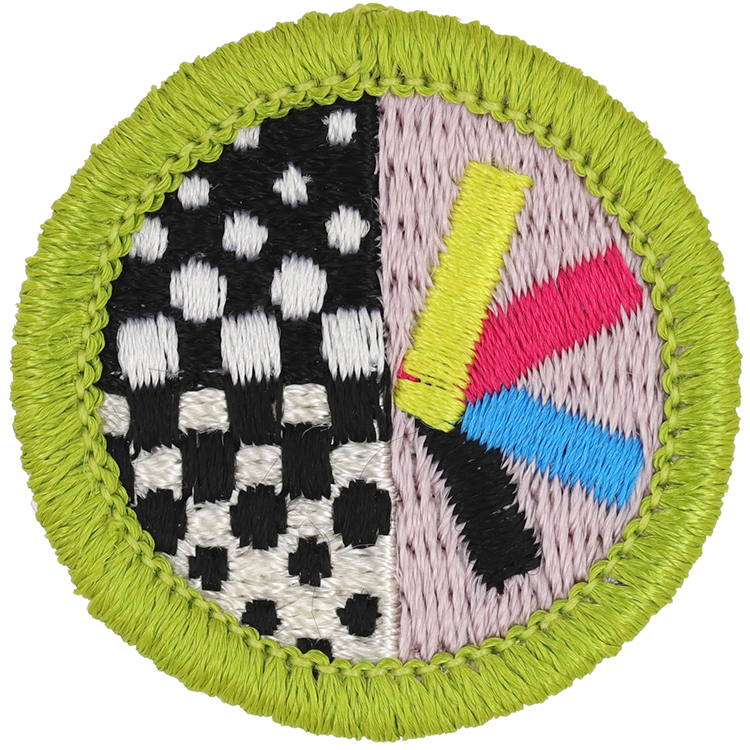
Fig. 1: GraArt-H4-Front
- Embroidery: Cotton thread, dull sheen
- Border: Lt green merrowed
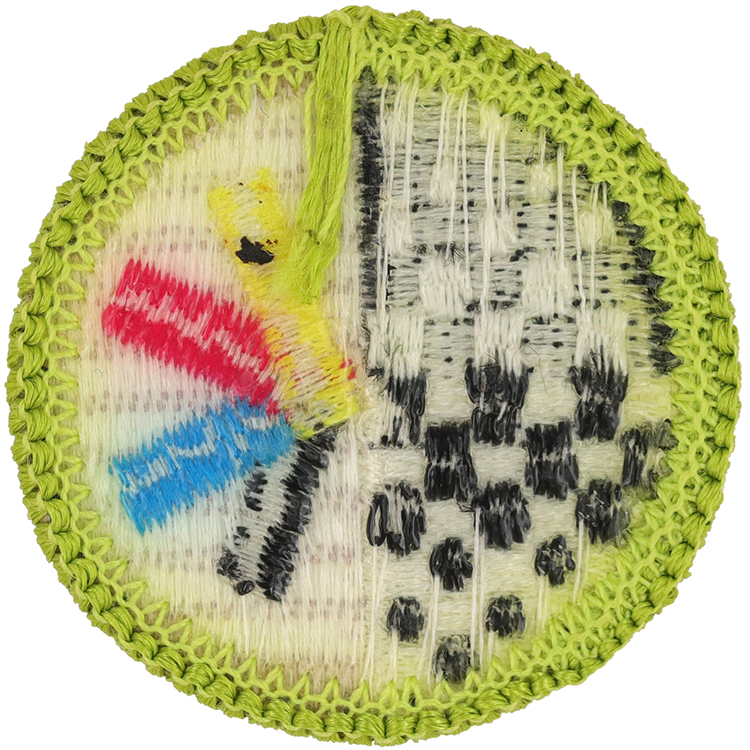
Fig. 2: GraArt-H4-Reverse
- Back: Lt green lock stitch, molded plastic
Item Name: Graphic Arts 1987 - 1990
Item ID: GraArt-H4
Collector Rating: 1
Pamphlets Used to Earn this Badge
Requirements September 1987 until April 1999
1. Tell about the process for producing printed communications: offset lithography, gravure, flexography, letterpress (relief), screen printing, and electronic processes. Show samples of each or make sketches that explain how these processes work.
2. Design a printed piece such as a poster or advertising flier. Make an accurate layout and be sure to specify the type to be used. Explain the difference between typefaces and explain their purposes. Explain how type is arranged and the skills needed to proceed to print.
3. Explain the difference between a line and a halftone and how each is made.
4. With your counselor, choose ONE of these printing processes to print the piece you designed.
(a) Offset lithographic printing
(1) Using the layout you made, set the type, keyline or pasteup, and prepare a suitable negative.
(2) Properly strip the negative for exposure onto an offset plate. Expose and process this plate.
(3) Using this plate, print at least 50 copies.
(b) Screen process printing
(1) Using the layout you made, hand letter or set the type, keyline or pasteup, and prepare a photographic or hand-cut stencil.
(2) Adhere this stencil to a screen frame and prepare the screen for printing.
(3) Using a screen printing base with clamps, print at least 25 copies.
(c) Letterpress printing
(1) Using the layout you made, set the type either by hand or machine and select an appropriate engraving to illustrate your project.
(2) Lockup your type and engraving in a chase for printing.
(3) Using this form, print at least 50 copies.
5. Do the following:
(a) Review with your counselor a brief background on the history of bookbinding.
(b) Explain the differences between perfect, spiral, plastic comb, and case binding.
(c) Explain saddle stitching, perfect binding, and four side trim.
(d) Make a scrapbook and bind it using one of the methods.
(e) Explain the pagination process.
6. Identify three career opportunities in graphic arts and tell how you can prepare for each of them.
7.Do ONE of the following:
(a) Visit a newspaper printing plant. Follow a story from the editor's desk through composition and printing. Tell about your visit, including careers you observed and the equipment used in the production of the newspaper.
(b) Visit a commercial printing plant. Follow a job through production. Tell about your visit, including careers you observed and the equipment used in the production of the job