-
Merit Badges
- Legend to identify Merit Badges
- 1910 British Merit Badges
- Square 1911 - 33
- Wide Crimped 1934 & 35
-
Narrow Tan Crimped 1936 - 42
- Tan Heavyweight Cloth with Silk Embroidery and Printed Back 1936 - 37
- Tan Heavyweight Cloth with Silk Embroidery and Plain Back 1937 - 38
- Tan Lightweight Cloth with Silk Embroidery and Plain Back 1938 - 39
- Tan Lightweight Cloth with Cotton Continuous Loop Embroidery and Plain Back 1939 - 42
- Tan Lightweight Cloth with Cotton Lockstitch Embroidery and Plain Back 1939 - 42
- Blue Background 1942 - 46
- Wartime 1942 - 46
- Khaki Narrow Crimped 1946 - 59
- Green Twill Gauze Back 1960 - 68
- Fully Embroidered Merrowed Edge 1960 - 72
- Unprinted Plastic Back 1972 - 01
- Printed Plastic Back 2002 - Current
-
Merit Badge Paper
- Merit Badge Applications
- Merit Badge Cards
-
Merit Badge Pamphlets
- Type 1 White Cover - Rectangle Drawing On Cover
- Type 2 White Cover 5-375" x 8" Title at Top
- Type 3A Tan Cover - 200 Fifth Avenue
- Type 3B Tan Cover - 2 line address New York City
- Type 3C Tan Cover - 2 line address New York N.Y.
- Type 3D Tan Cover - 1 line address New York N.Y.
- Type 4 Standing Scout Cover
- Type 5A War Cover
- Type 5B Red and White
- Type 6 Photo-Red Cover
- Type 7 Full Photo Cover or Bulls-eye Cover
- Type 8 Full Photo - Green Stripe Cover
- Type 9 Full Photo - Red Stripe Cover
- Type 10A Blue Stripe - Logo above bottom blue stripe - FDL centered
- Type 10B - Blue Stripe in bottom of photo area. FDL to left of text
- Special Covers
- Boy Craft Helps
- Merit Badge Counselor's Guides
-
Youth Position
- Junior Assistant Scoutmaster
- Senior Patrol Leader
- Assistant Senior Patrol Leader
- Patrol Leader
- Assistant Patrol Leader
- Troop Guide
- Scribe
- Quartermaster
- Instructor
- Chaplain Aide
- Den Chief
- Librarian
- Musician
- Webmaster
- Bugler
- Troop Historian
- Troop Representative
- Unit Representative
- Leadership Corps
- Honor Guard
- Leave No Trace Trainer
- Outdoor Ethics Guide
-
Patrol Medallions
- Patrol Medallions Introduction
- Legend to identify Patrol Medallions
- Patrol Shoulder Knot-Ribbons
- Felt Handmade Patrol Medallions
- Square Felt Patrol Medallions
- Round Broadcloth Patrol Medallions
- Red Twill Patrol Medallions
- Multi-Color Cloth Patrol Medallions
- Tan Cloth Patrol Medallions
- Patrol Medallion Back Patches
- Woodbadge Patrol Medallion

Fig. 1: FisMan-H5-Front
- Embroidery: Rayon thread
- Border: Merrowed
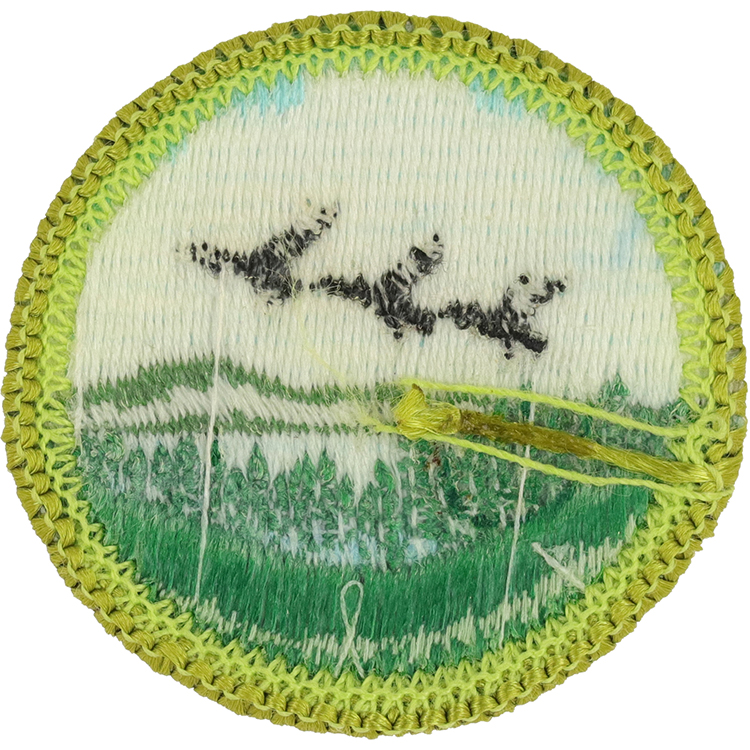
Fig. 2: FisMan-H5-Reverse
- Back: Molded plastic

Fig. 3: FisMan-H5-mve1-front
- Minor variation: Yellow border

Fig. 4: FisMan-H5-mve1-reverse
- Back: Molded plastic
Item Name: Fish and Wildlife Management 1990 - 2002
Item ID: FisMan-H5
Collector Rating: 1
Pamphlets Used to Earn this Badge


Requirements September 1987 until January 2005
1. Describe the meaning and purposes of fish and wildlife conservation and management.
2. List and discuss at least three major problems that continue to threaten your state's fish and wildlife resources.
3. Describe some practical ways in which everyone can help with the fish and wildlife conservation effort.
4. List and describe five major fish and wildlife management practices used by managers in your state.
5. Do ONE of the following:
(a) Construct, erect, and check regularly at least two artificial nest boxes (wood duck, bluebird, squirrel, etc.) and keep written records for one nesting season.
(b) Construct, erect, and check regularly bird feeders and keep written records of the kinds of birds visiting the feeders in the wintertime.
(c) Design and implement a backyard wildlife habitat improvement project and report the results.
(d) Design and construct a wildlife blind near a game trail, waterhole, salt lick, bird feeder, or birdbath and take good photographs or make sketches from the blind of any combination of 10 wild birds, mammals, reptiles, or amphibians.
6. Do ONE of the following:
(a) Observe and record 25 species of wildlife. Your list may include mammals, birds, reptiles, or fish. Write down when and where each animal was seen.
(b) List the wildlife species in your state that are classified as endangered, threatened, exotic, game species, furbearers, or migratory game birds.
(c) Start a scrapbook or North American wildlife. Insert markers to divide the book into separate parts for mammals, birds, reptiles, and fish. Collect articles on such subjects as life histories, habitat, behavior, and feeding habits on all of the four categories and place them in your notebook accordingly. Articles and pictures may be cut from old discarded newspapers; science, nature, and outdoor magazines; or can be photocopied from other sources. Enter at least 10 articles on mammals, 10 on birds, 5 on reptiles, and 5 on fish. Put each animal on a separate sheet in alphabetical order. Include pictures whenever possible.
7. Do ONE of the following:
(a) Determine the age of five species of fish from scale samples or identify various age classes of one species in a lake and report the results.
(b) Conduct a creel census on a small lake to estimate catch per unit effort.
(c) Examine the stomach contents of three species of fish and record the findings.
(d) Make a freshwater aquarium. Include at least four species of native plants and four species of animal life, such a whirligig beetles, freshwater shrimp, tadpoles, water snails, and golden shiners. After 60 days of observation, discuss with your counselor the life cycles, food chains, and management needs you have recognized.