-
Merit Badges
- Legend to identify Merit Badges
- 1910 British Merit Badges
- Square 1911 - 33
- Wide Crimped 1934 & 35
-
Narrow Tan Crimped 1936 - 42
- Tan Heavyweight Cloth with Silk Embroidery and Printed Back 1936 - 37
- Tan Heavyweight Cloth with Silk Embroidery and Plain Back 1937 - 38
- Tan Lightweight Cloth with Silk Embroidery and Plain Back 1938 - 39
- Tan Lightweight Cloth with Cotton Continuous Loop Embroidery and Plain Back 1939 - 42
- Tan Lightweight Cloth with Cotton Lockstitch Embroidery and Plain Back 1939 - 42
- Blue Background 1942 - 46
- Wartime 1942 - 46
- Khaki Narrow Crimped 1946 - 59
- Green Twill Gauze Back 1960 - 68
- Fully Embroidered Merrowed Edge 1960 - 72
- Unprinted Plastic Back 1972 - 01
- Printed Plastic Back 2002 - Current
-
Merit Badge Paper
- Merit Badge Applications
- Merit Badge Cards
-
Merit Badge Pamphlets
- Type 1 White Cover - Rectangle Drawing On Cover
- Type 2 White Cover 5-375" x 8" Title at Top
- Type 3A Tan Cover - 200 Fifth Avenue
- Type 3B Tan Cover - 2 line address New York City
- Type 3C Tan Cover - 2 line address New York N.Y.
- Type 3D Tan Cover - 1 line address New York N.Y.
- Type 4 Standing Scout Cover
- Type 5A War Cover
- Type 5B Red and White
- Type 6 Photo-Red Cover
- Type 7 Full Photo Cover or Bulls-eye Cover
- Type 8 Full Photo - Green Stripe Cover
- Type 9 Full Photo - Red Stripe Cover
- Type 10A Blue Stripe - Logo above bottom blue stripe - FDL centered
- Type 10B - Blue Stripe in bottom of photo area. FDL to left of text
- Special Covers
- Boy Craft Helps
- Merit Badge Counselor's Guides
-
Youth Position
- Junior Assistant Scoutmaster
- Senior Patrol Leader
- Assistant Senior Patrol Leader
- Patrol Leader
- Assistant Patrol Leader
- Troop Guide
- Scribe
- Quartermaster
- Instructor
- Chaplain Aide
- Den Chief
- Librarian
- Musician
- Webmaster
- Bugler
- Troop Historian
- Troop Representative
- Unit Representative
- Leadership Corps
- Honor Guard
- Leave No Trace Trainer
- Outdoor Ethics Guide
-
Patrol Medallions
- Patrol Medallions Introduction
- Legend to identify Patrol Medallions
- Patrol Shoulder Knot-Ribbons
- Felt Handmade Patrol Medallions
- Square Felt Patrol Medallions
- Round Broadcloth Patrol Medallions
- Red Twill Patrol Medallions
- Multi-Color Cloth Patrol Medallions
- Tan Cloth Patrol Medallions
- Patrol Medallion Back Patches
- Woodbadge Patrol Medallion
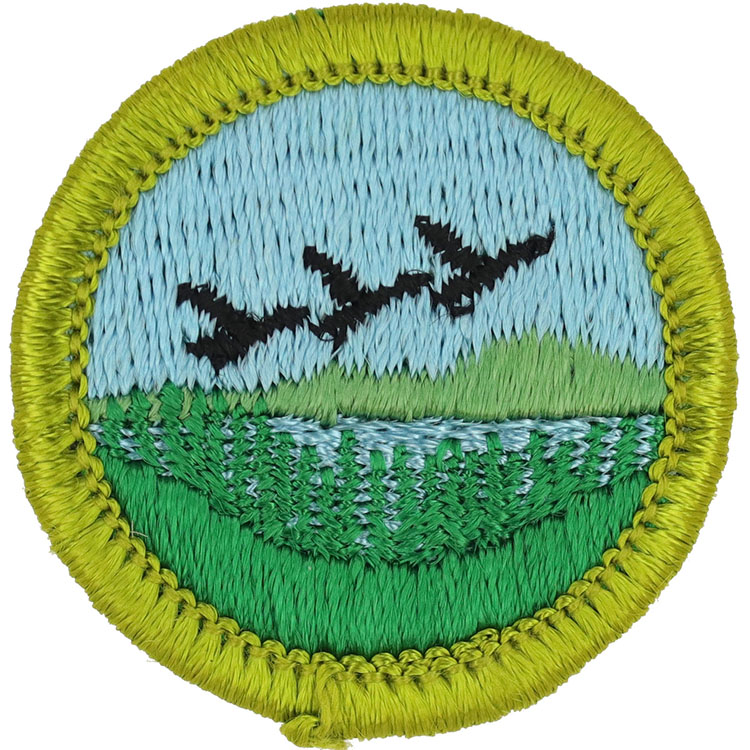
Fig. 1: FisMan-H1-Front
- Embroidery: Cotton thread
- Border: Merrowed
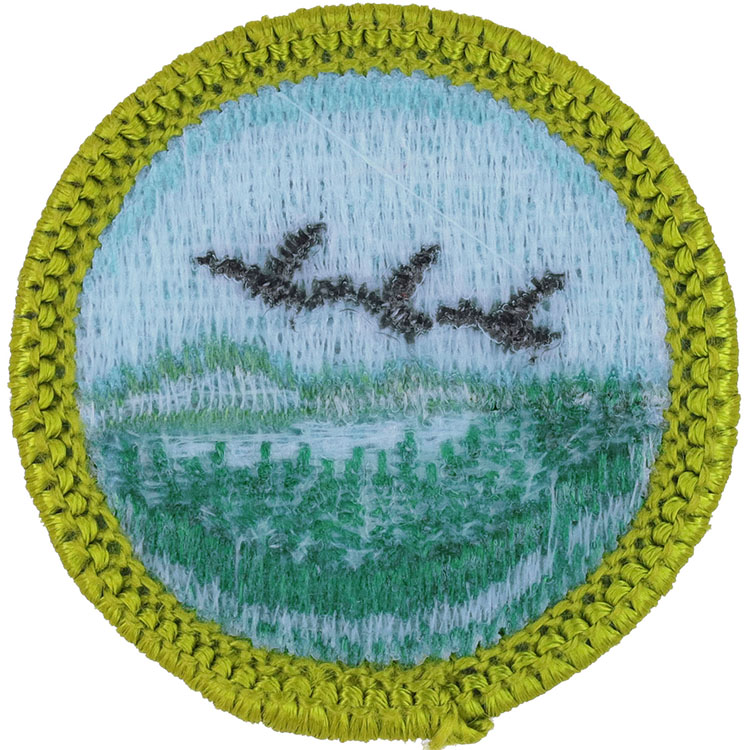
Fig. 2: FisMan-H1-Reverse
- Back: Blue plastic with waffle pattern
Item Name: Fish and Wildlife Management 1972 - 1975
Item ID: FisMan-H1
Collector Rating: 1
Pamphlets Used to Earn this Badge

Requirements June 1972 until September 1987
1. Describe the history of fish and wildlife conservation in America. Tell the development of the profession of fisheries management and wildlife management. Define fish and wildlife management. Give examples and dates of main legislation in this history. Explain why past fish and wildlife management has been concerned mainly with game animals.
2. Describe five different relationships between man and fish and wildlife. Use both good and bad examples.
3. Describe the four methods used in fish and wildlife management to maintain or increase numbers. Give an example of each for your state.
4. Name three local plants useful as wildlife food. Name three others useful as cover for wildlife.
5. Tell which agencies are responsible for fish and wildlife management in your state. Tell the difference between their authorities and responsibilities. Describe opportunities for a career in one of these. Explain how hunting, fishing, and trapping laws are set in your state.
6. Do ONE:
(a) Pick two 5-acre plots of different wildlife habitats. Get help from your counselor in this. Describe in writing the vegetation. List the wildlife and their numbers seen in two 3-hour visitation to each plot. Explain the differences you saw. Suggest ways changes could be made to help the wildlife. Tell what would happen if the numbers of one kind of animal doubled or tripled.
(b) Visit a wildlife refuge or management area or managed fishing waters. Interview the resident manager. Write at least 500 words on what is being done to improve the area for fish and wildlife.
(c) Visit a game farm or fish hatchery. Interview the resident manager. Write a report of at least 500 words on the place of game farm birds or hatchery fish in conservation.
(d) Go out 2 days with a commercial fisherman. Describe his catch. Tell methods used. Write about the importance of such fish to the world's economy and health.
(e) Work with your counselor on the following study. Study for 6 weeks the kinds of wildlife within several blocks of your home. List those good for your neighborhood. Also list those that are bad. Explain why you have put each on your lists. Suggest plans for increasing the good wildlife in your neighborhood. Tell what groups might help to do this.
(f) Attend a camp for a week or more where conservation is a major part of the program. Write about how you will use the things learned.
7. Do ONE of the following:
(a) Plan and carry out a project that will improve a water or land area for fish or wildlife. Work with your counselor or a fish and wildlife manager.
(b) Organize and run a neighborhood campaign to clean up places that harbor rats or other harmful wildlife.