-
Merit Badges
- Legend to identify Merit Badges
- 1910 British Merit Badges
- Square 1911 - 33
- Wide Crimped 1934 & 35
-
Narrow Tan Crimped 1936 - 42
- Tan Heavyweight Cloth with Silk Embroidery and Printed Back 1936 - 37
- Tan Heavyweight Cloth with Silk Embroidery and Plain Back 1937 - 38
- Tan Lightweight Cloth with Silk Embroidery and Plain Back 1938 - 39
- Tan Lightweight Cloth with Cotton Continuous Loop Embroidery and Plain Back 1939 - 42
- Tan Lightweight Cloth with Cotton Lockstitch Embroidery and Plain Back 1939 - 42
- Blue Background 1942 - 46
- Wartime 1942 - 46
- Khaki Narrow Crimped 1946 - 59
- Green Twill Gauze Back 1960 - 68
- Fully Embroidered Merrowed Edge 1960 - 72
- Unprinted Plastic Back 1972 - 01
- Printed Plastic Back 2002 - Current
-
Merit Badge Paper
- Merit Badge Applications
- Merit Badge Cards
-
Merit Badge Pamphlets
- Type 1 White Cover - Rectangle Drawing On Cover
- Type 2 White Cover 5-375" x 8" Title at Top
- Type 3A Tan Cover - 200 Fifth Avenue
- Type 3B Tan Cover - 2 line address New York City
- Type 3C Tan Cover - 2 line address New York N.Y.
- Type 3D Tan Cover - 1 line address New York N.Y.
- Type 4 Standing Scout Cover
- Type 5A War Cover
- Type 5B Red and White
- Type 6 Photo-Red Cover
- Type 7 Full Photo Cover or Bulls-eye Cover
- Type 8 Full Photo - Green Stripe Cover
- Type 9 Full Photo - Red Stripe Cover
- Type 10A Blue Stripe - Logo above bottom blue stripe - FDL centered
- Type 10B - Blue Stripe in bottom of photo area. FDL to left of text
- Special Covers
- Boy Craft Helps
- Merit Badge Counselor's Guides
-
Youth Position
- Junior Assistant Scoutmaster
- Senior Patrol Leader
- Assistant Senior Patrol Leader
- Patrol Leader
- Assistant Patrol Leader
- Troop Guide
- Scribe
- Quartermaster
- Instructor
- Chaplain Aide
- Den Chief
- Librarian
- Musician
- Webmaster
- Bugler
- Troop Historian
- Troop Representative
- Unit Representative
- Leadership Corps
- Honor Guard
- Leave No Trace Trainer
- Outdoor Ethics Guide
-
Patrol Medallions
- Patrol Medallions Introduction
- Legend to identify Patrol Medallions
- Patrol Shoulder Knot-Ribbons
- Felt Handmade Patrol Medallions
- Square Felt Patrol Medallions
- Round Broadcloth Patrol Medallions
- Red Twill Patrol Medallions
- Multi-Color Cloth Patrol Medallions
- Tan Cloth Patrol Medallions
- Patrol Medallion Back Patches
- Woodbadge Patrol Medallion
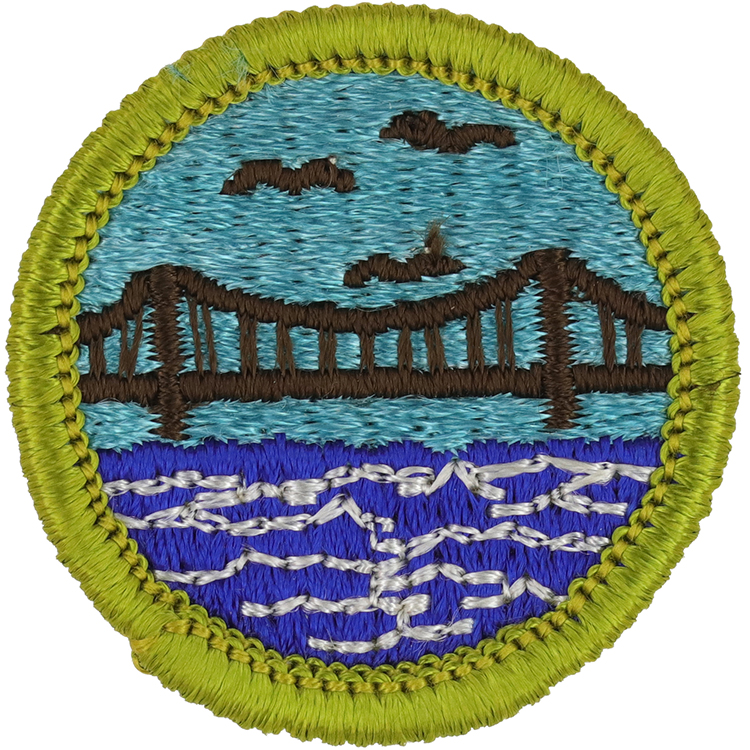
Fig. 1: Engine-G-Front
- Embroidery: Cotton thread
- Border: Merrowed
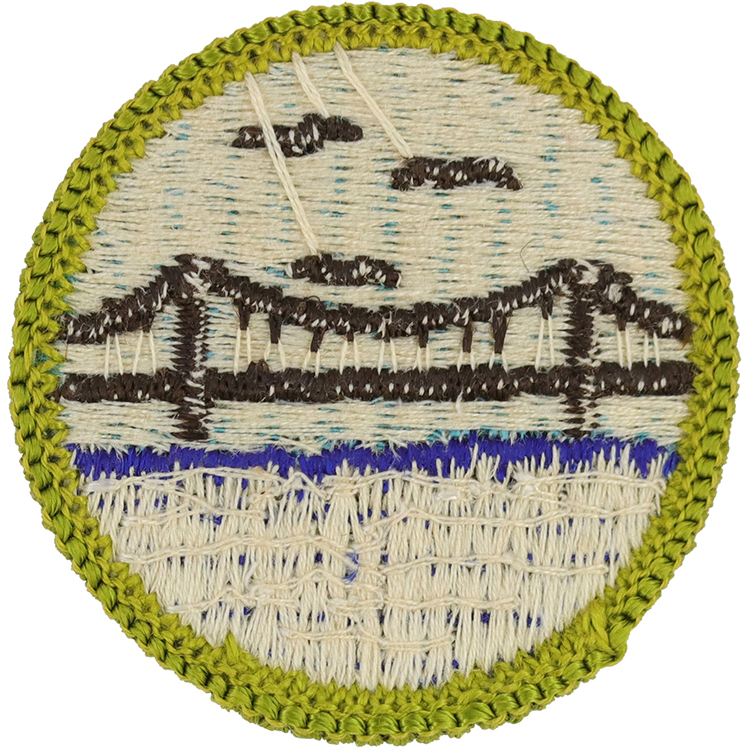
Fig. 2: Engine-G-Reverse
- Back: Starched cloth
Item Name: Engineering 1967 - 1972
Item ID: Engine-G
Collector Rating: 1
Pamphlets Used to Earn this Badge
Requirements September 1962 until January 1969
1. Know what high school preparation is required for admission to an accredited engineering college. Read "Faith of the Engineer" and point out in what ways this is similar to the Scout Oath.
2. Briefly describe the type of work done by an engineer and specifically know how the activity of the following branches of engineering benefit our society: aeronautical engineer, chemical engineer, civil engineer, mechanical engineer, electrical engineer, industrial engineer, mining engineer, and metallurgical engineer.
3. With the assistance of your merit badge counselor, make an inspection trip to a manufacturing or processing plant or an engineering project in your locality. Discuss the activities with an engineer on the project or plant. Prepare a report describing the inspection trip emphasizing those features that involve engineering knowledge and skills.
4. Make a slide rule, demonstrate its use in solving problems, and explain the mathematical basis for the rule.
5. Do three of the following:
(a) Design a cam, linkage, gear train, or other mechanical device for transforming motion; prepare a working drawing and build a working model from wood, plastic, or metal.
(b) Design and build a simple electrical or electronic device such as an amplifier, regenerative radio receiver, electric motor, simple analog summing circuits.
(c) Show by a diagram how the forces are distributed in a lock bridge (see Pioneering) carrying a 200 pound person at the center, if the two members are inclined 30 degrees above the horizontal.
(d) Explain with the aid of a diagram and calculate how much it would cost to pump 100,000 gallons of water from sea level into a reservoir whose surface is at 550 feet elevation, if electric power costs 6 cents per kwhr, and the combined pump and motor efficiency was 80 percent and 5 percent of the water was lost in leaks along the way.
(e) Write a report explaining how energy in a fuel is converted into useful work in a typical machine such as an automobile, diesel tractor, drilling machine, airplane, rocket, or turbine engine. Use sketches and diagrams to illustrate the process.
(f) Select with the advice of the merit badge counselor a busy street or other traffic artery in your community. Go to the location and make a study of the traffic flow both in periods of heavy and light traffic. Obtain from the appropriate city official the predicted increase in automobiles and population over the next 5 years. Report on the investigation, including your plan of how the traffic situation 5 years hence might be alleviated at the particular location.
(g) Set up a distilling apparatus with and without a fractionating column. Draw a graph of product purity versus percent distilled. Explain why better results are obtained with a fractionating column.
(h) Demonstrate how to use one device for obtaining engineering measurements such as transit, builder's level, micrometer calipers, Wheatstone bridge, potentiometer, thermocouple for measuring temperatures, pilot tube for measuring gas or liquid velocities, stroboscopic tachometer, oscilloscope, frequency counter.
(i) Set up a device for measuring heat transfer. Draw a graph plotting heat transfer versus rate of flow. Explain why better heat transfer is obtained with a high rate of flow than with a low rate of flow.
(j) In place of one activity under this requirement, the merit badge counselor may choose similar projects that will make use of engineering activities in the local area.
Requirements January 1969 until June 1972
1. Know what high school preparation is required for admission to an accredited engineering college. Read "Faith of the Engineer" and point out in what ways this is similar to the Scout Oath.
2. Briefly describe the type of work done by an engineer and specifically know how the activity of the following branches of engineering benefit our society: aeronautical engineer, chemical engineer, civil engineer, mechanical engineer, electrical engineer, industrial engineer, mining engineer, and metallurgical engineer.
3. With the assistance of your merit badge counselor, make an inspection trip to a manufacturing or processing plant or an engineering project in your locality. Discuss the activities with an engineer on the project or plant. Prepare a report describing the inspection trip emphasizing those features that involve engineering knowledge and skills.
4. Make a slide rule, demonstrate its use in solving problems, and explain the mathematical basis for the rule.
5. Do THREE of the following nine projects:
(a) Design a cam, linkage, gear train, or other mechanical device for transforming motion; prepare a working drawing and build a working model from wood, plastic, or metal.
(b) Build a simple electrical or electronic device such as an oscillator, regenerative radio receiver, electric motor, or simple analog summing circuit. (Kits may be used.)
(c) Show by a diagram how the forces are distributed in a king post truss bridge carrying a 200-pound person at the center, if the two members are inclined 30 degrees above the horizontal.
(d) Explain with the aid of a diagram and calculate how much it would cost to pump 100,000 gallons of water from sea level into a reservoir whose surface is at 550 feet elevation, if electric power costs 6 cents per kwhr, and the combined pump and motor efficiency was 80 percent and 5 percent of the water was lost in leaks along the way.
(e) Write a report explaining how energy in a fuel is converted into useful work in a typical machine such as an automobile, diesel tractor, drilling machine, airplane, rocket, or turbine engine. Use sketches and diagrams to illustrate the process.
(f) Select with the advice of the merit badge counselor a busy street or other traffic artery in your community. Go to the location and make a study of the traffic flow both in periods of heavy and light traffic. Obtain from the appropriate city official the predicted increase in automobiles and population over the next 5 years. Report on the investigation, including your plan of how the traffic situation 5 years hence might be alleviated at the particular location.
(g) Set up a distilling apparatus with and without a fractionating column. Draw a graph of product purity versus percent distilled. Explain why better results are obtained with a fractionating column.
(h) Demonstrate how to use one device for obtaining engineering measurements such as transit, builder's level, micrometer calipers, Wheatstone bridge, potentiometer, thermocouple for measuring temperatures, pilot tube for measuring gas or liquid velocities, stroboscopic tachometer, oscilloscope, frequency counter.
(i) Set up a device for measuring heat transfer. Draw a graph plotting heat transfer versus rate of flow. Explain why better heat transfer is obtained with a high rate of flow than with a low rate of flow.
(j) In place of one activity under this requirement, the merit badge counselor may choose similar projects that will make use of engineering activities in the local area.