-
Merit Badges
- Legend to identify Merit Badges
- 1910 British Merit Badges
- Square 1911 - 33
- Wide Crimped 1934 & 35
-
Narrow Tan Crimped 1936 - 42
- Tan Heavyweight Cloth with Silk Embroidery and Printed Back 1936 - 37
- Tan Heavyweight Cloth with Silk Embroidery and Plain Back 1937 - 38
- Tan Lightweight Cloth with Silk Embroidery and Plain Back 1938 - 39
- Tan Lightweight Cloth with Cotton Continuous Loop Embroidery and Plain Back 1939 - 42
- Tan Lightweight Cloth with Cotton Lockstitch Embroidery and Plain Back 1939 - 42
- Blue Background 1942 - 46
- Wartime 1942 - 46
- Khaki Narrow Crimped 1946 - 59
- Green Twill Gauze Back 1960 - 68
- Fully Embroidered Merrowed Edge 1960 - 72
- Unprinted Plastic Back 1972 - 01
- Printed Plastic Back 2002 - Current
-
Merit Badge Paper
- Merit Badge Applications
- Merit Badge Cards
-
Merit Badge Pamphlets
- Type 1 White Cover - Rectangle Drawing On Cover
- Type 2 White Cover 5-375" x 8" Title at Top
- Type 3A Tan Cover - 200 Fifth Avenue
- Type 3B Tan Cover - 2 line address New York City
- Type 3C Tan Cover - 2 line address New York N.Y.
- Type 3D Tan Cover - 1 line address New York N.Y.
- Type 4 Standing Scout Cover
- Type 5A War Cover
- Type 5B Red and White
- Type 6 Photo-Red Cover
- Type 7 Full Photo Cover or Bulls-eye Cover
- Type 8 Full Photo - Green Stripe Cover
- Type 9 Full Photo - Red Stripe Cover
- Type 10A Blue Stripe - Logo above bottom blue stripe - FDL centered
- Type 10B - Blue Stripe in bottom of photo area. FDL to left of text
- Special Covers
- Boy Craft Helps
- Merit Badge Counselor's Guides
-
Youth Position
- Junior Assistant Scoutmaster
- Senior Patrol Leader
- Assistant Senior Patrol Leader
- Patrol Leader
- Assistant Patrol Leader
- Troop Guide
- Scribe
- Quartermaster
- Instructor
- Chaplain Aide
- Den Chief
- Librarian
- Musician
- Webmaster
- Bugler
- Troop Historian
- Troop Representative
- Unit Representative
- Leadership Corps
- Honor Guard
- Leave No Trace Trainer
- Outdoor Ethics Guide
-
Patrol Medallions
- Patrol Medallions Introduction
- Legend to identify Patrol Medallions
- Patrol Shoulder Knot-Ribbons
- Felt Handmade Patrol Medallions
- Square Felt Patrol Medallions
- Round Broadcloth Patrol Medallions
- Red Twill Patrol Medallions
- Multi-Color Cloth Patrol Medallions
- Tan Cloth Patrol Medallions
- Patrol Medallion Back Patches
- Woodbadge Patrol Medallion
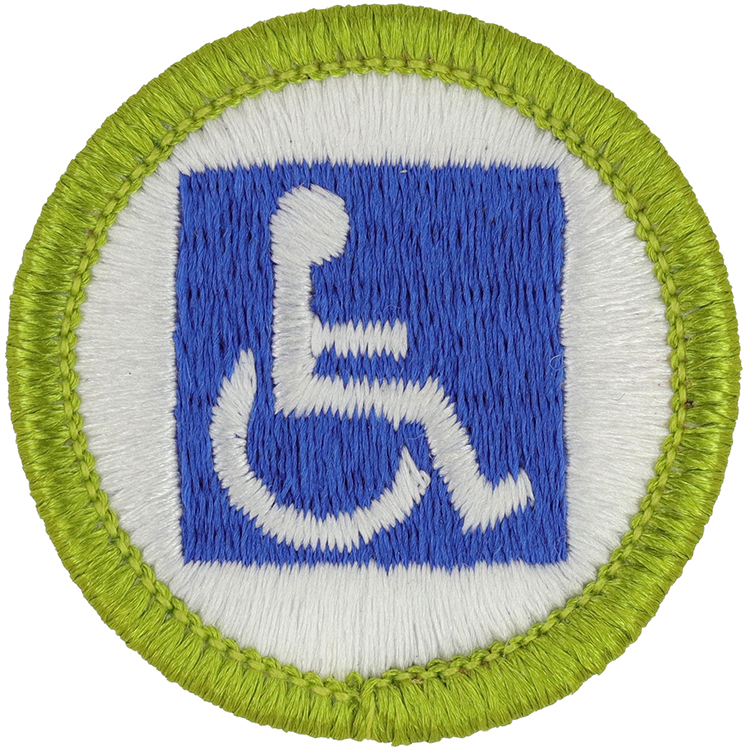
Fig. 1: DisAwa-J1-Front
- Embroidery: Rayon thread
- Border: Merrowed
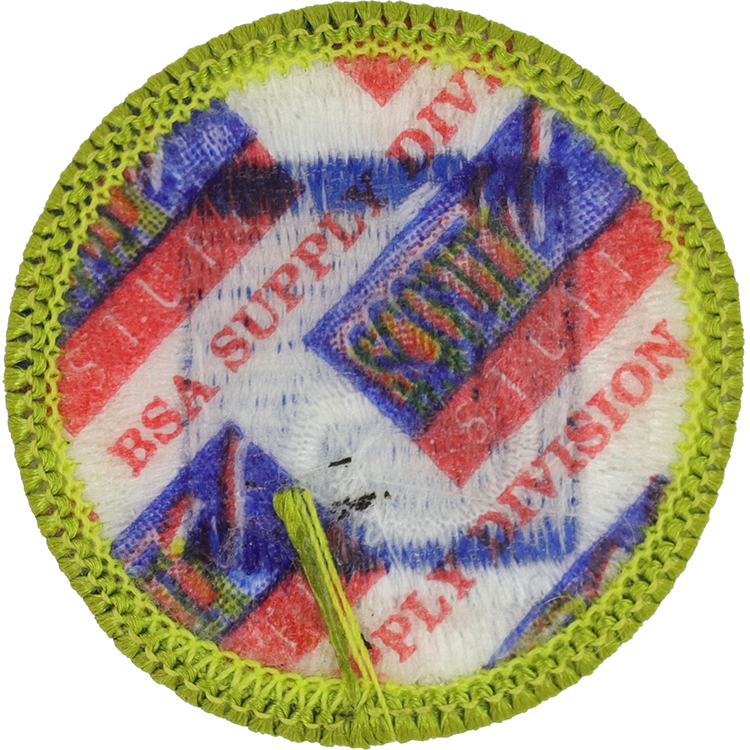
Fig. 2: DisAwa-J1-Reverse
- Back: Scout Stuff imprint
Item Name: Disabilities Awareness 2002 - 2009
Item ID: DisAwa-J1
Collector Rating: 1
Pamphlets Used to Earn this Badge
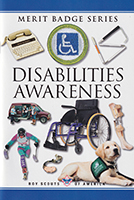
Requirements September 1993 until January 2006
1. Visit an agency that works with physically, mentally, emotionally, or educationally disabled people. Collect publications about the agency's activities on behalf of its members. Learn what is being done through training, employment, and education of their members.
2. Speak with a person with a disability or read an article or book by or about a person with a disability and report to your counselor what you learned about that person's experiences in dealing with a disability.
3. Spend fifteen hours within a three-month period in one of the following ways:
(a) Visit a Cub Scout pack or Boy Scout troop that works with disabilities. Learn about their activities, assist the leaders, and work with the members of the group.
(b) Enlist the help of your unit leader and the parents or guardians of someone with a disabling condition and invite the disabled individual to join your troop, team, or post. Help him or her become a participating member.
4. Locate and study literature about the accessibility of nonaccessibility of public and private places to disabled individuals. Observe and discuss with your counselor the accessibility or nonaccessibility for disabled people in the following:
(a) Five places with good accessibility.
(b) Five places with poor accessibility.
(c) Your school, church, synagogue, or mosque.
(d) Your Scout camping site.
5. Display in a public place the material you have collected for the other requirements of this merit badge so that others canbe made more aware of citizens with disabilities.
6. Make a commitment to your merit badge counselor as to what you will do in the future for people with disabling conditions, Discuss how your awareness has changed as a result of what you learned.
Requirements January 2006 until January 2014
1. Discuss with your counselor proper disability etiquette and person-first language. Explain why these are important.
2. Visit an agency that works with people with physical, mental, emotional, or educational disabilities. Collect and read information about the agency’s activities. Learn about opportunities its members have for training, employment, and education.
3. Do Two of the following:
(a) Talk to a Scout who has a disability and learn about his experience taking part in Scouting activities and earning different merit badges.
(b) Talk to an individual who has a disability and learn about this person’s experiences and the activities in which this person likes to participate.
(c) Learn how people with disabilities take part in a particular adaptive sport and recreational activity. Discuss what you have learned with your counselor.
(d) Learn about independent living aids such as service animals, canes, and teletypewriters TTYs). Discuss with your counselor how people use such aids.
4. Visit TWO of the following locations and take notes about the accessibility to people with disabilities. In your notes, give examples of five things that could be done to improve upon the site and five things about the site that make it friendly to people with disabilities. Discuss your observations with your counselor.
(a) Your school
(b) Your place of worship
(c) Your Scout camping site
(d) A public exhibit or attraction (such as a theater, museum, or park)
5. Explain what advocacy is. Do ONE of the following advocacy activities:
(a) Present a counselor-approved awareness program to a Cub Scout pack or other group. During your presentation, explain and use person-first language.
(b) Find out about disability awareness education programs in your school or school system, or conduct a disability advocacy agency. Volunteer with a program or agency for eight hours.
(c) Using resources such as disability advocacy agencies, government agencies, the Internet (with your parent’s permission), and news magazines, learn about myths and misconceptions that influence the general public’s understanding of people with disabilities and learn the facts about each myth. Share you list with your counselor, then use it to make a presentation to a Cub Scout pack or other group.
6. Make a commitment to your merit badge counselor describing what you will do to show a positive attitude about people with disabilities and to encourage positive attitudes among others. Discuss how your awareness has changed as a result of what you have learned
7. Name five professions that provide services to people with disabilities. Pick one that interests you and find out the education, training, and experience required for this profession. Discuss what you learn with your counselor, and tell why this profession interests you.