-
Merit Badges
- Legend to identify Merit Badges
- 1910 British Merit Badges
- Square 1911 - 33
- Wide Crimped 1934 & 35
-
Narrow Tan Crimped 1936 - 42
- Tan Heavyweight Cloth with Silk Embroidery and Printed Back 1936 - 37
- Tan Heavyweight Cloth with Silk Embroidery and Plain Back 1937 - 38
- Tan Lightweight Cloth with Silk Embroidery and Plain Back 1938 - 39
- Tan Lightweight Cloth with Cotton Continuous Loop Embroidery and Plain Back 1939 - 42
- Tan Lightweight Cloth with Cotton Lockstitch Embroidery and Plain Back 1939 - 42
- Blue Background 1942 - 46
- Wartime 1942 - 46
- Khaki Narrow Crimped 1946 - 59
- Green Twill Gauze Back 1960 - 68
- Fully Embroidered Merrowed Edge 1960 - 72
- Unprinted Plastic Back 1972 - 01
- Printed Plastic Back 2002 - Current
-
Merit Badge Paper
- Merit Badge Applications
- Merit Badge Cards
-
Merit Badge Pamphlets
- Type 1 White Cover - Rectangle Drawing On Cover
- Type 2 White Cover 5-375" x 8" Title at Top
- Type 3A Tan Cover - 200 Fifth Avenue
- Type 3B Tan Cover - 2 line address New York City
- Type 3C Tan Cover - 2 line address New York N.Y.
- Type 3D Tan Cover - 1 line address New York N.Y.
- Type 4 Standing Scout Cover
- Type 5A War Cover
- Type 5B Red and White
- Type 6 Photo-Red Cover
- Type 7 Full Photo Cover or Bulls-eye Cover
- Type 8 Full Photo - Green Stripe Cover
- Type 9 Full Photo - Red Stripe Cover
- Type 10A Blue Stripe - Logo above bottom blue stripe - FDL centered
- Type 10B - Blue Stripe in bottom of photo area. FDL to left of text
- Special Covers
- Boy Craft Helps
- Merit Badge Counselor's Guides
-
Youth Position
- Junior Assistant Scoutmaster
- Senior Patrol Leader
- Assistant Senior Patrol Leader
- Patrol Leader
- Assistant Patrol Leader
- Troop Guide
- Scribe
- Quartermaster
- Instructor
- Chaplain Aide
- Den Chief
- Librarian
- Musician
- Webmaster
- Bugler
- Troop Historian
- Troop Representative
- Unit Representative
- Leadership Corps
- Honor Guard
- Leave No Trace Trainer
- Outdoor Ethics Guide
-
Patrol Medallions
- Patrol Medallions Introduction
- Legend to identify Patrol Medallions
- Patrol Shoulder Knot-Ribbons
- Felt Handmade Patrol Medallions
- Square Felt Patrol Medallions
- Round Broadcloth Patrol Medallions
- Red Twill Patrol Medallions
- Multi-Color Cloth Patrol Medallions
- Tan Cloth Patrol Medallions
- Patrol Medallion Back Patches
- Woodbadge Patrol Medallion
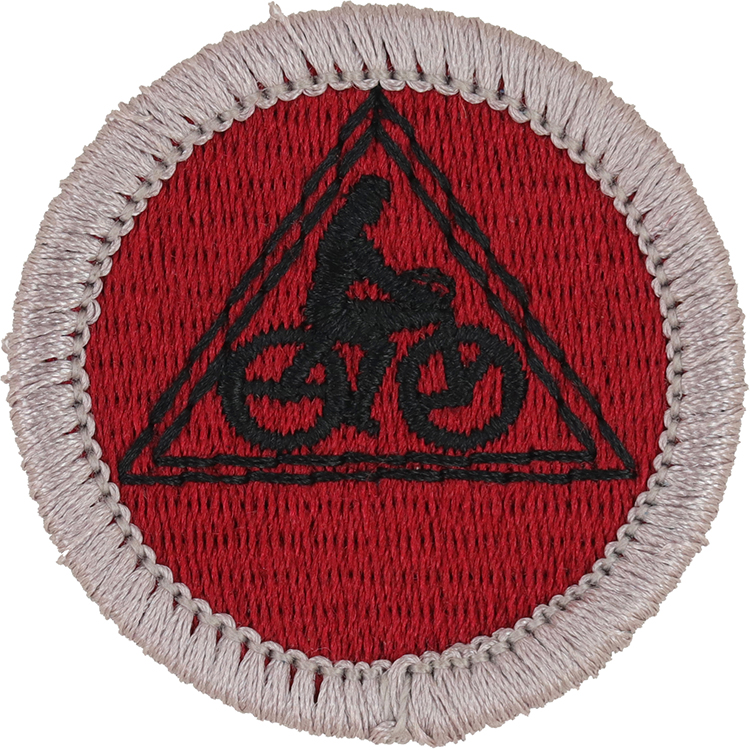
Fig. 1: Cyclin-L1-Front
- Embroidery: Rayon thread
- Border: Merrowed
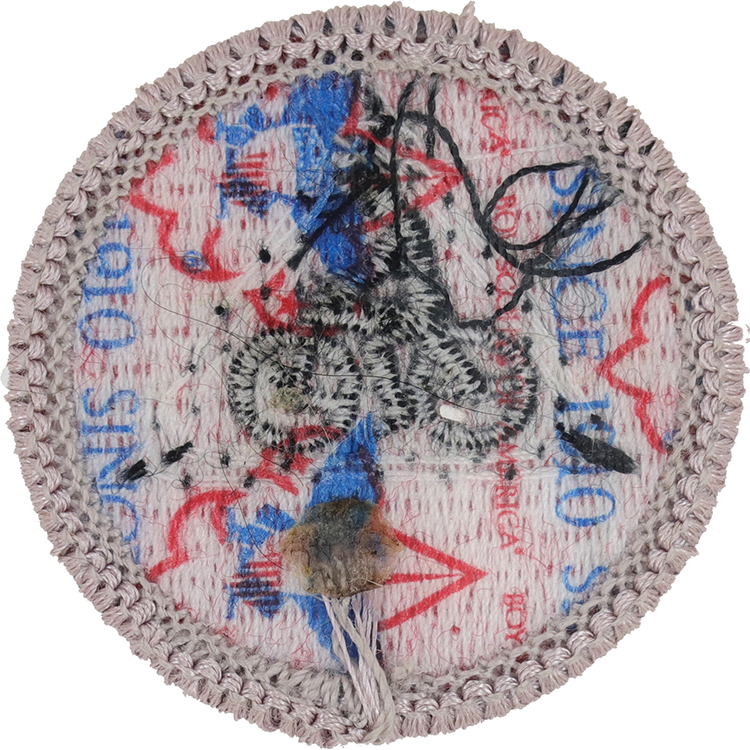
Fig. 2: Cyclin-L1-Reverse
- Back: Since 1910 imprint with large Tenderfoot image
Item Name: Cycling 2014 - Current
Item ID: Cyclin-L1
Collector Rating: 1
Pamphlets Used to Earn this Badge

Requirements January 2014 until Current
1. Do the following:
- Explain to your counselor the most likely hazards you may encounter while participating in cycling activities and what you should do to anticipate, help prevent, mitigate, and respond to these hazards.
- Show that you know first aid for injuries or illnesses that could occur while cycling, including cuts, scratches, blisters, sunburn, heat exhaustion, heatstroke, hypothermia, frostbite, dehydration, insect stings, tick bites, and snake bite. Explain to your counselor why you should be able to identify the poisonous plants and poisonous animals that are found in your area.
- Explain the importance of wearing a properly sized and fitted helmet while cycling, and of wearing the right clothing for the weather. Know the BSA Bike Safety Guidelines.
2. Clean and adjust a bicycle. Prepare it for inspection using a bicycle safety checklist. Be sure the bicycle meets local laws.
3. Show your bicycle to your counselor for inspection. Point out the adjustments or repairs you have made. Do the following:
- Show all points that need regular lubrication.
- Show points that should be checked regularly to make sure the bicycle is safe to ride.
- Show how to adjust brakes, seat level and height, and stirring tube.
4. Describe how to bike safely with foot brakes and with hand brakes.
5. Show how to repair a flat by removing the tire, replacing or patching the tube, and remounting the tire.
6. Describe your state and local traffic laws for bicycles. Compare them with motor-vehicle laws.
7. Using the BSA buddy system, complete all of the requirements for one of the following options: Road hiking or mountain biking*.
Option A: Road to Biking
(a) Take a road test with your counselor and demonstrate the following:
(1) Properly mount, paddle, and break, including emergency stops.
(2) On an urban street with light traffic, properly execute a left turn from the center of the street; also demonstrate an alternate left turn technique used during periods of heavy traffic.
(3) Properly execute a right turn.
(4) Demonstrate appropriate actions at a right-turn-only-lane when you are continuing straight.
(5) Show proper curbside and road edge riding. Show how to ride safely along a row of parked cars.
(6) Cross railroad tracks properly.
(b) Avoiding main highways, take two rides of 10 miles each, two rides of 15 miles each, and two rides of 25 miles each. You must make a report of the rides taken. List dates for the routes traveled, and interesting things seen.
(c) After completing requirement be for the road biking option, do one of the following:
(1) Lay out on a road map a 50 mile trip. Stay away from main highways. Using your map, make this ride in eight hours.
(2) Participate in an organized bike tour of at least 50 miles. Make this ride in eight hours. Afterward, use the tours cue sheet to make a map of the ride.
Option B: Mountain Biking
(a) Take a trail ride with your counselor and demonstrate the following:
(1) Properly mount, pedal, and break, including emergency stops.
(2) Show shifting skills as applicable to climes and obstacles.
(3) Show proper trail etiquette to hikers and others cyclist, including yield the right-of-way.
(4) Show proper technique riding up and down hills.
(5) Demonstrate how to properly cross an obstacle by either going over the obstacle on your bike or dismounting your bike and crossing over or around the obstacle.
(6) Cross rocks, gravel, and roots properly.
(b) Describe the rules of trail writing, including how to know when a trail is unsuitable for writing.
(c) On trails approved by your counselor, take two rides of 2 miles each, two rides of 5 miles each, and two rides of 8 miles each. You must make a report of the rides taken. List dates for the routes traveled, and interesting things seen.
(d) After fulfilling the previous requirement, lay out on a map a 22 mile trip. You may include multiple trail systems, if needed. Stay away from main highways. Using your map, make this ride in six hours.