-
Merit Badges
- Legend to identify Merit Badges
- 1910 British Merit Badges
- Square 1911 - 33
- Wide Crimped 1934 & 35
-
Narrow Tan Crimped 1936 - 42
- Tan Heavyweight Cloth with Silk Embroidery and Printed Back 1936 - 37
- Tan Heavyweight Cloth with Silk Embroidery and Plain Back 1937 - 38
- Tan Lightweight Cloth with Silk Embroidery and Plain Back 1938 - 39
- Tan Lightweight Cloth with Cotton Continuous Loop Embroidery and Plain Back 1939 - 42
- Tan Lightweight Cloth with Cotton Lockstitch Embroidery and Plain Back 1939 - 42
- Blue Background 1942 - 46
- Wartime 1942 - 46
- Khaki Narrow Crimped 1946 - 59
- Green Twill Gauze Back 1960 - 68
- Fully Embroidered Merrowed Edge 1960 - 72
- Unprinted Plastic Back 1972 - 01
- Printed Plastic Back 2002 - Current
-
Merit Badge Paper
- Merit Badge Applications
- Merit Badge Cards
-
Merit Badge Pamphlets
- Type 1 White Cover - Rectangle Drawing On Cover
- Type 2 White Cover 5-375" x 8" Title at Top
- Type 3A Tan Cover - 200 Fifth Avenue
- Type 3B Tan Cover - 2 line address New York City
- Type 3C Tan Cover - 2 line address New York N.Y.
- Type 3D Tan Cover - 1 line address New York N.Y.
- Type 4 Standing Scout Cover
- Type 5A War Cover
- Type 5B Red and White
- Type 6 Photo-Red Cover
- Type 7 Full Photo Cover or Bulls-eye Cover
- Type 8 Full Photo - Green Stripe Cover
- Type 9 Full Photo - Red Stripe Cover
- Type 10A Blue Stripe - Logo above bottom blue stripe - FDL centered
- Type 10B - Blue Stripe in bottom of photo area. FDL to left of text
- Special Covers
- Boy Craft Helps
- Merit Badge Counselor's Guides
-
Youth Position
- Junior Assistant Scoutmaster
- Senior Patrol Leader
- Assistant Senior Patrol Leader
- Patrol Leader
- Assistant Patrol Leader
- Troop Guide
- Scribe
- Quartermaster
- Instructor
- Chaplain Aide
- Den Chief
- Librarian
- Musician
- Webmaster
- Bugler
- Troop Historian
- Troop Representative
- Unit Representative
- Leadership Corps
- Honor Guard
- Leave No Trace Trainer
- Outdoor Ethics Guide
-
Patrol Medallions
- Patrol Medallions Introduction
- Legend to identify Patrol Medallions
- Patrol Shoulder Knot-Ribbons
- Felt Handmade Patrol Medallions
- Square Felt Patrol Medallions
- Round Broadcloth Patrol Medallions
- Red Twill Patrol Medallions
- Multi-Color Cloth Patrol Medallions
- Tan Cloth Patrol Medallions
- Patrol Medallion Back Patches
- Woodbadge Patrol Medallion
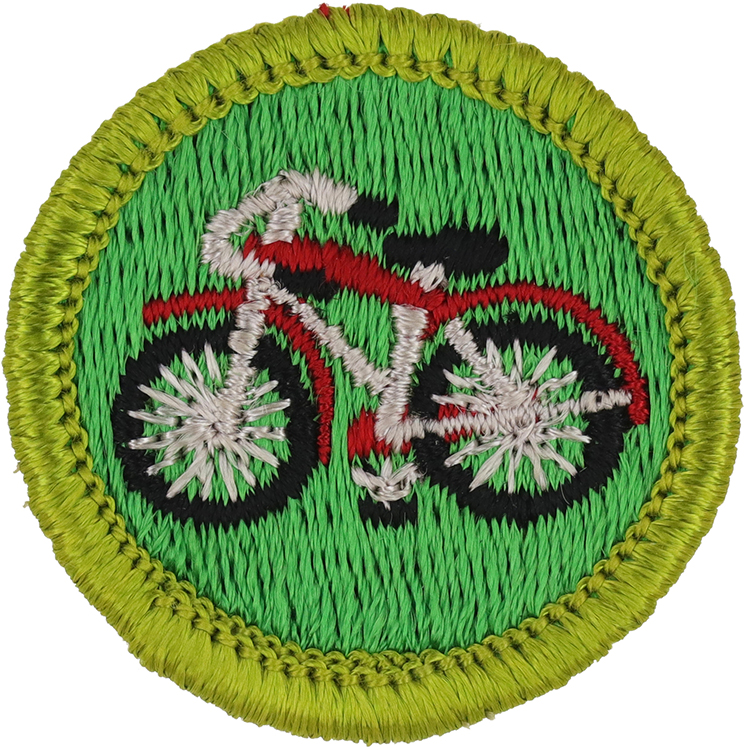
Fig. 1: Cyclin-G-Front
- Embroidery: Cotton thread
- Border: Merrowed
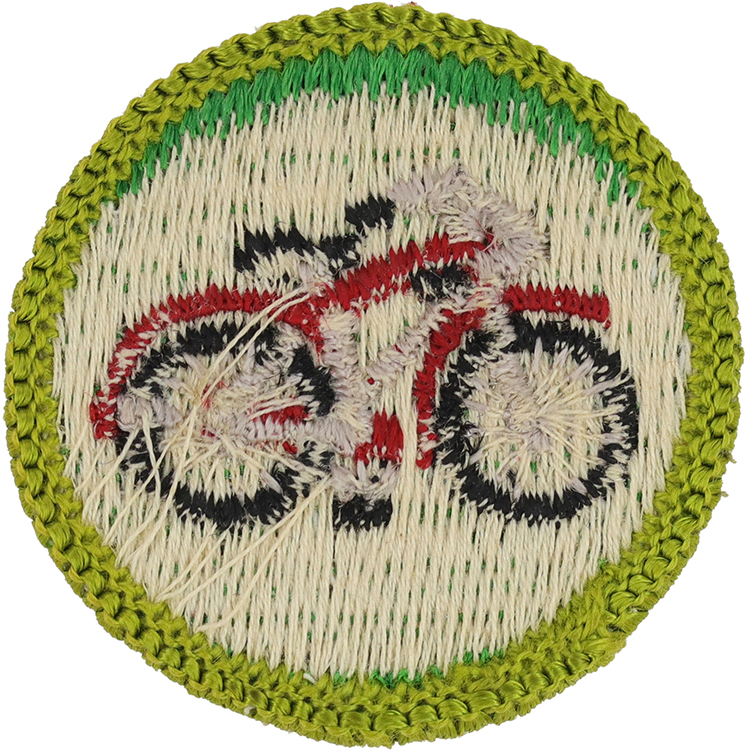
Fig. 2: Cyclin-G-Reverse
- Back: Starched cloth
Item Name: Cycling 1969 - 1972
Item ID: Cyclin-G
Collector Rating: 1
Pamphlets Used to Earn this Badge
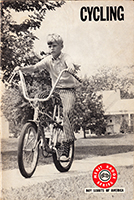
Requirements January 1969 until June 1972
1. Clean and properly adjust a bicycle, preparing it for inspection according to the checklist in the merit badge pamphlet (or one obtained from your counselor). Be sure the bicycle conforms with your local laws for bicycles.
2. Submit your bicycle to your counselor for inspection, pointing out the adjustments or repairs you have made, and do the following:
(a) Indicate all points that need lubricating regularly.
(b) Indicate points that should be inspected regularly to make sure the bicycle is safe to ride.
(c) Show how to adjust chain tension, brakes, seat level and height, steering post.
3. Describe safe braking techniques for foot brakes and for hand brakes.
4. Using an old bicycle tire, show how to repair a puncture.
5. Demonstrate the following techniques for safe and efficient riding:
(a) Proper mounting, pedaling, braking (include emergency stops using both feet for foot brakes or with front and rear hand brakes).
(b) Ride a straight line. Be able to ride at least 100 feet between straight, parallel lines 6 inches apart, 4 our of 5 times.
(c) Show proper curbside and road edge riding; to watch for rear, side, and oncoming traffic.
(d) Maneuvering. Ride an obstacle course to the satisfaction of your counselor, changing from very slow to reasonably higher speed. Do a complete turn in a 15-foot road or driveway.
(e) Hand signals.
6. Describe local traffic regulations for bicycles, comparing them with motor-vehicle regulations. Know bicycle safety code.
7. Avoiding insofar as possible heavily traveled highways, ride 25 consecutive miles on each of 2 days each month for a period of 3 months; in other words, six rides of 25 miles each during the 3 months. You must submit to the merit badge counselor a report of the rides taken, including date, routes traveled, and interesting things observed.*
8. After the 3-month conditioning period in Requirement 7, lay out on a road map a 50-mile route, avoiding heavily traveled highways insofar as possible. Using your map, ride this route in an 8-hour period.
* Bicycle must be equipped with all necessary safety features and be registered as required by your State and local traffic laws.