-
Merit Badges
- Legend to identify Merit Badges
- 1910 British Merit Badges
- Square 1911 - 33
- Wide Crimped 1934 & 35
-
Narrow Tan Crimped 1936 - 42
- Tan Heavyweight Cloth with Silk Embroidery and Printed Back 1936 - 37
- Tan Heavyweight Cloth with Silk Embroidery and Plain Back 1937 - 38
- Tan Lightweight Cloth with Silk Embroidery and Plain Back 1938 - 39
- Tan Lightweight Cloth with Cotton Continuous Loop Embroidery and Plain Back 1939 - 42
- Tan Lightweight Cloth with Cotton Lockstitch Embroidery and Plain Back 1939 - 42
- Blue Background 1942 - 46
- Wartime 1942 - 46
- Khaki Narrow Crimped 1946 - 59
- Green Twill Gauze Back 1960 - 68
- Fully Embroidered Merrowed Edge 1960 - 72
- Unprinted Plastic Back 1972 - 01
- Printed Plastic Back 2002 - Current
-
Merit Badge Paper
- Merit Badge Applications
- Merit Badge Cards
-
Merit Badge Pamphlets
- Type 1 White Cover - Rectangle Drawing On Cover
- Type 2 White Cover 5-375" x 8" Title at Top
- Type 3A Tan Cover - 200 Fifth Avenue
- Type 3B Tan Cover - 2 line address New York City
- Type 3C Tan Cover - 2 line address New York N.Y.
- Type 3D Tan Cover - 1 line address New York N.Y.
- Type 4 Standing Scout Cover
- Type 5A War Cover
- Type 5B Red and White
- Type 6 Photo-Red Cover
- Type 7 Full Photo Cover or Bulls-eye Cover
- Type 8 Full Photo - Green Stripe Cover
- Type 9 Full Photo - Red Stripe Cover
- Type 10A Blue Stripe - Logo above bottom blue stripe - FDL centered
- Type 10B - Blue Stripe in bottom of photo area. FDL to left of text
- Special Covers
- Boy Craft Helps
- Merit Badge Counselor's Guides
-
Youth Position
- Junior Assistant Scoutmaster
- Senior Patrol Leader
- Assistant Senior Patrol Leader
- Patrol Leader
- Assistant Patrol Leader
- Troop Guide
- Scribe
- Quartermaster
- Instructor
- Chaplain Aide
- Den Chief
- Librarian
- Musician
- Webmaster
- Bugler
- Troop Historian
- Troop Representative
- Unit Representative
- Leadership Corps
- Honor Guard
- Leave No Trace Trainer
- Outdoor Ethics Guide
-
Patrol Medallions
- Patrol Medallions Introduction
- Legend to identify Patrol Medallions
- Patrol Shoulder Knot-Ribbons
- Felt Handmade Patrol Medallions
- Square Felt Patrol Medallions
- Round Broadcloth Patrol Medallions
- Red Twill Patrol Medallions
- Multi-Color Cloth Patrol Medallions
- Tan Cloth Patrol Medallions
- Patrol Medallion Back Patches
- Woodbadge Patrol Medallion

Fig. 1: CriPre-J1-Front
- Embroidery: Rayon thread
- Border: Merrowed
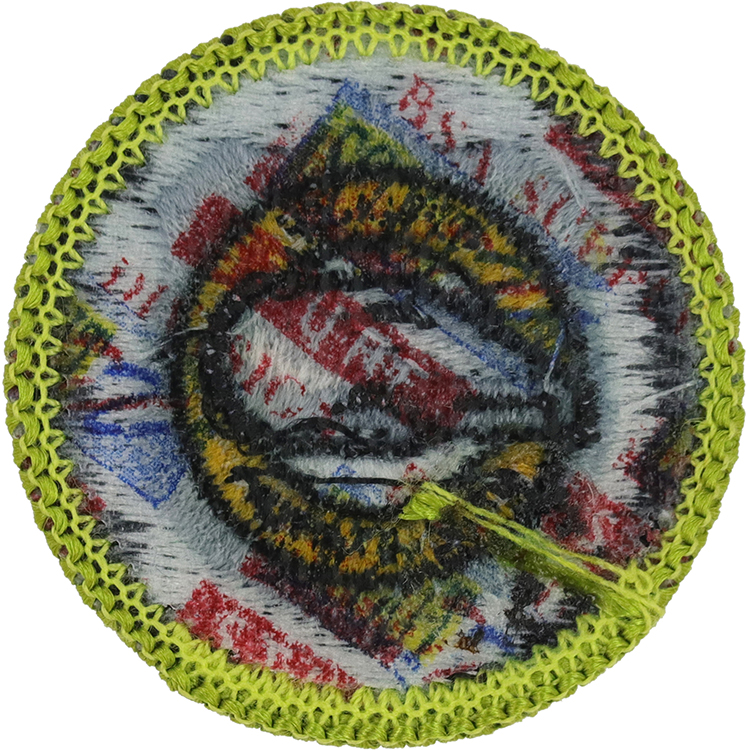
Fig. 2: CriPre-J1-Reverse
- Back: Scout Stuff imprint
Item Name: Crime Prenvention 2002 - 2009
Item ID: CriPre-J1
Collector Rating: 1
Pamphlets Used to Earn this Badge
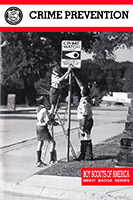
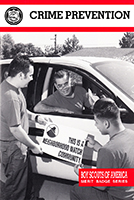
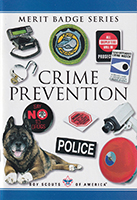
Requirements September 1996 until January 2006
1. Define “crime” and “crime prevention.”
2. Prepare a notebook of newspaper and othe clippings that addresses crime and crime prevention efforts in your community.
3. Do the following:
(a) Talk to a store owner or manager about the impact of crime on the way the store is run and how crime affects prices.
(b) Talk with a school teacher, principle, or school officer about the impact of crime in your school.
(c) Explain what a neighborhood watch is and how ti can benefit your neighborhood.
(d) Define white-collar crime and explain how it affects all citizens of the United States.
4. Discuss the following with your counselor:
(a) The role of a sheriff’s department or police department in crime prevention
(b) The role of citizens, including youth, in crime prevention
(c) Gangs and their impact on the community
(d) When and how to report a crime
(e) The role and value of laws in society
5. Do the following:
(a) Inspect your neighborhood for opportunities that may lead to crime. Learn how to do a crime prevention survey.
(b) Using the checklist in this pamphlet, conduct a security survey of your home and discuss the results with your family.
6. Teach your family or patrol members how to protect themselves from crime at home, at school, in your community, and while traveling.
7. Visit a jail or detention facility. Discuss your experience with your counselor.
8. Discuss with your counselor the purpose and operation of agencies in your community that help law enforcement personal prevent crime, and how the agencies help in emergency situations.
9. Discuss the following with your counselor:
(a) How drug abuse awareness programs, such as “Drugs: A deadly Game.” Help prevent crime
(b) Why alcohol, tobacco, and marijuana are sometimes called “gateway drugs” and how “gateway drugs” can lead to the use of other drugs
(c) Three resources in your city where a person with a drug problem or drug-related problem can go for help
(d) How the illegal sale and use of drugs lead to other crimes
(e) How to recognize child abuse
(f) The “three Rs” of Youth Protection
Requirements January 2006 until January 2018
1. Discuss the role and value of laws in society with regard to crime and crime prevention. Include in your discussion the definitions of “crime” and “crime prevention.”
2. Prepare a notebook of newspaper and other clippings that address crime and crime prevention effoets in your community.
3. Discuss the following with your counselor:
(a) The role of citizens, including youth, in crime prevention.
(b) Gangs and their impact on the community.
(c) When and how to report a crime.
4. After doing EACH of the following, discuss with your counselor what you have learned.
(a) Inspect your neighborhood for opportunities that may lead to crime. Learn how to do a crime prevention survey.
(b) Using the checklist in this pamphlet, conduct a security survey of your home and discuss the results with your family.
5. Teach your family or patrol members how to protect themselves from crime at home, at school, in your community, and while traveling.
6. Help raise awareness about one school safety issue facing students by doing ONE of the following:
(a) Create a poster for display on a school bulletin board.
(b) With permission from school officials, create a pagelong public service announcement that could be read over the public address system at school or posted on the student’s Web site.
(c) Make a presentation to a group such as a Cub Scout den that addresses the issue.
7. Do ONE of the following:
(a) Assist in the planning and organization of a crime prevention program on your community such as Neighborhood Watch, Community Watch, or Crime stoppers. Explain how this program can benefit your neighborhood.
(b) With your parent’s and counselor’s approval, visit a jail or detention facility or a criminal court hearing. Discuss your experience with your counselor.
8. Discuss the following with your counselor:
(a) How drug abuse awareness programs such as “Drugs: A deadly Game” hep prevent crime.
(b) Why alcohol, tobacco, and marijuana are sometimes called “gateway drugs” and how gateway drugs can lead to the use of other drugs.
(c) Three resources in your city where a person with a drug problem or drug-related problem can go for help.
(d) How the illegal sale and use of drugs lead to other crimes.
(e) How to recognize child abuse.
(f) The three R’s of Youth Protection.
9. Discuss the following with your counselor:
(a) The role of a sheriff’s or police department in crime prevention.
(b) The purpose and operation of agencies in your community that help law enforcement personal prevent crime, and how those agencies function during emergency situations.
(c) Explain the role private security plays in crime prevention.
(d) Choose a career in the crime prevention or security industry that interest you. Describe the level of education required and responsibilities of a person in that position. Tell why this position interest you.