-
Merit Badges
- Legend to identify Merit Badges
- 1910 British Merit Badges
- Square 1911 - 33
- Wide Crimped 1934 & 35
-
Narrow Tan Crimped 1936 - 42
- Tan Heavyweight Cloth with Silk Embroidery and Printed Back 1936 - 37
- Tan Heavyweight Cloth with Silk Embroidery and Plain Back 1937 - 38
- Tan Lightweight Cloth with Silk Embroidery and Plain Back 1938 - 39
- Tan Lightweight Cloth with Cotton Continuous Loop Embroidery and Plain Back 1939 - 42
- Tan Lightweight Cloth with Cotton Lockstitch Embroidery and Plain Back 1939 - 42
- Blue Background 1942 - 46
- Wartime 1942 - 46
- Khaki Narrow Crimped 1946 - 59
- Green Twill Gauze Back 1960 - 68
- Fully Embroidered Merrowed Edge 1960 - 72
- Unprinted Plastic Back 1972 - 01
- Printed Plastic Back 2002 - Current
-
Merit Badge Paper
- Merit Badge Applications
- Merit Badge Cards
-
Merit Badge Pamphlets
- Type 1 White Cover - Rectangle Drawing On Cover
- Type 2 White Cover 5-375" x 8" Title at Top
- Type 3A Tan Cover - 200 Fifth Avenue
- Type 3B Tan Cover - 2 line address New York City
- Type 3C Tan Cover - 2 line address New York N.Y.
- Type 3D Tan Cover - 1 line address New York N.Y.
- Type 4 Standing Scout Cover
- Type 5A War Cover
- Type 5B Red and White
- Type 6 Photo-Red Cover
- Type 7 Full Photo Cover or Bulls-eye Cover
- Type 8 Full Photo - Green Stripe Cover
- Type 9 Full Photo - Red Stripe Cover
- Type 10A Blue Stripe - Logo above bottom blue stripe - FDL centered
- Type 10B - Blue Stripe in bottom of photo area. FDL to left of text
- Special Covers
- Boy Craft Helps
- Merit Badge Counselor's Guides
-
Youth Position
- Junior Assistant Scoutmaster
- Senior Patrol Leader
- Assistant Senior Patrol Leader
- Patrol Leader
- Assistant Patrol Leader
- Troop Guide
- Scribe
- Quartermaster
- Instructor
- Chaplain Aide
- Den Chief
- Librarian
- Musician
- Webmaster
- Bugler
- Troop Historian
- Troop Representative
- Unit Representative
- Leadership Corps
- Honor Guard
- Leave No Trace Trainer
- Outdoor Ethics Guide
-
Patrol Medallions
- Patrol Medallions Introduction
- Legend to identify Patrol Medallions
- Patrol Shoulder Knot-Ribbons
- Felt Handmade Patrol Medallions
- Square Felt Patrol Medallions
- Round Broadcloth Patrol Medallions
- Red Twill Patrol Medallions
- Multi-Color Cloth Patrol Medallions
- Tan Cloth Patrol Medallions
- Patrol Medallion Back Patches
- Woodbadge Patrol Medallion
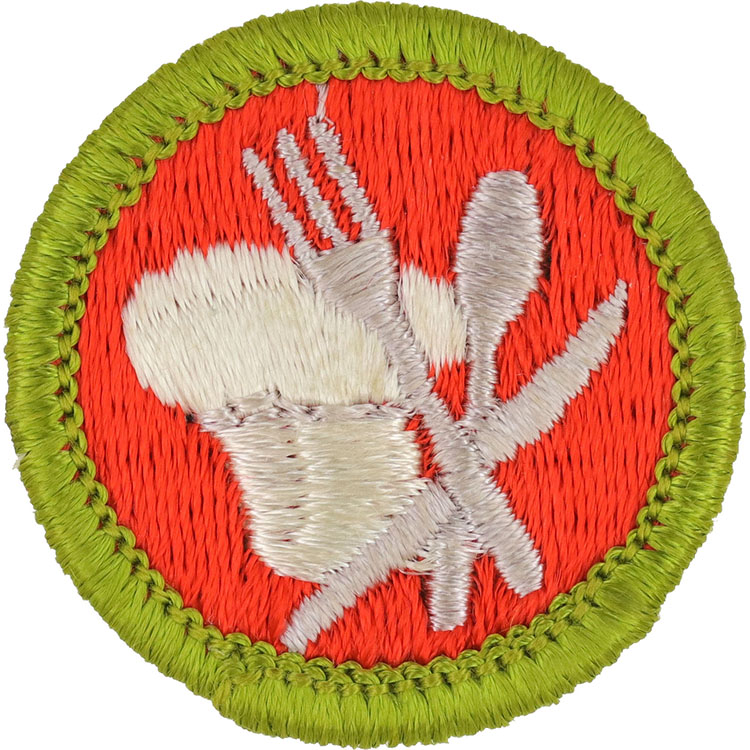
Fig. 1: Cookin-H1b-Front
- Embroidery: Cotton thread
- Border: Merrowed

Fig. 2: Cookin-H1b-Reverse
- Back: Blue plastic with waffle pattern
Item Name: Cooking 1973- 1975
Item ID: Cookin-H1b
Collector Rating: 1
Pamphlets Used to Earn this Badge
Requirements June 1972 until September 1995
1. Plan menus for 3 straight days (nine meals) of camping. Include the following:
(a) A camp dinner with soup; meat, fish, or chicken; two fresh vegetables; drink; and dessert. All are to be cooked.
(b) A one-pot dinner. Use foods other than canned.
(c) A breakfast, lunch, and dinner suitable for a trail or backpacking trip where light weight is important. Use as much dehydrated or dry frozen foods as you can. Get them from local food stores (not specialty stores). You should be able to store all foods used for several days without refrigeration. The lunch planned should not need cooking at the time of serving. The dinner must include hot soup or a salad; meat, fish, or chicken; vegetable and starch food or a second vegetable; baked biscuits; and drink. (The menus for the other two breakfasts and two lunches shall be the kind you can prepare in camp or on the trail.)
2. Do the following:
(a) Make a food list, showing cost and amount needed to feed three or more boys using the menus planned in No. 1.
(b) List the utensils needed to cook and serve these meals.
(c) Figure the weight of the foods in No. 1c.
3. Using the menus planned in No. 1:
(a_ Prepare and serve for yourself and two others, the three dinners, the lunch, and the breakfast planned in No. 1. Time your cooking so that each course will be ready to serve at the proper time.*
(b) For the meals prepared in No. 3a, for which a fire is needed, pick a good spot for your fire. Build a fireplace. Include a support for your cooking utensils from rocks, logs, or like material. (Where local laws do not allow you to do this, the counselor may change the requirement to meet the law.) The same fireplace may be used for more than one meal. Use charcoal as fuel in cooking at least one meal.
(c) For each meal prepared in No. 3a, use safe food-handling practices. Use the correct way to get rid of garbage, cans, foil, paper, and other rubbish by burning and using a tote-litter bag. After each meal, clean up the site thoroughly.
*The meals in No. 3a may be prepared for different trips. They need not be prepared consecutively. Scouts earning this badge in summer camp should plan around food they can get at the camp commissary.