-
Merit Badges
- Legend to identify Merit Badges
- 1910 British Merit Badges
- Square 1911 - 33
- Wide Crimped 1934 & 35
-
Narrow Tan Crimped 1936 - 42
- Tan Heavyweight Cloth with Silk Embroidery and Printed Back 1936 - 37
- Tan Heavyweight Cloth with Silk Embroidery and Plain Back 1937 - 38
- Tan Lightweight Cloth with Silk Embroidery and Plain Back 1938 - 39
- Tan Lightweight Cloth with Cotton Continuous Loop Embroidery and Plain Back 1939 - 42
- Tan Lightweight Cloth with Cotton Lockstitch Embroidery and Plain Back 1939 - 42
- Blue Background 1942 - 46
- Wartime 1942 - 46
- Khaki Narrow Crimped 1946 - 59
- Green Twill Gauze Back 1960 - 68
- Fully Embroidered Merrowed Edge 1960 - 72
- Unprinted Plastic Back 1972 - 01
- Printed Plastic Back 2002 - Current
-
Merit Badge Paper
- Merit Badge Applications
- Merit Badge Cards
-
Merit Badge Pamphlets
- Type 1 White Cover - Rectangle Drawing On Cover
- Type 2 White Cover 5-375" x 8" Title at Top
- Type 3A Tan Cover - 200 Fifth Avenue
- Type 3B Tan Cover - 2 line address New York City
- Type 3C Tan Cover - 2 line address New York N.Y.
- Type 3D Tan Cover - 1 line address New York N.Y.
- Type 4 Standing Scout Cover
- Type 5A War Cover
- Type 5B Red and White
- Type 6 Photo-Red Cover
- Type 7 Full Photo Cover or Bulls-eye Cover
- Type 8 Full Photo - Green Stripe Cover
- Type 9 Full Photo - Red Stripe Cover
- Type 10A Blue Stripe - Logo above bottom blue stripe - FDL centered
- Type 10B - Blue Stripe in bottom of photo area. FDL to left of text
- Special Covers
- Boy Craft Helps
- Merit Badge Counselor's Guides
-
Youth Position
- Junior Assistant Scoutmaster
- Senior Patrol Leader
- Assistant Senior Patrol Leader
- Patrol Leader
- Assistant Patrol Leader
- Troop Guide
- Scribe
- Quartermaster
- Instructor
- Chaplain Aide
- Den Chief
- Librarian
- Musician
- Webmaster
- Bugler
- Troop Historian
- Troop Representative
- Unit Representative
- Leadership Corps
- Honor Guard
- Leave No Trace Trainer
- Outdoor Ethics Guide
-
Patrol Medallions
- Patrol Medallions Introduction
- Legend to identify Patrol Medallions
- Patrol Shoulder Knot-Ribbons
- Felt Handmade Patrol Medallions
- Square Felt Patrol Medallions
- Round Broadcloth Patrol Medallions
- Red Twill Patrol Medallions
- Multi-Color Cloth Patrol Medallions
- Tan Cloth Patrol Medallions
- Patrol Medallion Back Patches
- Woodbadge Patrol Medallion

Fig. 1: CoiCol-J1-Front
- Embroidery: Rayon thread
- Border: Merrowed
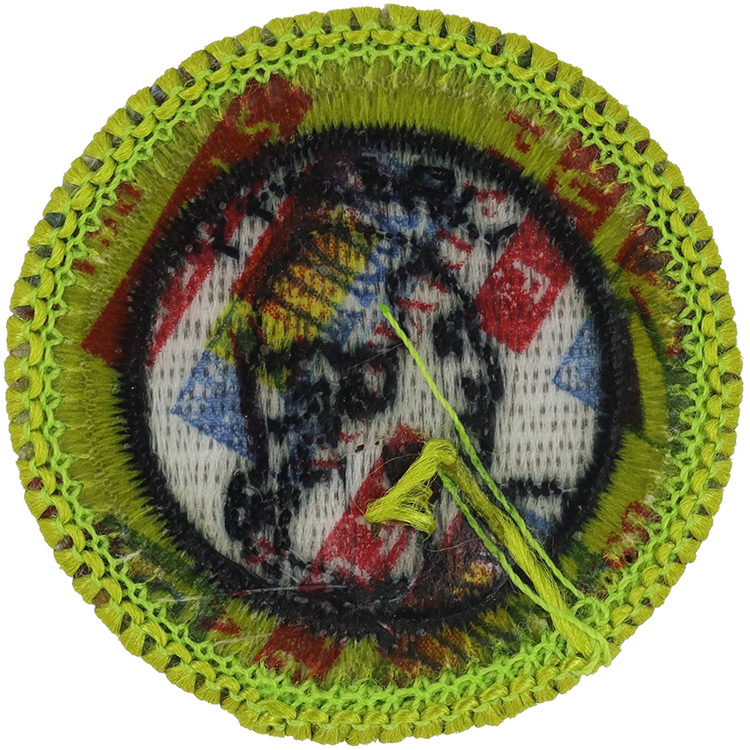
Fig. 2: CoiCol-J1-Reverse
- Back: Scout Stuff imprint
Item Name: Coin Collecting 2002 - 2009
Item ID: CoiCol-J1
Collector Rating: 1
Pamphlets Used to Earn this Badge
Requirements January 1975 until January 2003
1. Do these:
(a) Collect a type set of U.S. coins by any year currently being minted or in circulation. Commemorative, proof, silver, rare, or expensive coins are not needed. Have at least one coin from each mint in your type set.
(b) In your type set, point out and identify the mint mark (if any) on each coin. Tell when each mint first started making coins.
(c) For each coin in your type set, point out the location of the initials (if any) of each coin's designer(s).
2. Do these:
(a) Tell about the various grades of coins. Show six examples.
(b) Tell what buffed and whizzed coins are. Tell how to detect them.
3. (a) Tell how to detect counterfeit coins.
(b) Tell how to properly clean coins.
4. Do TWO of the following:
(a) Make enlarged sketches of both sides of five different kinds of U.S. coins minted from 1792 through the present year. Make sketches of both sides of five different colonial or state coins minted before 1792. Show all designs, dates, and lettering clearly.
(b) Collect, classify, and mount 50 different coins of 10 different countries.
(c) Collect a type set of U.S. coins minted during the 20th century (except commemorative, proof, gold, rare, or expensive coins).
(d) Collect a set of some U.S. series of coins beginning with your year of birth (except for rare or expensive coins).
(e) Collect, classify, describe, and mount 10 medals, tokens, or combination of both. Have three different medals or tokens and three different metals or compositions in the collection.
(f) Show the location of and explain the following on a current piece of U.S. paper money: (1) the Federal Reserve Bank and letter, (2) serial number, (3) series, (4) check letter, (5) face plate number, (6) back plate number, (7) seal and seal color, (8) signatures, (9) denomination. Describe three things to look for in detecting counterfeits.
Requirements January 2003 until January 2009
1. Understand how coins are made, and where the active U,S. Mint facilities are located.
2. Explain these collecting terms:
(a) Obverse
(b) Reverse
(c) Reeding
(d) Clad
(e) Type set
(f) Date set
3. Explain the terms poor, good, very good, fine, very fine, extremely fine, and uncirculated. Show five different grade examples of the same coin type. Explain the term “proof” and why it is not a grade. Tell what “encapsulate coins are.
4. Know three different ways to store a collection, and describe the benefits, drawbacks, and expense of each method. Pick one to use when completing requirements.
5. Do the following:
(a) Identify the people depicted on the following denominations of US paper money: $1, $5, $10, $20, $50, $100.
(b) Explain “legal tender.”
(c) Describe the role the federal reserve system plays in the distribution of currency.
- Do the following:
(a) Demonstrate to your counselor that you know how to use two US or world coin reference catalogs.
(b) Read a new numismatic magazine or newspaper and tell your counselor about what you learned.
7. Describe the name 1999-2008 50 State Quarters Program. Collect and show your counselor five different state quarters you have acquired from circulation.
8. Collect from circulation a set of currently circulating US coins. Include one coin of each denomination (sent, nickel, dime, quarter, half-dollar, Susan B. Anthony or Sacagawea dollar). For each coin, locate the mint marks, if any, and the designer’s initials, if any.
9. Do ONE of the following:
(a) Collect and identify 50 foreign coins from at least 10 different countries.
(b) Collect and identify 20 bank notes from at least five different countries.
(c) Collect identify 15 different tokens or medals.
(d) Collect a date set of a single type since the year of your birth.
10. Do ONE of the following:
(a) Tour a U.S. Mint facility, the Bureau of Engraving and Printing, or a Federal Reserve bank, and describe what you learned to your counselor.
(b) With your parent’s permission, attend a coin show or coin club meeting, view the web site of the U.S. Mint a coin dealer, and report on what you learned.
(c) Give a talk about coin collecting to your troop or class at school.
(d) Do drawings of five colonial-era U.S. coins.
Requirements January 2009 until January 2010
1. Understand how coins are made, and where the active U,S. Mint facilities are located.2. Explain these collecting terms:
(a) Obverse
(b) Reverse
(c) Reeding
(d) Clad
(e) Type set
(f) Date set
3. Explain the grading terms Uncirculated, Extremely Fine, Very Fine, Very Good, Good, and Poor. Show five different grade examples of the same coin type. Explain the term proof and why it is not a grade. Tell what “encapsulate coins are.
4. Know three different ways to store a collection, and describe the benefits, drawbacks, and expense of each method. Pick one to use when completing requirements.
5. Do the following:
(a) Demonstrate to your counselor that you know how to use two U.S. or world coin reference catalogs.
(b) Read a numismatic magazine or newspaper and tell your counselor about what you learned.
6. Describe the 1999- 2008 50 State Quarters® Program. Collect and show your counselor five different state quarters you have acquired from circulation
7. Collect from circulation a set of currently circulating US coins. Include one coin of each denomination cent, nickel, dime, quarter, half-dollar, dollar). For each coin, locate the mint marks, if any, and the designer’s initials, if any.
8. Do the following:
(a) Identify the people depicted on the following denominations of current UsS. Paper money: $1, $2, $5, $10, $20, $50, and $100.
(b) Explain “legal tender”
(c) Describe the role the Federal Reserve System plays in the distribution of currency.
9. Do ONE of the following:
(a) Collect and identify 50 foreign coins from at least 10 different countries.
(b) Collect and identify 20 bank notes from at least five different countries.
(c) Collect and identify 15 different tokens or medals.
(d) For each year since the year of your birth, collect a date set of a single type of coin.
10. Do ONE of the following:
(a) Tour a U.S. Mint facility, a Bureau of Engraving and Printing facility, a Federal Reserve bank, or a numismatic museum or exhibit, and describe what you learned to your counselor.
(b) With your parent’s permission, attend a coin show or coin club meeting, or view the web site of the U.S. Mint or a coin dealer, and report on what you learned.
(c) Give a talk about coin collecting to a group such as your troop, a Cub Scout pack, or your class at school.
(d) Do drawings of five Colonial-era U.S. coins.