-
Merit Badges
- Legend to identify Merit Badges
- 1910 British Merit Badges
- Square 1911 - 33
- Wide Crimped 1934 & 35
-
Narrow Tan Crimped 1936 - 42
- Tan Heavyweight Cloth with Silk Embroidery and Printed Back 1936 - 37
- Tan Heavyweight Cloth with Silk Embroidery and Plain Back 1937 - 38
- Tan Lightweight Cloth with Silk Embroidery and Plain Back 1938 - 39
- Tan Lightweight Cloth with Cotton Continuous Loop Embroidery and Plain Back 1939 - 42
- Tan Lightweight Cloth with Cotton Lockstitch Embroidery and Plain Back 1939 - 42
- Blue Background 1942 - 46
- Wartime 1942 - 46
- Khaki Narrow Crimped 1946 - 59
- Green Twill Gauze Back 1960 - 68
- Fully Embroidered Merrowed Edge 1960 - 72
- Unprinted Plastic Back 1972 - 01
- Printed Plastic Back 2002 - Current
-
Merit Badge Paper
- Merit Badge Applications
- Merit Badge Cards
-
Merit Badge Pamphlets
- Type 1 White Cover - Rectangle Drawing On Cover
- Type 2 White Cover 5-375" x 8" Title at Top
- Type 3A Tan Cover - 200 Fifth Avenue
- Type 3B Tan Cover - 2 line address New York City
- Type 3C Tan Cover - 2 line address New York N.Y.
- Type 3D Tan Cover - 1 line address New York N.Y.
- Type 4 Standing Scout Cover
- Type 5A War Cover
- Type 5B Red and White
- Type 6 Photo-Red Cover
- Type 7 Full Photo Cover or Bulls-eye Cover
- Type 8 Full Photo - Green Stripe Cover
- Type 9 Full Photo - Red Stripe Cover
- Type 10A Blue Stripe - Logo above bottom blue stripe - FDL centered
- Type 10B - Blue Stripe in bottom of photo area. FDL to left of text
- Special Covers
- Boy Craft Helps
- Merit Badge Counselor's Guides
-
Youth Position
- Junior Assistant Scoutmaster
- Senior Patrol Leader
- Assistant Senior Patrol Leader
- Patrol Leader
- Assistant Patrol Leader
- Troop Guide
- Scribe
- Quartermaster
- Instructor
- Chaplain Aide
- Den Chief
- Librarian
- Musician
- Webmaster
- Bugler
- Troop Historian
- Troop Representative
- Unit Representative
- Leadership Corps
- Honor Guard
- Leave No Trace Trainer
- Outdoor Ethics Guide
-
Patrol Medallions
- Patrol Medallions Introduction
- Legend to identify Patrol Medallions
- Patrol Shoulder Knot-Ribbons
- Felt Handmade Patrol Medallions
- Square Felt Patrol Medallions
- Round Broadcloth Patrol Medallions
- Red Twill Patrol Medallions
- Multi-Color Cloth Patrol Medallions
- Tan Cloth Patrol Medallions
- Patrol Medallion Back Patches
- Woodbadge Patrol Medallion
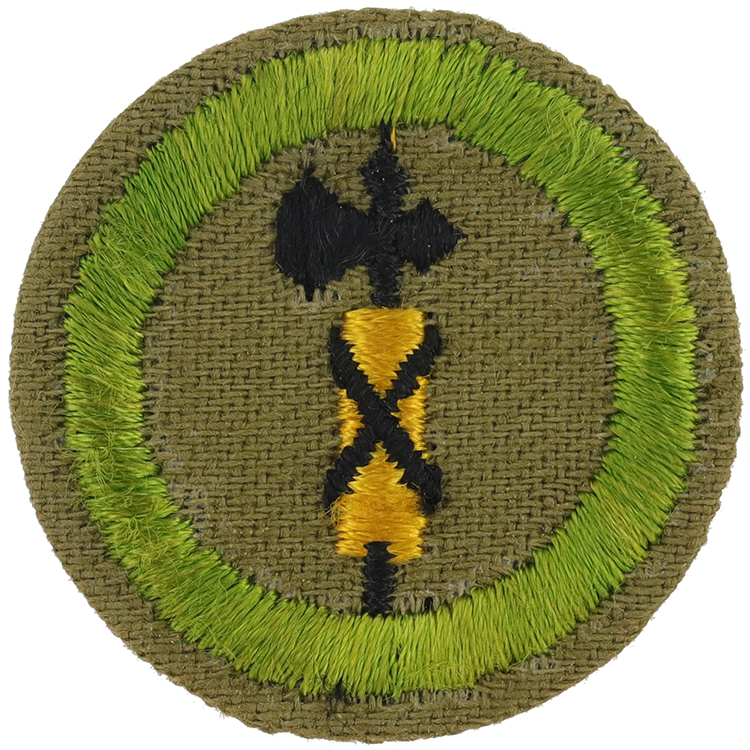
Fig. 1: Civics-D4-Front
- Cloth: War
- Embroidery: Cotton lock stitch
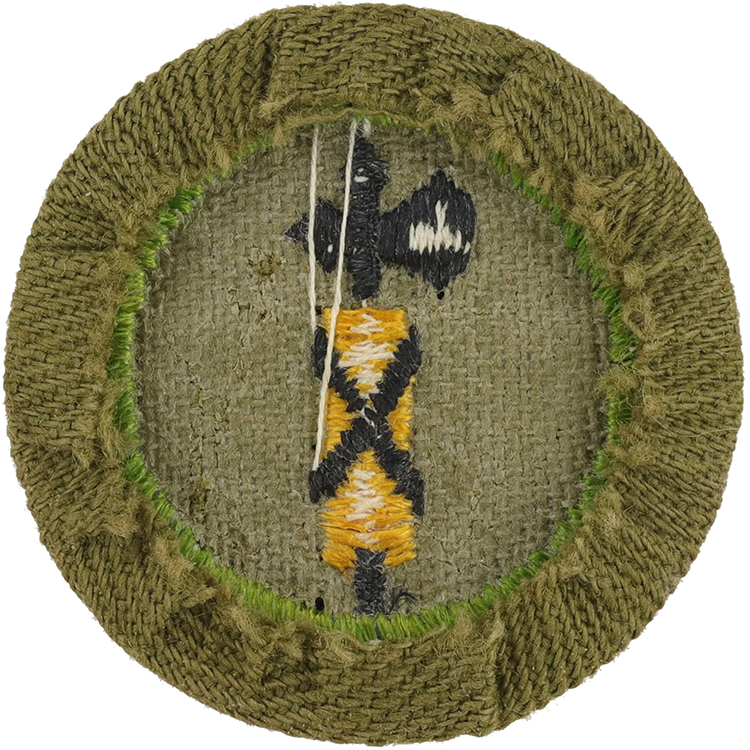
Fig. 2: Civics-D4-Reverse
- Back: Plain NO imprint with starch
Item Name: Civics 1942 - 1945
Item ID: Civics-D4
Collector Rating: 1
Pamphlets Used to Earn this Badge
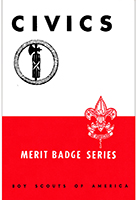
Requirements November 1938 until December 1942
To obtain this Merit Badge a Scout must in addition to meeting the following requirements, be familiar with the Declaration of Independence, the Constitution of the United States, and have a working knowledge of the structure of his federal, state and local Government.
1.(a) Tell which department of his local government has jurisdiction in each of the following instances-automobile accident, mad dog scare, permit to hold a political meeting in a public building, building permit, dog license, contagious disease, garbage disposal.
(b) Learn by visiting one of these departments and talking with some of those responsible for its management, how it operates. Tell where the money comes from to run the department and what it costs the average family in the community per year.
2. (a) Present a simple scrapbook of clippings from newspapers or other current literature, setting forth some local, county, state, or national civic problem, if possible showing both sides of the question. Explain how he thinks it can best be solved, or list the principal arguments on both sides, OR
(b) List the various departments of his local government such as fire, police, health, department of education, etc., with the amount of tax money spent during the last year for the work of each. List departments in the order of amounts spent.
3. List at least two important civic regulations, which apply to him or his family, with regard to each of the following: highway safety, property rights, fire hazards, sanitation, and special permits such as hunting and fishing.
4. Attend a political meeting, meeting of a city or town council, a session of court, or other public civic meeting, and make a full report of his observations.
5. Take active part in at least one co-operative civic enterprise, such as: Checking a local precinct for complete list of voting registration or for accuracy of registration; get-out-the-vote campaign; clean-up week; anti-noise campaign; improving the appearance or usefulness of a vacant lot; collecting magazines and books regularly and taking them to hospital, old peoples' home or similar institution; cleaning up some spot of historic interest: control of insect pests.
6. Select someone who has figured prominently in the history of his community or in the history of our country and from incidents in his life show why he deserves the title "a good citizen."
7. Select four types of foreign government and tell how each differs from that of the United States.
Requirements December 1942 until June 1948
1. Be familiar with the Declaration of Independence, the Constitution of the United States, and have a working knowledge of the structure of his federal, state and local Government.
2.(a) Tell which department of his local government has jurisdiction in each of the following instances-automobile accident, mad dog scare, permit to hold a political meeting in a public building, building permit, dog license, contagious disease, garbage disposal.
(b) Learn by visiting one of these departments and talking with some of those responsible for its management, how it operates. Tell where the money comes from to run the department and what it costs the average family in the community per year.
3. (a) Present a simple scrapbook of clippings from newspapers or other current literature, setting forth some local, county, state, or national civic problem, if possible showing both sides of the question. Explain how he thinks it can best be solved, or list the principal arguments on both sides, OR
(b) List the various departments of his local government such as fire, police, health, department of education, etc., with the amount of tax money spent during the last year for the work of each. List departments in the order of amounts spent.
4. List at least two important civic regulations, which apply to him or his family, with regard to each of the following: highway safety, property rights, fire hazards, sanitation, and special permits such as hunting and fishing.
5. Attend a political meeting, meeting of a city or town council, a session of court, or other public civic meeting, and make a full report of his observations.
6. Take active part in at least one co-operative civic enterprise, such as: Checking a local precinct for complete list of voting registration or for accuracy of registration; get-out-the-vote campaign; clean-up week; anti-noise campaign; improving the appearance or usefulness of a vacant lot; collecting magazines and books regularly and taking them to hospital, old peoples' home or similar institution; cleaning up some spot of historic interest: control of insect pests.
7. Select someone who has figured prominently in the history of his community or in the history of our country and from incidents in his life show why he deserves the title "a good citizen."
8. Select four types of foreign government and tell how each differs from that of the United States.