-
Merit Badges
- Legend to identify Merit Badges
- 1910 British Merit Badges
- Square 1911 - 33
- Wide Crimped 1934 & 35
-
Narrow Tan Crimped 1936 - 42
- Tan Heavyweight Cloth with Silk Embroidery and Printed Back 1936 - 37
- Tan Heavyweight Cloth with Silk Embroidery and Plain Back 1937 - 38
- Tan Lightweight Cloth with Silk Embroidery and Plain Back 1938 - 39
- Tan Lightweight Cloth with Cotton Continuous Loop Embroidery and Plain Back 1939 - 42
- Tan Lightweight Cloth with Cotton Lockstitch Embroidery and Plain Back 1939 - 42
- Blue Background 1942 - 46
- Wartime 1942 - 46
- Khaki Narrow Crimped 1946 - 59
- Green Twill Gauze Back 1960 - 68
- Fully Embroidered Merrowed Edge 1960 - 72
- Unprinted Plastic Back 1972 - 01
- Printed Plastic Back 2002 - Current
-
Merit Badge Paper
- Merit Badge Applications
- Merit Badge Cards
-
Merit Badge Pamphlets
- Type 1 White Cover - Rectangle Drawing On Cover
- Type 2 White Cover 5-375" x 8" Title at Top
- Type 3A Tan Cover - 200 Fifth Avenue
- Type 3B Tan Cover - 2 line address New York City
- Type 3C Tan Cover - 2 line address New York N.Y.
- Type 3D Tan Cover - 1 line address New York N.Y.
- Type 4 Standing Scout Cover
- Type 5A War Cover
- Type 5B Red and White
- Type 6 Photo-Red Cover
- Type 7 Full Photo Cover or Bulls-eye Cover
- Type 8 Full Photo - Green Stripe Cover
- Type 9 Full Photo - Red Stripe Cover
- Type 10A Blue Stripe - Logo above bottom blue stripe - FDL centered
- Type 10B - Blue Stripe in bottom of photo area. FDL to left of text
- Special Covers
- Boy Craft Helps
- Merit Badge Counselor's Guides
-
Youth Position
- Junior Assistant Scoutmaster
- Senior Patrol Leader
- Assistant Senior Patrol Leader
- Patrol Leader
- Assistant Patrol Leader
- Troop Guide
- Scribe
- Quartermaster
- Instructor
- Chaplain Aide
- Den Chief
- Librarian
- Musician
- Webmaster
- Bugler
- Troop Historian
- Troop Representative
- Unit Representative
- Leadership Corps
- Honor Guard
- Leave No Trace Trainer
- Outdoor Ethics Guide
-
Patrol Medallions
- Patrol Medallions Introduction
- Legend to identify Patrol Medallions
- Patrol Shoulder Knot-Ribbons
- Felt Handmade Patrol Medallions
- Square Felt Patrol Medallions
- Round Broadcloth Patrol Medallions
- Red Twill Patrol Medallions
- Multi-Color Cloth Patrol Medallions
- Tan Cloth Patrol Medallions
- Patrol Medallion Back Patches
- Woodbadge Patrol Medallion
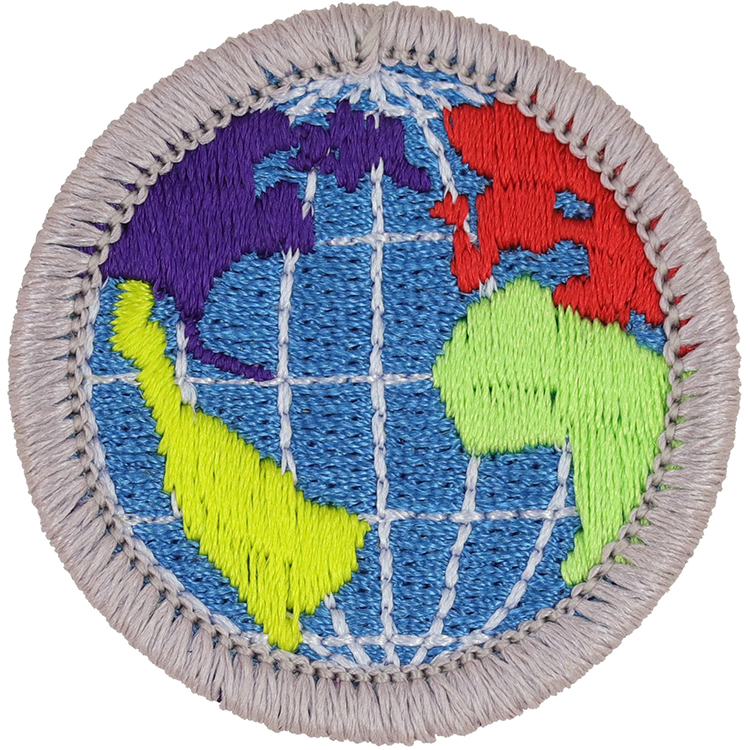
Fig. 1: CitWor-K-Front
- Embroidery: Rayon thread
- Border: Merrowed
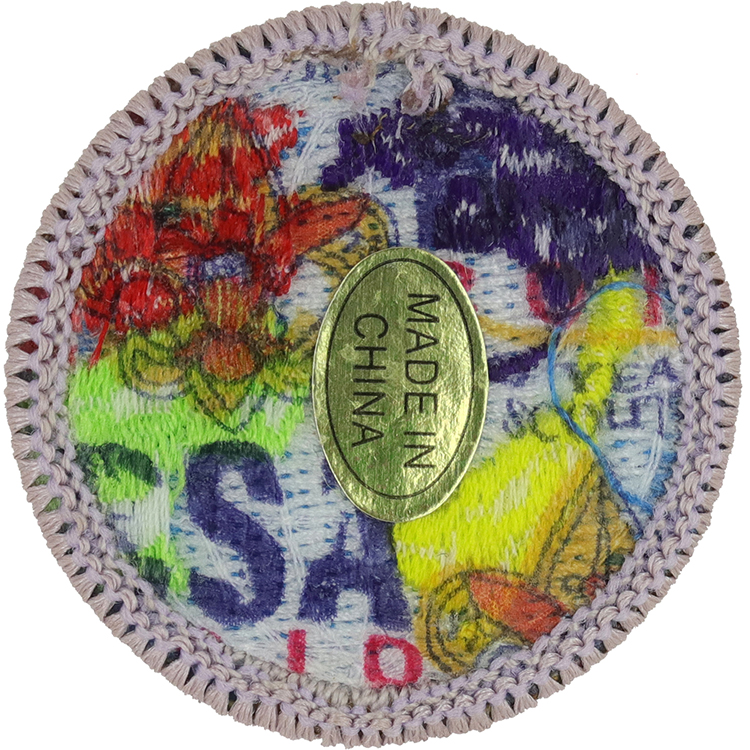
Fig. 2: CitWor-K-Reverse
- Back: 100th Anniversary imprint
Item Name: Citizenship in the World 2010 - 2013
Item ID: CitWor-K
Collector Rating: 1
Pamphlets Used to Earn this Badge

Requirements January 2006 until January 2016
1. Explain what citizenship in the world means to you and what you think it takes to be a good world citizen.
2. Explain how one becomes a citizen in the United States, and explain the rights, duties, and obligations on U.S. citizenship. Discuss the similarities and differences between the rights, duties, and obligations on U.S. citizens and the citizens of two other countries.
3. Do the following:
(a) Pick a current world event. In relation to this current event, discuss with your counselor how a country’s national interest and its relationship with other countries might affect areas such as its security, its economy, its values, and the health of its citizens.
(b) Select a foreign country and discuss with your counselor how its geography, national resources, and climate influence its economy and its global partnerships with other countries.
4. Do TWO of the following:
(a) Explain international law and how it differs from national law. Explain the role of international law and how international law can be used as a tool for conflict resolution.
(b) Using resources such as major daily newspaper, the Internet (with your parent’s permission), and News magazines, observe a current issue that involves international trade, foreign exchange, balance of payments, tariffs, and free trade. Explain what you have learned. Include in your discussion an explanation of why countries must cooperate in order for world trade and global competition to thrive.
(c) Select TWO of the following organizations and describe their role in the world.
(1) The United Nations
(2) The World Court
(3) World Organization of the Scout Movement
(4) The World Health Organization
(5) Amnesty International
(6) The International Committee of the Red Cross
(7) CARE
5. Do the following:
(a) Discuss the differences between constitutional and nonconsitutional governments.
(b) Name at least five different types of governments currently in power in the world.
(c) Show on a world map countries that use each of these five different forms of government.
6. Do the following:
(a) Explain how a government is represented abroad and how the United States government is accredited to international organizations.
(b) Describe the roles of the following in the conduct of foreign relations.
(1) Ambassador
(2) Consul
(3) Bureau of International Information Programs
(4) Agency for International Development
(5) United States and Foreign Commercial Service
(c) Explain the purpose of a passport and visa for international travel.
7. Do TWO of the following (with your parent’s permission) and share with your counselor what you have learned.
(a) Visit the Web site of the U.S. State Department. Learn more about an issue you find interesting that is discussed on this Web site.
(b) Visit the Web site of an international news organization or foreign government, OR examine a foreign newspaper available at your local library, bookstore, or newsstand. Find a news story about a human right realized in the United States that is not recognized in another country.
(c) Visit with a student or Scout from another country and discuss the typical values, holidays, ethnic foods, and traditions practiced or enjoyed there.
(d) Attend a world Scout jamboree.
(e) Participate in or attend an international event in your area, such as an ethnic festival, concert, or play.