-
Merit Badges
- Legend to identify Merit Badges
- 1910 British Merit Badges
- Square 1911 - 33
- Wide Crimped 1934 & 35
-
Narrow Tan Crimped 1936 - 42
- Tan Heavyweight Cloth with Silk Embroidery and Printed Back 1936 - 37
- Tan Heavyweight Cloth with Silk Embroidery and Plain Back 1937 - 38
- Tan Lightweight Cloth with Silk Embroidery and Plain Back 1938 - 39
- Tan Lightweight Cloth with Cotton Continuous Loop Embroidery and Plain Back 1939 - 42
- Tan Lightweight Cloth with Cotton Lockstitch Embroidery and Plain Back 1939 - 42
- Blue Background 1942 - 46
- Wartime 1942 - 46
- Khaki Narrow Crimped 1946 - 59
- Green Twill Gauze Back 1960 - 68
- Fully Embroidered Merrowed Edge 1960 - 72
- Unprinted Plastic Back 1972 - 01
- Printed Plastic Back 2002 - Current
-
Merit Badge Paper
- Merit Badge Applications
- Merit Badge Cards
-
Merit Badge Pamphlets
- Type 1 White Cover - Rectangle Drawing On Cover
- Type 2 White Cover 5-375" x 8" Title at Top
- Type 3A Tan Cover - 200 Fifth Avenue
- Type 3B Tan Cover - 2 line address New York City
- Type 3C Tan Cover - 2 line address New York N.Y.
- Type 3D Tan Cover - 1 line address New York N.Y.
- Type 4 Standing Scout Cover
- Type 5A War Cover
- Type 5B Red and White
- Type 6 Photo-Red Cover
- Type 7 Full Photo Cover or Bulls-eye Cover
- Type 8 Full Photo - Green Stripe Cover
- Type 9 Full Photo - Red Stripe Cover
- Type 10A Blue Stripe - Logo above bottom blue stripe - FDL centered
- Type 10B - Blue Stripe in bottom of photo area. FDL to left of text
- Special Covers
- Boy Craft Helps
- Merit Badge Counselor's Guides
-
Youth Position
- Junior Assistant Scoutmaster
- Senior Patrol Leader
- Assistant Senior Patrol Leader
- Patrol Leader
- Assistant Patrol Leader
- Troop Guide
- Scribe
- Quartermaster
- Instructor
- Chaplain Aide
- Den Chief
- Librarian
- Musician
- Webmaster
- Bugler
- Troop Historian
- Troop Representative
- Unit Representative
- Leadership Corps
- Honor Guard
- Leave No Trace Trainer
- Outdoor Ethics Guide
-
Patrol Medallions
- Patrol Medallions Introduction
- Legend to identify Patrol Medallions
- Patrol Shoulder Knot-Ribbons
- Felt Handmade Patrol Medallions
- Square Felt Patrol Medallions
- Round Broadcloth Patrol Medallions
- Red Twill Patrol Medallions
- Multi-Color Cloth Patrol Medallions
- Tan Cloth Patrol Medallions
- Patrol Medallion Back Patches
- Woodbadge Patrol Medallion
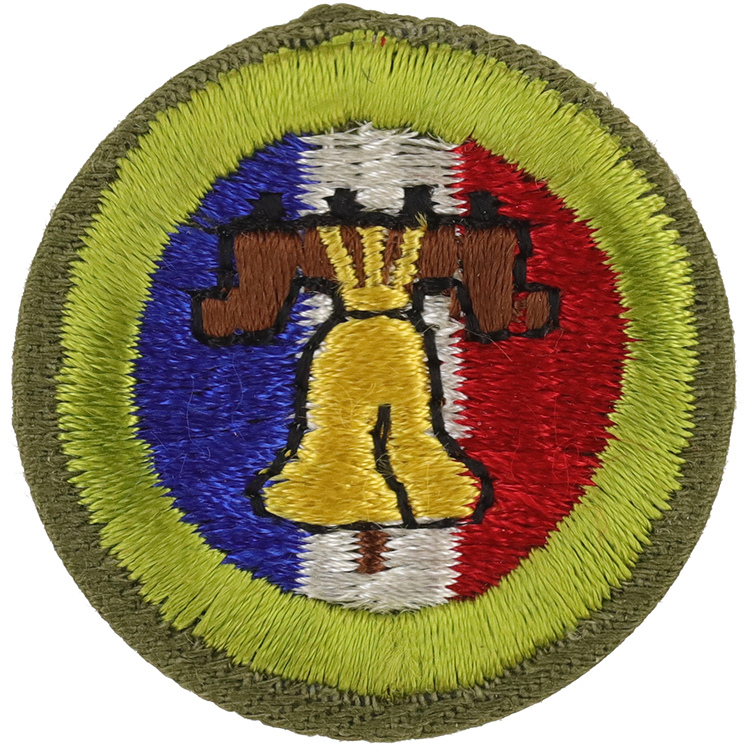
Fig. 1: CitNat-E2-Front
- Cloth: Khaki right twill
- Embroidery: Cotton lock stitch
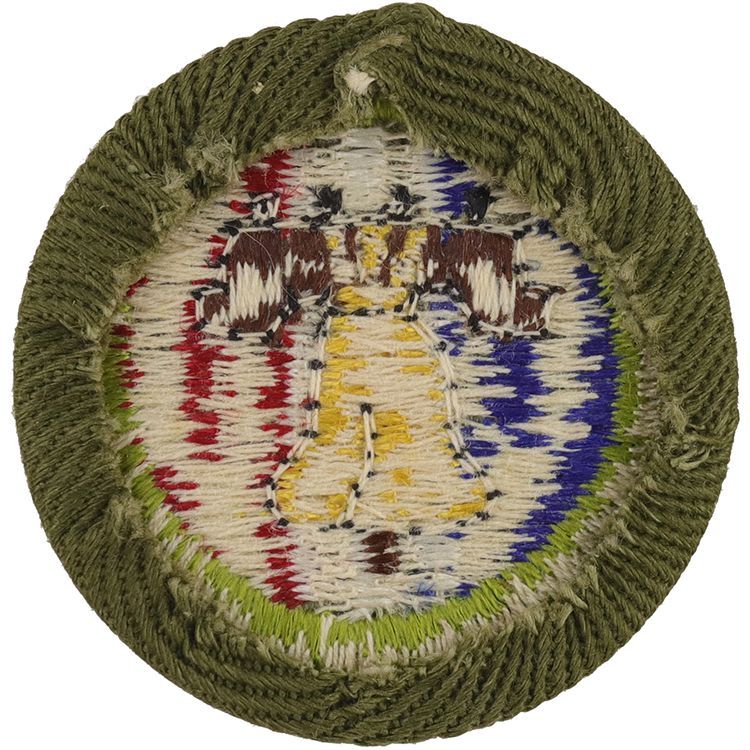
Fig. 2: CitNat-E2-Reverse
- Back: Plain NO imprint with starch
Item Name: Citizenshin in the Nation 1952 - 1960
Item ID: CitNat-E2
Collector Rating: 1
Pamphlets Used to Earn this Badge


Requirements January 1952 until June 1972
1. Read the Declaration of Independence and tell in your own words the meaning of the "self-evident truths" referred to.
2. Read the Constitution of the United States of America with its amendments, and: (a) explain its purpose as set forth in the Preamble; (b) draw a diagram to show the organization of our government into three branches as provided in Articles 1, 2, and 3; (c) describe and explain the purpose of the system of checks and balances in this organization; (d) tell how the Constitution may be amended as provided in Article 5.
3. Present newspaper or magazine clippings which show instances of how at least three of the privileges in our Bill of Rights have been protected in our country or how they have been denied in some other countries.
4. Take part in a group discussion (in your troop, Explorer unit, school, 4-H Club, family, or similar group) of an important national problem of the day.
5. Do one of the following: (a) Visit your national or state capitol, or a federal project which serves your community or region, or a place associated with a person or event which figured in the history of our nation. Prepare a report of your visit. (b) Correspond with someone, preferably a Scout or Explorer, who lives in another region of the United States or one of the U.S. territories. Exchange ideas, descriptive material, hobby items, etc.
6. Tell the names of the senators from your state and the representatives from your district in Congress and how you should address a letter to them at their Washington offices.
7. Tell what branch or department of the federal government is responsible for ten of the following: national parks; national forests; fish and wildlife protection; weather forecasting; flood control; investigation of violations of federal laws; judgment on such violations; minting of money; appropriations for government expenses; foreign policy; supreme command of our armed forces; soil conservation; child welfare; atomic energy.
8. Do the following: (a) Describe five ways in which the federal government serves you, your family, and your community directly. (b) Discuss with your parents (or guardians) and counselor the ways in which federal income, social security, excise, and other taxes, as well as import duties, affect the cost of living.
9. Have or obtain a birth certificate or other legal evidence of your citizenship. Or, if foreign born, learn what a person must do to gain United States citizenship.