-
Merit Badges
- Legend to identify Merit Badges
- 1910 British Merit Badges
- Square 1911 - 33
- Wide Crimped 1934 & 35
-
Narrow Tan Crimped 1936 - 42
- Tan Heavyweight Cloth with Silk Embroidery and Printed Back 1936 - 37
- Tan Heavyweight Cloth with Silk Embroidery and Plain Back 1937 - 38
- Tan Lightweight Cloth with Silk Embroidery and Plain Back 1938 - 39
- Tan Lightweight Cloth with Cotton Continuous Loop Embroidery and Plain Back 1939 - 42
- Tan Lightweight Cloth with Cotton Lockstitch Embroidery and Plain Back 1939 - 42
- Blue Background 1942 - 46
- Wartime 1942 - 46
- Khaki Narrow Crimped 1946 - 59
- Green Twill Gauze Back 1960 - 68
- Fully Embroidered Merrowed Edge 1960 - 72
- Unprinted Plastic Back 1972 - 01
- Printed Plastic Back 2002 - Current
-
Merit Badge Paper
- Merit Badge Applications
- Merit Badge Cards
-
Merit Badge Pamphlets
- Type 1 White Cover - Rectangle Drawing On Cover
- Type 2 White Cover 5-375" x 8" Title at Top
- Type 3A Tan Cover - 200 Fifth Avenue
- Type 3B Tan Cover - 2 line address New York City
- Type 3C Tan Cover - 2 line address New York N.Y.
- Type 3D Tan Cover - 1 line address New York N.Y.
- Type 4 Standing Scout Cover
- Type 5A War Cover
- Type 5B Red and White
- Type 6 Photo-Red Cover
- Type 7 Full Photo Cover or Bulls-eye Cover
- Type 8 Full Photo - Green Stripe Cover
- Type 9 Full Photo - Red Stripe Cover
- Type 10A Blue Stripe - Logo above bottom blue stripe - FDL centered
- Type 10B - Blue Stripe in bottom of photo area. FDL to left of text
- Special Covers
- Boy Craft Helps
- Merit Badge Counselor's Guides
-
Youth Position
- Junior Assistant Scoutmaster
- Senior Patrol Leader
- Assistant Senior Patrol Leader
- Patrol Leader
- Assistant Patrol Leader
- Troop Guide
- Scribe
- Quartermaster
- Instructor
- Chaplain Aide
- Den Chief
- Librarian
- Musician
- Webmaster
- Bugler
- Troop Historian
- Troop Representative
- Unit Representative
- Leadership Corps
- Honor Guard
- Leave No Trace Trainer
- Outdoor Ethics Guide
-
Patrol Medallions
- Patrol Medallions Introduction
- Legend to identify Patrol Medallions
- Patrol Shoulder Knot-Ribbons
- Felt Handmade Patrol Medallions
- Square Felt Patrol Medallions
- Round Broadcloth Patrol Medallions
- Red Twill Patrol Medallions
- Multi-Color Cloth Patrol Medallions
- Tan Cloth Patrol Medallions
- Patrol Medallion Back Patches
- Woodbadge Patrol Medallion
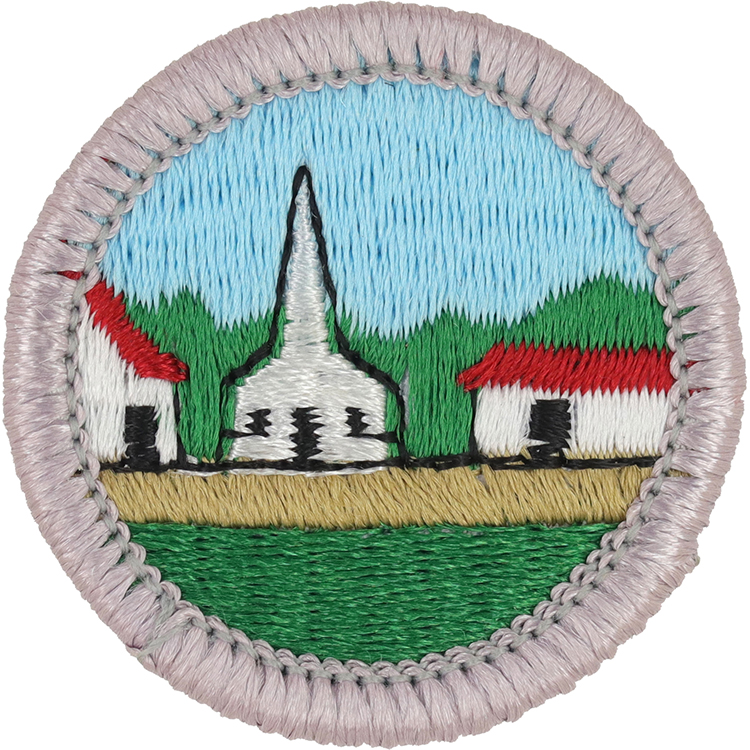
Fig. 1: CitCom-H5-Front
- Embroidery: Rayon thread
- Border: Merrowed
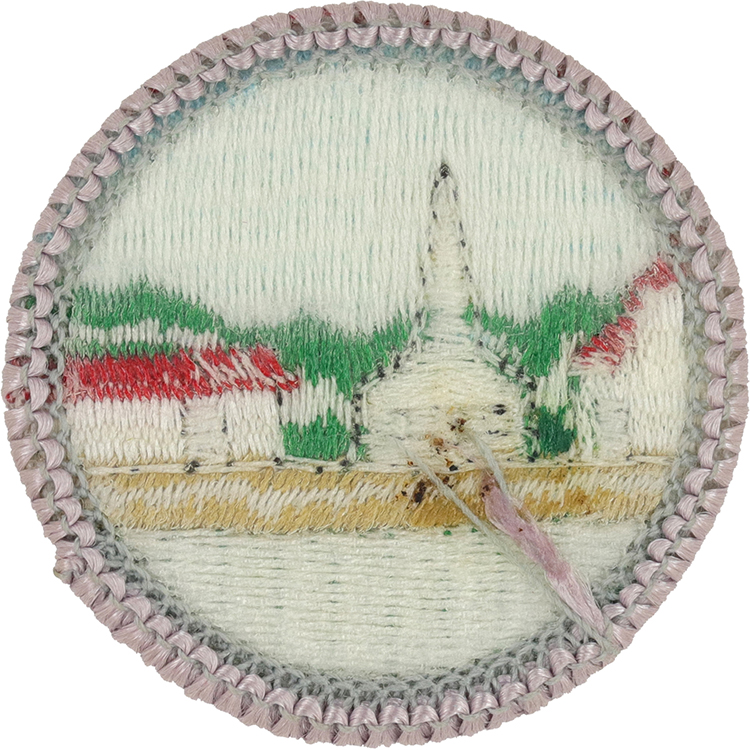
Fig. 2: CitCom-H5-Reverse
- Back: Molded plastic
Item Name: Citizenship in the Community 1990 - 2002
Item ID: CitCom-H5
Collector Rating: 1
Pamphlets Used to Earn this Badge
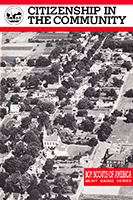
Requirements January 1984 until September 1993
1. Describe your community to your counselor giving:
(a) Short history
(b) Cultures and ethnic groups
(c) Major places of employment
What is the future of your community?
2. Mark or point out on a map of your community the following:
(a) Chief government buildings
(b) Fire station, police station, and hospital nearest your home
(c) Schools, churches, and synagogues near your home
(d) Main highways to neighboring cities and towns
(e) Nearest railroads and bus stations and airport, if any
(f) Chief industries or other major places of employment
(g) Historical and other interesting points
3. Do the following:
(a) Chart the organization of your local or state government. Show the top offices and tell which are elected or appointed.
(b) Name the political parties in your community government and list four persons active in the politics of your community and what positions they hold.
4. Attend ONE:
(a) County or parish board meeting
(b) City council meeting
(c) School board meeting
(d) Municipal, county, or state court session
5. After visiting the governmental meeting, obtain a copy of that body's published budget. Review the major sources of income and expenses for its operation with your counselor.
6. List the services your community provides to the citizens in return for the taxes paid by you and your parents.
7. Select a city, county, or school problem or issue under consideration from the local newspaper or news broadcast and write a letter expressing your views to the mayor, administrator, or school board president. Show this letter and any response to your counselor.
8. List and describe the work of five volunteer organizations through which people in your community work together for the good of your community.
9. Tell how to report an accident or an emergency in your community.
10. List five ways you can demonstrate good citizenship in your community, religious institution, school, or Scouting unit.
Requirements September 1993 until January 2005.
1. Describe your community to your counselor giving:
(a) Short history
(b) Cultures and ethnic groups
(c) Major places of employment
What is the future of your community?
2. Mark or point out on a map of your community the following:
(a) Chief government buildings such as your city hall, county courthouse, and public works/services facility
(b) Fire station, police station, and hospital nearest your home
(c) Schools, churches, and synagogues near your home
(d) Main highways to neighboring cities and towns
(e) Nearest railroads and bus stations and airport, if any
(f) Chief industries or other major places of employment (g) Historical and other interesting points
3. Do the following:
(a) Chart the organization of your local or state government. Show the top offices and tell which are elected or appointed.
(b) Name the political parties in your community government and list four persons active in the politics of your community and what positions they hold.
4. Attend ONE of the following:
(a) County or parish board meeting
(b) City council meeting
(c) School board meeting
(d) Municipal, county, or state court session
5. After visiting the governmental meeting, obtain a copy of that body's published budget. Review the major sources of income and expenses for its operation with your counselor.
6. List the services your community provides to the citizens in return for the taxes paid by you and your parents.
7. Select a city, county, or school problem or issue under consideration from the local newspaper or news broadcast and write a letter expressing your views to the mayor, administrator, or school board president. Show this letter and any response to your counselor.
8. List and describe the work of five volunteer organizations through which people in your community work together for the good of your community.
9. Tell how to report an accident or an emergency in your community.
10. List five ways you can demonstrate good citizenship in your community, religious institution, school, or Scouting unit.