-
Merit Badges
- Legend to identify Merit Badges
- 1910 British Merit Badges
- Square 1911 - 33
- Wide Crimped 1934 & 35
-
Narrow Tan Crimped 1936 - 42
- Tan Heavyweight Cloth with Silk Embroidery and Printed Back 1936 - 37
- Tan Heavyweight Cloth with Silk Embroidery and Plain Back 1937 - 38
- Tan Lightweight Cloth with Silk Embroidery and Plain Back 1938 - 39
- Tan Lightweight Cloth with Cotton Continuous Loop Embroidery and Plain Back 1939 - 42
- Tan Lightweight Cloth with Cotton Lockstitch Embroidery and Plain Back 1939 - 42
- Blue Background 1942 - 46
- Wartime 1942 - 46
- Khaki Narrow Crimped 1946 - 59
- Green Twill Gauze Back 1960 - 68
- Fully Embroidered Merrowed Edge 1960 - 72
- Unprinted Plastic Back 1972 - 01
- Printed Plastic Back 2002 - Current
-
Merit Badge Paper
- Merit Badge Applications
- Merit Badge Cards
-
Merit Badge Pamphlets
- Type 1 White Cover - Rectangle Drawing On Cover
- Type 2 White Cover 5-375" x 8" Title at Top
- Type 3A Tan Cover - 200 Fifth Avenue
- Type 3B Tan Cover - 2 line address New York City
- Type 3C Tan Cover - 2 line address New York N.Y.
- Type 3D Tan Cover - 1 line address New York N.Y.
- Type 4 Standing Scout Cover
- Type 5A War Cover
- Type 5B Red and White
- Type 6 Photo-Red Cover
- Type 7 Full Photo Cover or Bulls-eye Cover
- Type 8 Full Photo - Green Stripe Cover
- Type 9 Full Photo - Red Stripe Cover
- Type 10A Blue Stripe - Logo above bottom blue stripe - FDL centered
- Type 10B - Blue Stripe in bottom of photo area. FDL to left of text
- Special Covers
- Boy Craft Helps
- Merit Badge Counselor's Guides
-
Youth Position
- Junior Assistant Scoutmaster
- Senior Patrol Leader
- Assistant Senior Patrol Leader
- Patrol Leader
- Assistant Patrol Leader
- Troop Guide
- Scribe
- Quartermaster
- Instructor
- Chaplain Aide
- Den Chief
- Librarian
- Musician
- Webmaster
- Bugler
- Troop Historian
- Troop Representative
- Unit Representative
- Leadership Corps
- Honor Guard
- Leave No Trace Trainer
- Outdoor Ethics Guide
-
Patrol Medallions
- Patrol Medallions Introduction
- Legend to identify Patrol Medallions
- Patrol Shoulder Knot-Ribbons
- Felt Handmade Patrol Medallions
- Square Felt Patrol Medallions
- Round Broadcloth Patrol Medallions
- Red Twill Patrol Medallions
- Multi-Color Cloth Patrol Medallions
- Tan Cloth Patrol Medallions
- Patrol Medallion Back Patches
- Woodbadge Patrol Medallion
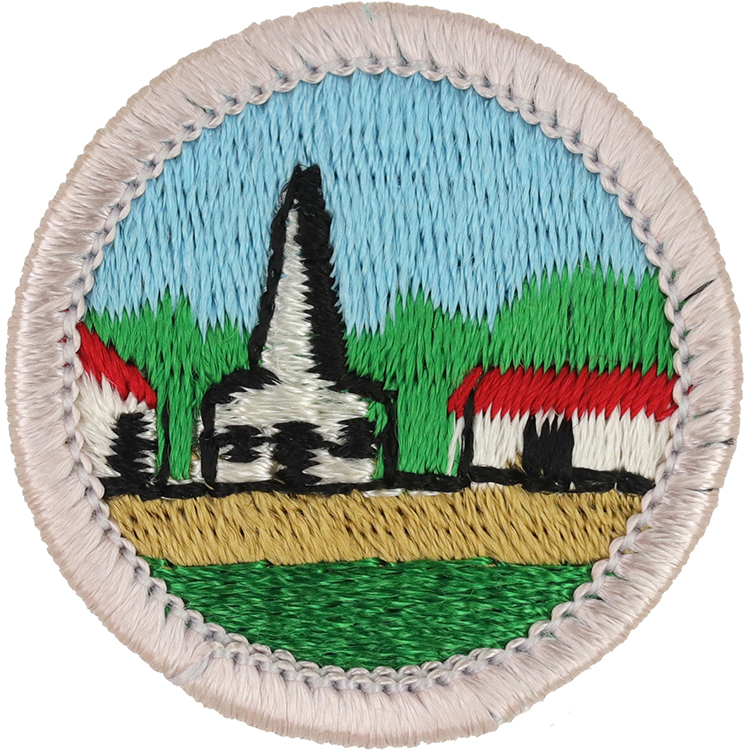
Fig. 1: CitCom-H3-Front
- Embroidery: Cotton thread, dull sheen
- Border: Dk green merrowed
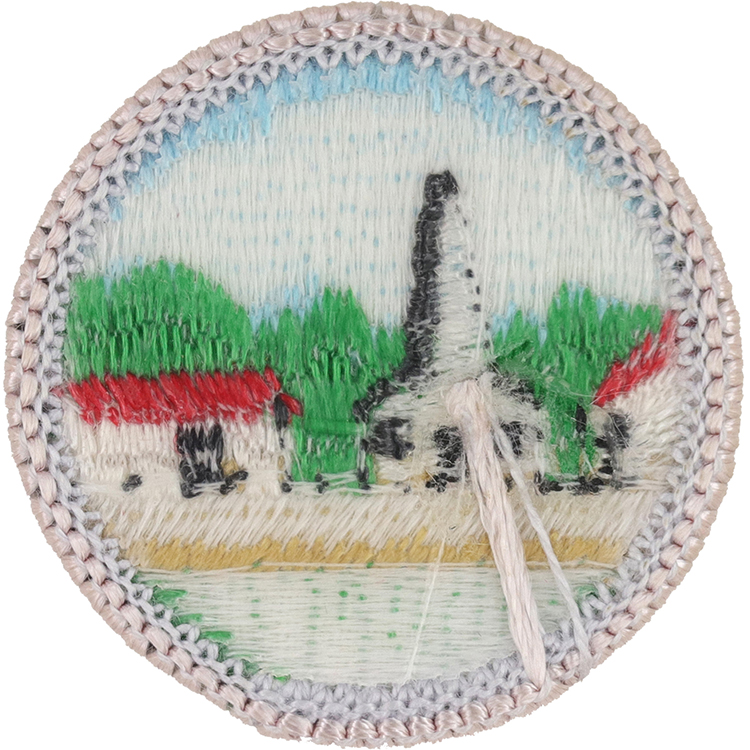
Fig. 2: CitCom-H3-Reverse
- Back: Molded plastic
Item Name: Citizenship in the Community 1976 - 1978
Item ID: CitCom-H3
Collector Rating: 1
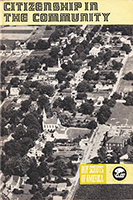
Pamphlets Used to Earn this Badge
1. Tell how you would describe your town to a Scout from another state. Give a short history of your town. Tell about its ethnic and other groups, the economy, and the culture. Describe the future of your town.
2. Mark or point out on a map of your town the following:
(a) Chief government buildings.
(b) Fire station, police station, and hospital nearest your home.
(c) Schools, churches, and synagogues near your home.
(d) Main highways to neighboring cities and towns.
(e) Nearest railroads and bus stations and airport, if any.
(f) Chief industries or other major places of employment.
(g) Historical and other interesting points.
3. Make a list of community problems. Pick one in your community. From newspapers, news broadcasts, or other kinds of public information and talk, gather ideas on both sides of your chosen problem. Give your own ideas on it.
4. Chart the organization of your state government. Show all three branches. Tell what each does.
5. Do ONE of the following:
(a) Chart the organization of your village, town, city, or county government. Show top officers, courts, and departments. Show which officers are elected and which are appointed.
(b) Tell how to do seven of the following in your community: (1) report a fire; (2) report an automobile accident; (3) call an ambulance; (4) report damage to electric power, gas, or water supply system; (5) report damage to or need of repairs on streets, roads, bridges, or sewage system; (6) obtain a bicycle license; (7) obtain a dog license; (8) report a contagious disease; (9) report a mad dog scare; (10) obtain a building permit; (11) call a veterinarian; (12) obtain help from your county agricultural agent.
(c) Visit one department of your local government. Report on what services it does for the community. OR, attend a court session or a public meeting of a government body. Report on what took place.
6. Tell how much it costs to run your local government for one year. Tell where the money comes from. Outline for what it is chiefly spent. What kind of taxes do your family and others in your community pay to meet this cost?
7. Show that you have taken an active part in elections of your officers and matters of business in groups to which you belong.
8. List and describe the work of vive volunteer organizations through which people of your community work together for the general good. Do something or take part in the activities of one of these organizations other than Scouting.
9. Do ONE of the following:
(a) Name the main political parties in your community or state. Explain their different points of view on one public issue.
(b) Describe one job in your community in some form of public service. Tell what qualifications are needed for the job.
10. Do ONE of the following:
(a) Draw the course of your home water supply from water-shed to water tap and to receiving stream. Show waste treatment, if any.
(b) Find out if the water supply is likely to be a problem in your town in the future. Explain why.
11. Define water pollution. Give the main causes and results of water pollution nationally and in your town. Find out what steps, if any, are taken to control pollution in your area. Tell what other steps might be taken.
12. Tell how good land-use planning is important to five of the following: community planner, highway builders, camp planners, small landowner, farmers, ranchers, recreation planners, industrial and housing developers, fishermen, and hunters.
13. Do the following:
(a) List and explain at least five privileges and forms of protection you enjoy as a citizen in your community. Describe your obligations to the community.
(b) Plan your own program of community service. Get approval of your plan from your Scoutmaster and counselor. Give 5 hours of your time in carrying it out; or give 5 hours of community service carried out by your Scouting group.
Requirements December 1977 until January 1984.
1. Tell how you would describe your town to a Scout from another state. Give a short history of your town. Tell about its ethnic and other groups, the economy, and the culture. Describe the future of your town.
2. Mark or point out on a map of your town the following:
(a) Chief government buildings.
(b) Fire station, police station, and hospital nearest your home.
(c) Schools, churches, and synagogues near your home.
(d) Main highways to neighboring cities and towns.
(e) Nearest railroads and bus stations and airport, if any.
(f) Chief industries or other major places of employment.
(g) Historical and other interesting points.
3. Make a list of community problems. Pick one in your community. From newspapers, news broadcasts, or other kinds of public information and talk, gather ideas on both sides of your chosen problem. Give your own ideas on it.
4. Chart the organization of your state government. Show all three branches. Tell what each does.
5. Do ONE of the following:
(a) Chart the organization of your village, town, city, or county government. Show top officers, courts, and departments. Show which officers are elected and which are appointed.
(b) Tell how to do seven of the following in your community: (1) report a fire; (2) report an automobile accident; (3) call an ambulance; (4) report damage to electric power, gas, or water supply system; (5) report damage to or need of repairs on streets, roads, bridges, or sewage system; (6) obtain a bicycle license; (7) obtain a dog license; (8) report a contagious disease; (9) report a mad dog scare; (10) obtain a building permit; (11) call a veterinarian; (12) obtain help from your county agricultural agent.
(c) Visit one department of your local government. Report on what services it does for the community. OR, attend a court session or a public meeting of a government body. Report on what took place.
6. Tell how much it costs to run your local government for one year. Tell where the money comes from. Outline for what it is chiefly spent. What kind of taxes do your family and others in your community pay to meet this cost?
7. Show that you have taken an active part in elections of your officers and matters of business in groups to which you belong.
8. List and describe the work of vive volunteer organizations through which people of your community work together for the general good. Do something or take part in the activities of one of these organizations other than Scouting.
9. Do ONE of the following:
(a) Name the main political parties in your community or state. Explain their different points of view on one public issue.
(b) Describe one job in your community in some form of public service. Tell what qualifications are needed for the job.
10. Do ONE of the following:
(a) Draw the course of your home water supply from water-shed to water tap and to receiving stream. Show waste treatment, if any.
(b) Find out if the water supply is likely to be a problem in your town in the future. Explain why.
11. Define water pollution. Give the main causes and results of water pollution nationally and in your town. Find out what steps, if any, are taken to control pollution in your area. Tell what other steps might be taken.
12. Tell how good land-use planning is important to five of the following: community planner, highway builders, camp planners, small landowner, farmers, ranchers, recreation planners, industrial and housing developers, fishermen, and hunters.
13. Do the following:
(a) List and explain at least five privileges and forms of protection you enjoy as a citizen in your community. Describe your obligations to the community.
(b) Plan your own program of community service. Get approval of your plan from your Scoutmaster and counselor. Give 5 hours of your time in carrying it out; or give 5 hours of community service carried out by your troop or patrol.