-
Merit Badges
- Legend to identify Merit Badges
- 1910 British Merit Badges
- Square 1911 - 33
- Wide Crimped 1934 & 35
-
Narrow Tan Crimped 1936 - 42
- Tan Heavyweight Cloth with Silk Embroidery and Printed Back 1936 - 37
- Tan Heavyweight Cloth with Silk Embroidery and Plain Back 1937 - 38
- Tan Lightweight Cloth with Silk Embroidery and Plain Back 1938 - 39
- Tan Lightweight Cloth with Cotton Continuous Loop Embroidery and Plain Back 1939 - 42
- Tan Lightweight Cloth with Cotton Lockstitch Embroidery and Plain Back 1939 - 42
- Blue Background 1942 - 46
- Wartime 1942 - 46
- Khaki Narrow Crimped 1946 - 59
- Green Twill Gauze Back 1960 - 68
- Fully Embroidered Merrowed Edge 1960 - 72
- Unprinted Plastic Back 1972 - 01
- Printed Plastic Back 2002 - Current
-
Merit Badge Paper
- Merit Badge Applications
- Merit Badge Cards
-
Merit Badge Pamphlets
- Type 1 White Cover - Rectangle Drawing On Cover
- Type 2 White Cover 5-375" x 8" Title at Top
- Type 3A Tan Cover - 200 Fifth Avenue
- Type 3B Tan Cover - 2 line address New York City
- Type 3C Tan Cover - 2 line address New York N.Y.
- Type 3D Tan Cover - 1 line address New York N.Y.
- Type 4 Standing Scout Cover
- Type 5A War Cover
- Type 5B Red and White
- Type 6 Photo-Red Cover
- Type 7 Full Photo Cover or Bulls-eye Cover
- Type 8 Full Photo - Green Stripe Cover
- Type 9 Full Photo - Red Stripe Cover
- Type 10A Blue Stripe - Logo above bottom blue stripe - FDL centered
- Type 10B - Blue Stripe in bottom of photo area. FDL to left of text
- Special Covers
- Boy Craft Helps
- Merit Badge Counselor's Guides
-
Youth Position
- Junior Assistant Scoutmaster
- Senior Patrol Leader
- Assistant Senior Patrol Leader
- Patrol Leader
- Assistant Patrol Leader
- Troop Guide
- Scribe
- Quartermaster
- Instructor
- Chaplain Aide
- Den Chief
- Librarian
- Musician
- Webmaster
- Bugler
- Troop Historian
- Troop Representative
- Unit Representative
- Leadership Corps
- Honor Guard
- Leave No Trace Trainer
- Outdoor Ethics Guide
-
Patrol Medallions
- Patrol Medallions Introduction
- Legend to identify Patrol Medallions
- Patrol Shoulder Knot-Ribbons
- Felt Handmade Patrol Medallions
- Square Felt Patrol Medallions
- Round Broadcloth Patrol Medallions
- Red Twill Patrol Medallions
- Multi-Color Cloth Patrol Medallions
- Tan Cloth Patrol Medallions
- Patrol Medallion Back Patches
- Woodbadge Patrol Medallion
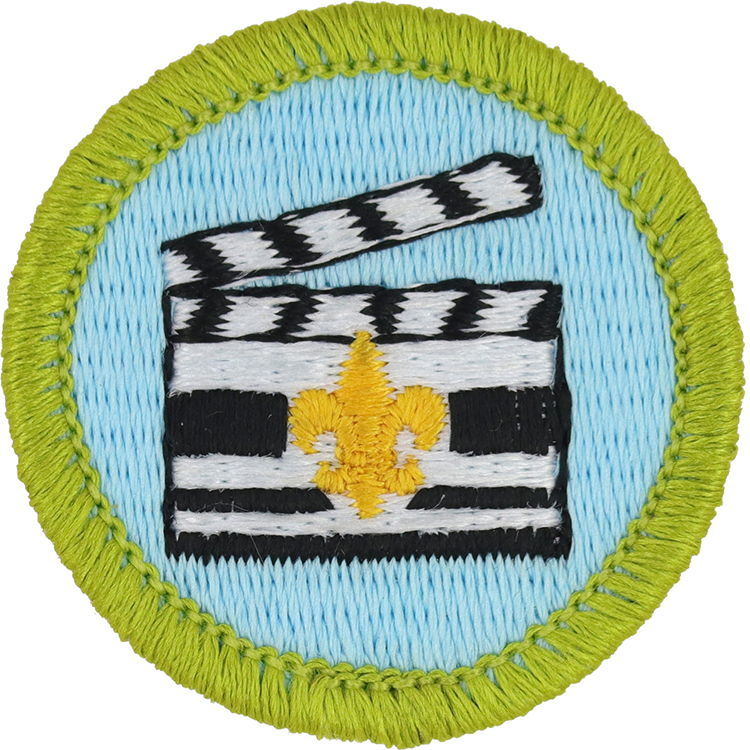
Fig. 1: Cinema-J1-Front
- Embroidery: Rayon thread
- Border: Merrowed
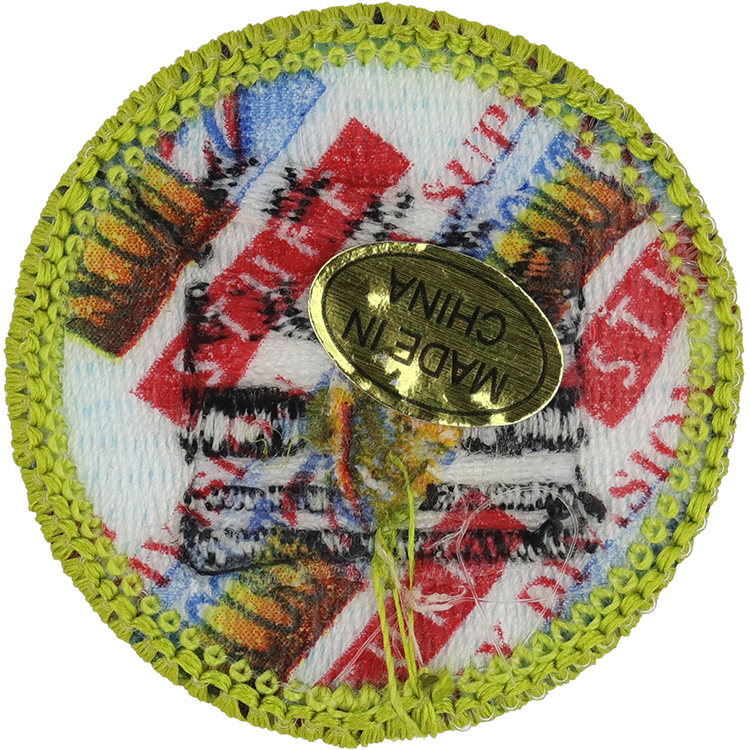
Fig. 2: Cinema-J1-Reverse
- Back: Scout Stuff imprint
Item Name: Cinematography 2002 - 2009
Item ID: Cinema-J1
Collector Rating: 1
Pamphlets Used to Earn this Badge
Requirements September 1989 until January 2002
1. Explain and demonstrate the proper elements of a good motion picture.
2. Do the following:
(a) Tell the story. How does it read on paper?
(b) Prepare a storyboard for your motion picture (this can be with stick figures and rough sketches).
(c) Demonstrate six of the following motion picture shooting techniques.
- Using a tripod/monopod
- Panning the camera/following the action
- Framing
- Lighting the subject
- Ensuring quality of light
- Hand-held shooting
- Recording good sound
- Editing
(d)Do ONE of the following, using techniques in planning a program for your troop or a school. Start with a storyboard, and complete the requirement by presenting it to your troop, patrol, or class.
- Film or videotape a court of honor and edit it to show a 10-to15-minute highlight of the activity.
- Create a minifeature of your own design using the techniques you have learned.
- Film or videotape a vignette that could be used to teach a new Scout a Scouting skill.
3. Do ONE of the following:
(a) Visit and watch how production work is done at a television station, production studio, cable television station, or related operation.
(b) Explain to your counselor the basic parts of a motion picture camera or video camera and how it operates.
4. Explain the jobs related to film or video production: director, producer, audio engineer, video engineer, crew support.
Requirements January 2002 until January 2009
1. Explain and demonstrate the proper elements of a good motion picture.
(a) Visual storytelling
(b) Rhythm
(c) The 180-degree axis rule
(d) Camera movement
(e) Framing and composition of camera shots
(f) lens selection
2. Do the following:
- Tell the story and plan to film in a three- or four-paragraph treatment. How does it read on paper?
- Prepare a storyboard for your motion picture (This can be with rough sketches and stick figures.)
- Demonstrate six of the following motion picture shooting techniques.
- Using a tripod
- Panning the camera
- Framing a shot
- Selecting an angle
- Selecting proper lighting
- Handheld shooting
- Do ONE of the following, using motion picture shooting techniques, in planning a program for your troop or a school. Start with a treatment and complete the requirement by presenting the program to the troop, patrol, or class.
- Film or videotape a court of honor and show it to an audience.
- Create a minifeature of your own design, using the techniques you have learned.
- Shoot a vignette that could be used to train a new Scout in a Scouting skill.
3. Do ONE of the following:
- Visit a film set or television production studio and watch how production work is done.
- Explain to your counselor the elements of the zoom lens and three important parts.
4. Explain the following jobs related to film or video production: director, producer, cinematographer, key grip, gaffer, best boy, assistant camera operator.
Requirements January 2009 until January 2014
1. Do the following:
- Discuss and demonstrate the proper elements of a good motion picture. In your discussion, include visual storytelling, rhythm, the 180-axis rule, camera movement, framing and composition of camera shots, and lens selection.
- Discuss the cinematographer’s role in the moviemaking process.
2. Do the following:
- In a three- or four-paragraph treatment, tell the story you plan to film, making sure that the treatment conveys a visual picture.
- Prepare a storyboard for your motion picture. (This can be done with rough sketches and stick figures.)
- Demonstrate the following motion picture shooting techniques:
- Using a tripod
- Panning a camera
- Framing a shot
- Selecting an angle
- Selecting proper lighting
- Hand-held shooting
- Using motion picture shooting techniques, plan ONE of the following programs. Start with a treatment and complete the requirement by presenting this program to a pack or your troop, patrol, or class.
- Film or videotape a court of honor and show it to an audience.
- Create a short feature of your own design, using the techniques you learned.
- Shoot a vignette that could be used to train a new Scout in a Scouting skill.
3. Do one of the following:
- With your parent’s permission and your counselor’s approval, visit a film set or television production studio and watch how production work is done.
- Explain to your counselor the elements of his own lens and three important parts.
4. Find out three career opportunities in cinematography. Pick one and find out the education, training, and experience required for this profession. Discuss this career with your counselor. Explain why this profession might interest you.