-
Merit Badges
- Legend to identify Merit Badges
- 1910 British Merit Badges
- Square 1911 - 33
- Wide Crimped 1934 & 35
-
Narrow Tan Crimped 1936 - 42
- Tan Heavyweight Cloth with Silk Embroidery and Printed Back 1936 - 37
- Tan Heavyweight Cloth with Silk Embroidery and Plain Back 1937 - 38
- Tan Lightweight Cloth with Silk Embroidery and Plain Back 1938 - 39
- Tan Lightweight Cloth with Cotton Continuous Loop Embroidery and Plain Back 1939 - 42
- Tan Lightweight Cloth with Cotton Lockstitch Embroidery and Plain Back 1939 - 42
- Blue Background 1942 - 46
- Wartime 1942 - 46
- Khaki Narrow Crimped 1946 - 59
- Green Twill Gauze Back 1960 - 68
- Fully Embroidered Merrowed Edge 1960 - 72
- Unprinted Plastic Back 1972 - 01
- Printed Plastic Back 2002 - Current
-
Merit Badge Paper
- Merit Badge Applications
- Merit Badge Cards
-
Merit Badge Pamphlets
- Type 1 White Cover - Rectangle Drawing On Cover
- Type 2 White Cover 5-375" x 8" Title at Top
- Type 3A Tan Cover - 200 Fifth Avenue
- Type 3B Tan Cover - 2 line address New York City
- Type 3C Tan Cover - 2 line address New York N.Y.
- Type 3D Tan Cover - 1 line address New York N.Y.
- Type 4 Standing Scout Cover
- Type 5A War Cover
- Type 5B Red and White
- Type 6 Photo-Red Cover
- Type 7 Full Photo Cover or Bulls-eye Cover
- Type 8 Full Photo - Green Stripe Cover
- Type 9 Full Photo - Red Stripe Cover
- Type 10A Blue Stripe - Logo above bottom blue stripe - FDL centered
- Type 10B - Blue Stripe in bottom of photo area. FDL to left of text
- Special Covers
- Boy Craft Helps
- Merit Badge Counselor's Guides
-
Youth Position
- Junior Assistant Scoutmaster
- Senior Patrol Leader
- Assistant Senior Patrol Leader
- Patrol Leader
- Assistant Patrol Leader
- Troop Guide
- Scribe
- Quartermaster
- Instructor
- Chaplain Aide
- Den Chief
- Librarian
- Musician
- Webmaster
- Bugler
- Troop Historian
- Troop Representative
- Unit Representative
- Leadership Corps
- Honor Guard
- Leave No Trace Trainer
- Outdoor Ethics Guide
-
Patrol Medallions
- Patrol Medallions Introduction
- Legend to identify Patrol Medallions
- Patrol Shoulder Knot-Ribbons
- Felt Handmade Patrol Medallions
- Square Felt Patrol Medallions
- Round Broadcloth Patrol Medallions
- Red Twill Patrol Medallions
- Multi-Color Cloth Patrol Medallions
- Tan Cloth Patrol Medallions
- Patrol Medallion Back Patches
- Woodbadge Patrol Medallion
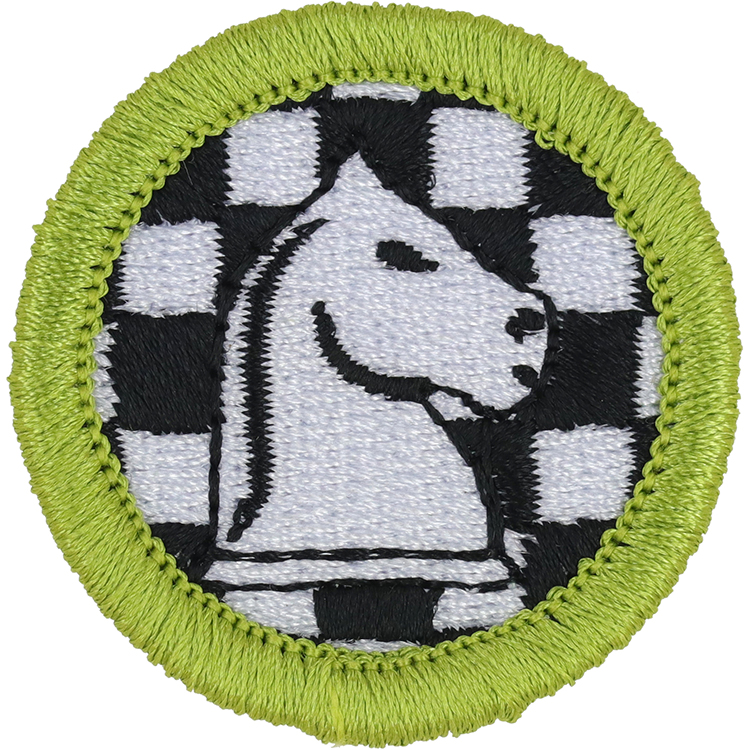
Fig. 1: Chess-K-Front
- Embroidery: Rayon thread
- Border: Merrowed
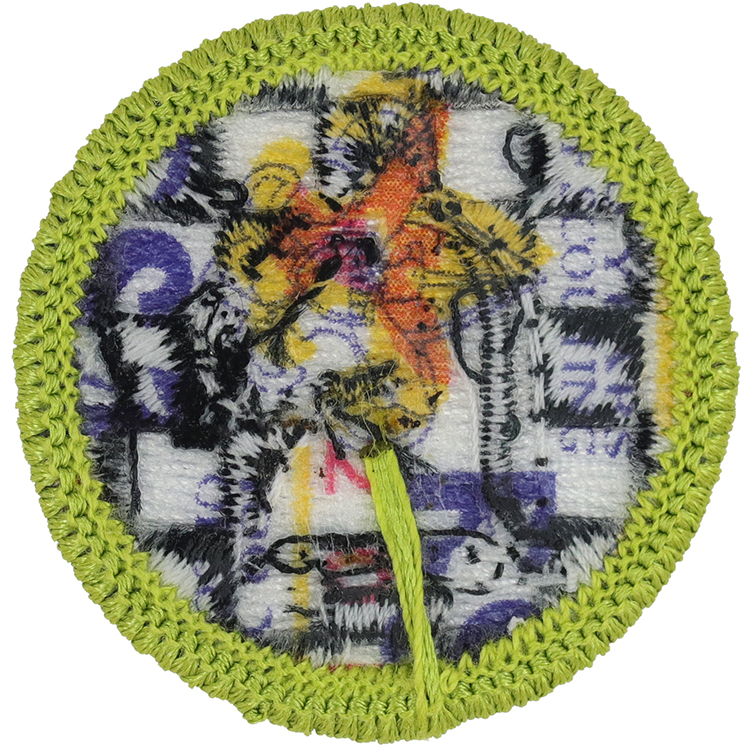
Fig. 2: Chess-K-Reverse
- Back: 100th Anniversary imprint
Item Name: Chess 2012 - 2013
Item ID: Chess-K
Collector Rating: 1
Pamphlets Used to Earn this Badge

Requirements January 2012 until January 2013
1. Discuss with your merit badge counselor the history of the game of chess. Explain why it is considered a game of planning and strategy.
2. Discuss with your merit badge counselor the following:
- The benefits of playing chess, including developing critical thinking skills, concentration skills, and decision-making skills, and how the skills can help you in other areas of your life
- Sportsmanship and chess etiquette
3. Demonstrate to your counselor that you know each of the following. Then, using Scouting’s teaching EDGE, teach the following to a Scout who does not know how to play chess:
- The name of each chess piece
- How to set up a chessboard
- How to each chess piece moves, including canceling and en passant captures
4. Do the following:
- Demonstrate scorekeeping using the algebraic system of chess notation.
- Discuss the differences between the opening, the middle game, and the in game.
- Explain for opening principles.
- Explain the four rules for castling.
- On a chessboard, demonstrate a “scholars mate” and a “fools mate.”
- Demonstrate on a chessboard four ways a chess game can’t end in a draw.
5. Do the following:
- Explain four of the following elements of chess strategy: exploiting weakness, force, King safety, upon structure, space, tempo, time.
- Explain any five of these chess tactics: clearance sacrifice, decoy, discovered attack, double attack, Fort, interposing, overloading, over protecting, pin, remove the defender, skewer, zwischenzug.
- Set up a chessboard with the white king on e1, the white rooks on a1 and h1, and the black king on thee 5. With White to move first, demonstrate how to force Checkmate on the black king.
- Set up and solve five direct-mate problems provided by your merit badge counselor.
6. Do ONE of the following:
- Play at least three games of chess with other Scouts and/or your merit badge counselor. Replay the games from your score sheets and discuss with your counselor how you might have played each came differently.
- Play a scholastic (youth) chess tournament and use your score sheets from that term to replay your games with your merit badge counselor. Discuss with your counselor how you might have played each came differently.
7. Organize and run a chess tournament with at least four players, plus you. Have each competitor play at least two games.
Requirements January 2013 until Current
1. Discuss with your merit badge counselor the history of the game of chess. Explain why it is considered a game of planning and strategy.
2. Discuss with your merit badge counselor the following:
- The benefits of playing chess, including developing critical thinking skills, concentration skills, and decision-making skills, and how the skills can help you in other areas of your life
- Sportsmanship and chess etiquette
3. emonstrate to your counselor that you know each of the following. Then, using Scouting’s Teaching EDGE, teach someone (preferably another Scout) who does not know how to play chess:
- The name of each chess piece
- How to set up a chessboard
- How to each chess piece moves, including canceling and en passant captures
4. Do the following:
- Demonstrate scorekeeping using the algebraic system of chess notation.
- Discuss the differences between the opening, the middle game, and the in game.
- Explain for opening principles.
- Explain the four rules for castling.
- On a chessboard, demonstrate a “scholars mate” and a “fools mate.”
- Demonstrate on a chessboard four ways a chess game can’t end in a draw.
5. Do the following:
- Explain four of the following elements of chess strategy: exploiting weakness, force, King safety, upon structure, space, tempo, time.
- Explain any five of these chess tactics: clearance sacrifice, decoy, discovered attack, double attack, Fort, interposing, overloading, over protecting, pin, remove the defender, skewer, zwischenzug.
- Set up a chessboard with the white king on e1, the white rooks on a1 and h1, and the black king on thee 5. With White to move first, demonstrate how to force Checkmate on the black king.
- Set up and solve five direct-mate problems provided by your merit badge counselor.
6. Do ONE of the following:
- Play at least three games of chess with other Scouts and/or your merit badge counselor. Replay the games from your score sheets and discuss with your counselor how you might have played each came differently.
- Play a scholastic (youth) chess tournament and use your score sheets from that term to replay your games with your merit badge counselor. Discuss with your counselor how you might have played each came differently
- Organize and run a chess tournament with at least four players, plus you. Have each competitor play at least two games.