-
Merit Badges
- Legend to identify Merit Badges
- 1910 British Merit Badges
- Square 1911 - 33
- Wide Crimped 1934 & 35
-
Narrow Tan Crimped 1936 - 42
- Tan Heavyweight Cloth with Silk Embroidery and Printed Back 1936 - 37
- Tan Heavyweight Cloth with Silk Embroidery and Plain Back 1937 - 38
- Tan Lightweight Cloth with Silk Embroidery and Plain Back 1938 - 39
- Tan Lightweight Cloth with Cotton Continuous Loop Embroidery and Plain Back 1939 - 42
- Tan Lightweight Cloth with Cotton Lockstitch Embroidery and Plain Back 1939 - 42
- Blue Background 1942 - 46
- Wartime 1942 - 46
- Khaki Narrow Crimped 1946 - 59
- Green Twill Gauze Back 1960 - 68
- Fully Embroidered Merrowed Edge 1960 - 72
- Unprinted Plastic Back 1972 - 01
- Printed Plastic Back 2002 - Current
-
Merit Badge Paper
- Merit Badge Applications
- Merit Badge Cards
-
Merit Badge Pamphlets
- Type 1 White Cover - Rectangle Drawing On Cover
- Type 2 White Cover 5-375" x 8" Title at Top
- Type 3A Tan Cover - 200 Fifth Avenue
- Type 3B Tan Cover - 2 line address New York City
- Type 3C Tan Cover - 2 line address New York N.Y.
- Type 3D Tan Cover - 1 line address New York N.Y.
- Type 4 Standing Scout Cover
- Type 5A War Cover
- Type 5B Red and White
- Type 6 Photo-Red Cover
- Type 7 Full Photo Cover or Bulls-eye Cover
- Type 8 Full Photo - Green Stripe Cover
- Type 9 Full Photo - Red Stripe Cover
- Type 10A Blue Stripe - Logo above bottom blue stripe - FDL centered
- Type 10B - Blue Stripe in bottom of photo area. FDL to left of text
- Special Covers
- Boy Craft Helps
- Merit Badge Counselor's Guides
-
Youth Position
- Junior Assistant Scoutmaster
- Senior Patrol Leader
- Assistant Senior Patrol Leader
- Patrol Leader
- Assistant Patrol Leader
- Troop Guide
- Scribe
- Quartermaster
- Instructor
- Chaplain Aide
- Den Chief
- Librarian
- Musician
- Webmaster
- Bugler
- Troop Historian
- Troop Representative
- Unit Representative
- Leadership Corps
- Honor Guard
- Leave No Trace Trainer
- Outdoor Ethics Guide
-
Patrol Medallions
- Patrol Medallions Introduction
- Legend to identify Patrol Medallions
- Patrol Shoulder Knot-Ribbons
- Felt Handmade Patrol Medallions
- Square Felt Patrol Medallions
- Round Broadcloth Patrol Medallions
- Red Twill Patrol Medallions
- Multi-Color Cloth Patrol Medallions
- Tan Cloth Patrol Medallions
- Patrol Medallion Back Patches
- Woodbadge Patrol Medallion
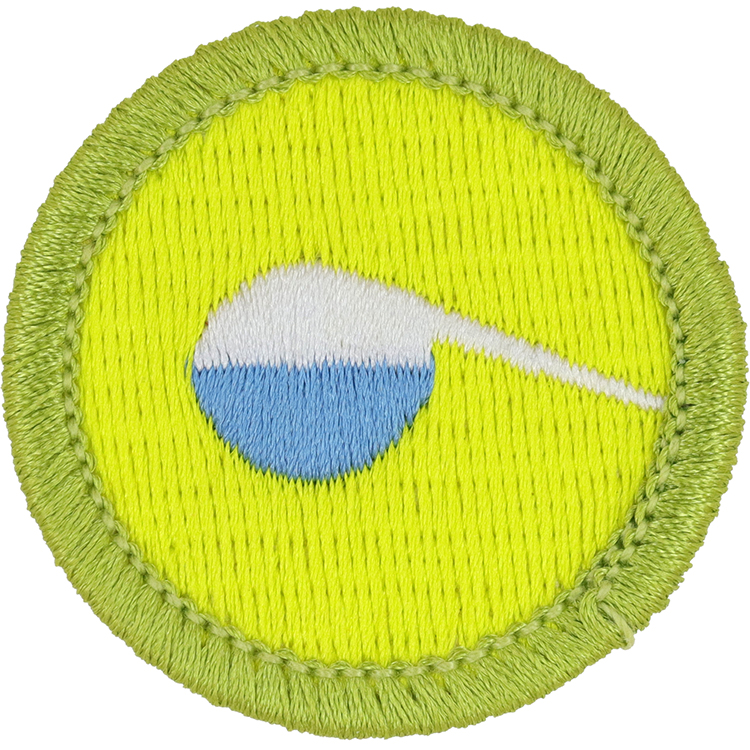
Fig. 1: Chemis-L1-Front
- Embroidery: Rayon thread
- Border: Merrowed
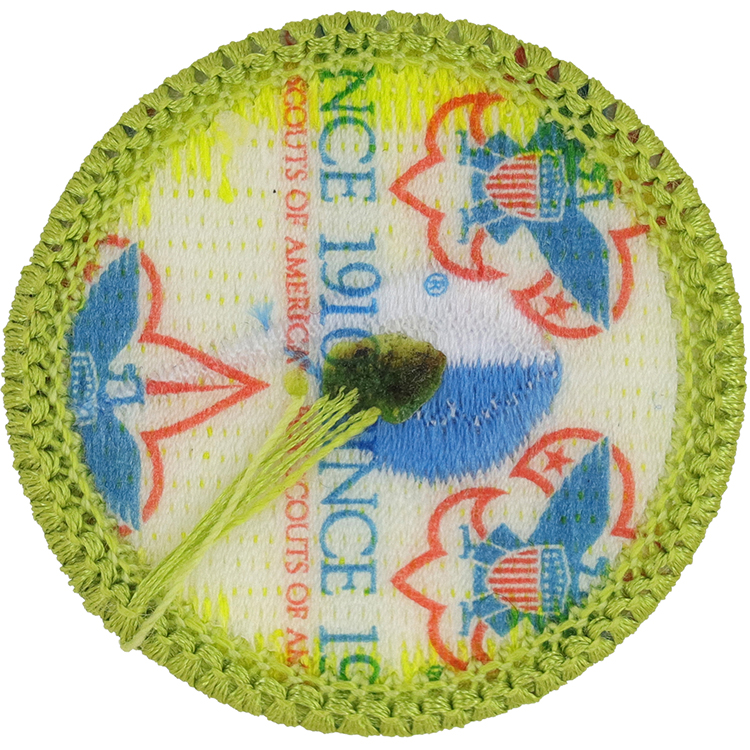
Fig. 2: Chemis-L1-Reverse
- Back: Since 1910 imprint with large Tenderfoot image
Item Name: Chemistry 2014 - Current
Item ID: Chemis-L1
Collector Rating: 1
Pamphlets Used to Earn this Badge

Requirements January 2006 until January 2016
1. Do EACH of the following activities:
(a) Describe three examples of safety equipment used in a chemistry laboratory and the reason each one is used.
(b) Describe what a material safety data sheet (MSDA) is and tell why it is used.
(c) Obtain an MSDS for both a paint and an insecticide. Compare and discuss the toxicity, disposal, and safe-handling sections for those two common household products.
(d) Discuss the safe storage of chemicals. How does the safe storage of chemicals apply to your home, your school, your community, and the environment?
2. Do EACH of the following activities:
(a) Predict what would happen if you placed an iron nail in a copper sulfate solution. Then, put an iron nail in a copper sulfate solution. Describe your observations and make a conclusion based on your observations. Compare your prediction and original conclusion with what actually happened. Write the formula for the reaction that you described.
(b) Describe how you would separate sand from water, table salt from water, oil from water, and gasoline from motor oil. Name the practical processes that require these kinds of separations.
(c) Describe the difference between a chemical reaction and a physical change.
3. Construct a Cartesian diver. Describe its function in terms of how gasses in general behave under different pressures and different temperatures. Describe how the behavior of gases affects a backpacker at high altitudes and a scuba diver underwater.
4. Do EACH of the following activities:
(a) Cut a round onion into small chunks. Separate the onion chunks into three equal portions. Leave the first portion raw. Cook the second portion of onion chunks until the pieces are translucent. Cook the third portion until the onions are caramelized, or brown in color. Taste each type of onion. Describe the taste of raw onions verses partially cooked onion verses caramelized onion. Explain what happens to molecules in the onion during the cooking process.
(b) Describe the chemical similarities and differences between toothpaste and an abrasive household cleaner. Explain how the end use or purpose of a product affects its chemical formulation.
(c) In a clear container, mix a half-cup of water with a tablespoon of oil. Explain why the oil and water do not mix. Find a substance that will help the two combine, and add it to the mixture. Describe what happened, and explain how that substance worked to combine the oil and water.
5. List the four classical divisions of chemistry. Briefly describe each one, and tell how it applies to your everyday life.
6. Do EACH of the following activities:
(a) Name two government agencies that are responsible for tracking in the use of chemicals for commercial or industrial use. Pick one agency and briefly describe its responsibilities to the public and the environment.
(b) Define pollution. Explain the chemical effects of ozone, global warming, and acid rain. Pick a current environmental problem as an example. Briefly describe what people are doing to resolve this hazard and to increase understanding of the problem.
(c) Using reasons from chemistry, describe the effect on the environment of ONE of the following:
(1) The production of aluminum cans or plastic milk cartons
(2) Sulfur from burning coal
(3) Used motor oil
(4) Newspaper
(d) Briefly describe the purpose of phosphates in fertilizer and in laundry detergent. Explain how the use of phosphates in fertilizers affects the environment. Also, explain why phosphates have been removed from laundry detergents.
7. Do ONE of the following activities:
(a) Visit a laboratory and talk to a practicing chemist. Ask what the chemist does and what training and education are needed to work as a chemist.
(b) Using resources found at the library and in periodicals, books, and the Internet (with your parent’s permission), learn about two different kinds of work done by chemists, chemical engineers, chemical technicians, or industrial chemists. For each of the four jobs, find out the education and training requirements.
(c) Visit an industrial plant that makes chemical products or uses chemical processes and describe the processes used. What, if any, pollutants are produced and how are they handled.
(d) Visit a county farm agency or similar governmental agency and learn how chemistry is used to meet the needs of agriculture in your county.
Requirements January 2016 until Current
1. Do EACH of the following activities:
(a) Describe three examples of safety equipment used in a chemistry laboratory and the reason each one is used.
(b) Describe what a safety data sheet (SDA) is and tell why it is used.
(c) Obtain an SDS for both a paint and an insecticide. Compare and discuss the toxicity, disposal, and safe-handling sections for those two common household products.
(d) Discuss the safe storage of chemicals. How does the safe storage of chemicals apply to your home, your school, your community, and the environment?
2. Do EACH of the following activities:
(a) Predict what would happen if you placed an iron nail in a copper sulfate solution. Then, put an iron nail in a copper sulfate solution. Describe your observations and make a conclusion based on your observations. Compare your prediction and original conclusion with what actually happened. Write the formula for the reaction that you described.
(b) Describe how you would separate sand from water, table salt from water, oil from water, and gasoline from motor oil. Name the practical processes that require these kinds of separations.
(c) Describe the difference between a chemical reaction and a physical change.
3. Construct a Cartesian diver. Describe its function in terms of how gasses in general behave under different pressures and different temperatures. Describe how the behavior of gases affects a backpacker at high altitudes and a scuba diver underwater.
4. Do EACH of the following activities:
(a) Cut a round onion into small chunks. Separate the onion chunks into three equal portions. Leave the first portion raw. Cook the second portion of onion chunks until the pieces are translucent. Cook the third portion until the onions are caramelized, or brown in color. Taste each type of onion. Describe the taste of raw onions verses partially cooked onion verses caramelized onion. Explain what happens to molecules in the onion during the cooking process.
(b) Describe the chemical similarities and differences between toothpaste and an abrasive household cleaner. Explain how the end use or purpose of a product affects its chemical formulation.
(c) In a clear container, mix a half-cup of water with a tablespoon of oil. Explain why the oil and water do not mix. Find a substance that will help the two combine, and add it to the mixture. Describe what happened, and explain how that substance worked to combine the oil and water.
5. List the four classical divisions of chemistry. Briefly describe each one, and tell how it applies to your everyday life.
6. Do EACH of the following activities:
(a) Name two government agencies that are responsible for tracking in the use of chemicals for commercial or industrial use. Pick one agency and briefly describe its responsibilities to the public and the environment.
(b) Define pollution. Explain the chemical effects of ozone, global warming, and acid rain. Pick a current environmental problem as an example. Briefly describe what people are doing to resolve this hazard and to increase understanding of the problem.
(c) Using reasons from chemistry, describe the effect on the environment of ONE of the following:
(1) The production of aluminum cans or plastic milk cartons
(2) Sulfur from burning coal
(3) Used motor oil
(4) Newspaper
(d) Briefly describe the purpose of phosphates in fertilizer and in laundry detergent. Explain how the use of phosphates in fertilizers affects the environment. Also, explain why phosphates have been removed from laundry detergents.
7. Do ONE of the following activities:
(a) Visit a laboratory and talk to a practicing chemist. Ask what the chemist does and what training and education are needed to work as a chemist.
(b) Using resources found at the library and in periodicals, books, and the Internet (with your parent’s permission), learn about two different kinds of work done by chemists, chemical engineers, chemical technicians, or industrial chemists. For each of the four positions, find out the education and training requirements.
(c) Visit an industrial plant that makes chemical products or uses chemical processes and describe the processes used. What, if any, pollutants are produced and how are they handled.
(d) Visit a county farm agency or similar governmental agency and learn how chemistry is used to meet the needs of agriculture in your county.