-
Merit Badges
- Legend to identify Merit Badges
- 1910 British Merit Badges
- Square 1911 - 33
- Wide Crimped 1934 & 35
-
Narrow Tan Crimped 1936 - 42
- Tan Heavyweight Cloth with Silk Embroidery and Printed Back 1936 - 37
- Tan Heavyweight Cloth with Silk Embroidery and Plain Back 1937 - 38
- Tan Lightweight Cloth with Silk Embroidery and Plain Back 1938 - 39
- Tan Lightweight Cloth with Cotton Continuous Loop Embroidery and Plain Back 1939 - 42
- Tan Lightweight Cloth with Cotton Lockstitch Embroidery and Plain Back 1939 - 42
- Blue Background 1942 - 46
- Wartime 1942 - 46
- Khaki Narrow Crimped 1946 - 59
- Green Twill Gauze Back 1960 - 68
- Fully Embroidered Merrowed Edge 1960 - 72
- Unprinted Plastic Back 1972 - 01
- Printed Plastic Back 2002 - Current
-
Merit Badge Paper
- Merit Badge Applications
- Merit Badge Cards
-
Merit Badge Pamphlets
- Type 1 White Cover - Rectangle Drawing On Cover
- Type 2 White Cover 5-375" x 8" Title at Top
- Type 3A Tan Cover - 200 Fifth Avenue
- Type 3B Tan Cover - 2 line address New York City
- Type 3C Tan Cover - 2 line address New York N.Y.
- Type 3D Tan Cover - 1 line address New York N.Y.
- Type 4 Standing Scout Cover
- Type 5A War Cover
- Type 5B Red and White
- Type 6 Photo-Red Cover
- Type 7 Full Photo Cover or Bulls-eye Cover
- Type 8 Full Photo - Green Stripe Cover
- Type 9 Full Photo - Red Stripe Cover
- Type 10A Blue Stripe - Logo above bottom blue stripe - FDL centered
- Type 10B - Blue Stripe in bottom of photo area. FDL to left of text
- Special Covers
- Boy Craft Helps
- Merit Badge Counselor's Guides
-
Youth Position
- Junior Assistant Scoutmaster
- Senior Patrol Leader
- Assistant Senior Patrol Leader
- Patrol Leader
- Assistant Patrol Leader
- Troop Guide
- Scribe
- Quartermaster
- Instructor
- Chaplain Aide
- Den Chief
- Librarian
- Musician
- Webmaster
- Bugler
- Troop Historian
- Troop Representative
- Unit Representative
- Leadership Corps
- Honor Guard
- Leave No Trace Trainer
- Outdoor Ethics Guide
-
Patrol Medallions
- Patrol Medallions Introduction
- Legend to identify Patrol Medallions
- Patrol Shoulder Knot-Ribbons
- Felt Handmade Patrol Medallions
- Square Felt Patrol Medallions
- Round Broadcloth Patrol Medallions
- Red Twill Patrol Medallions
- Multi-Color Cloth Patrol Medallions
- Tan Cloth Patrol Medallions
- Patrol Medallion Back Patches
- Woodbadge Patrol Medallion
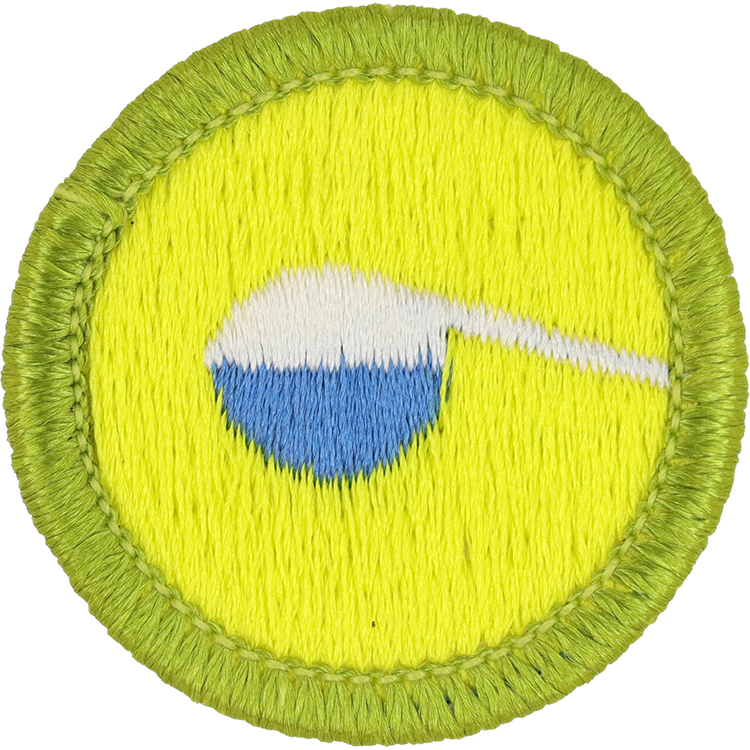
Fig. 1: Chemis-H5-Front
- Embroidery: Rayon thread
- Border: Merrowed

Fig. 2: Chemis-H5-Reverse
- Back: Molded plastic
Item Name: Chemistry 1990 - 2002
Item ID: Chemis-H5
Collector Rating: 1
Pamphlets Used to Earn this Badge

Requirements August 1982 until September 1991
1. Show that a candle flame uses up oxygen from the air, makes carbon dioxide, and makes water. Demonstrate that heating sawdust or wood chips makes a gas that burns.
2. Write the formulas for six compounds in water that make it hard. Write an equation that describes how a home water softener works. Show the difference in how soap and a detergent act in hard water.
3. Write the simple equation for photosynthesis. Explain what parts sunlight and chlorophyll play in it. Give the three main parts of a 10-6-4 fertilizer. Explain what each one does for plants. Draw from memory a sketch of the carbon dioxide oxygen cycle.
4. Explain what oxygen does in the animal body. Describe how oxygen, carbon dioxide, and carbon monoxide are carried in the body. Describe the chemical changes taking place when vegetables cook, meat cooks, bread dough rises, bread bakes, and bread is chewed.
5. Carry out an experiment to show three different ways of protecting iron or steel from rusting. Tell why aluminum doesn't rust the way iron does. Do an experiment in which one metal makes another metal deposit from solution. Explain what takes place in terms of the activity series of metals.
6. Do THREE of the following:
(a) Prepare an indicator from a plant leaf or bloom. Show that it works when vinegar neutralizes baking soda solution.
(b) Compare the strengths of 5 percent solution of baking soda and borax by titrating each with vinegar.
(c) Test two different bits of food for starch and for protein.
(d) Compare the amounts of vitamin C in two kinds of fruit juice.
(e) Show that an ink or food color has two or more colors by using paper chromatography.
7. Name two chemicals that cause air, water, or solid waste pollution near your home. Tell where these pollutants may have come from. Find one way to control one of them. Do ne test to show that air or water is polluted.
8. Do ONE of the following:
(a) Visit a plant that makes chemical products or uses chemical processes. Describe the processes used. What, if any, pollutants are produced? How are they handled?
(b) Visit a laboratory or place of business that uses chemicals. Find out how and why the chemicals are used.
(c) Visit a county agent to learn how chemistry is meeting farm problems of soil fertility and crop pests.
9. Describe two different kinds of work done by chemists, chemical engineers, and chemical technicians. Explain the differences in college courses for training each of these three kinds of people.
Requirements September 1991 until January 2005
1. Define chemistry and tell what chemicals are.
(a) Make a list of 10 chemicals found in your home and their use.
(b) Tell how chemicals in your home are safely stored and how to dispose of them safely.
(c) Tell the difference between a chemical reaction and a physical change.
2. Tell what analytic chemists do.
Do three of the following:
(a) Prepare an indicator from a plant leaf or bloom. Show that it works when vinegar neutralizes a baking soda solution.
(b) Compare the strengths of 5 percent solutions of baking soda and borax by titrating each with vinegar.
(c) Test two different bits of food for starch and for protein.
(d) Compare the amounts of vitamin C in two kinds of fruit juice.
(e) Show that an ink or food color has two or more colors by using paper chromatography.
3. Define biochemistry.
(a) Write the simple equation for photosynthesis. Explain what parts sunlight and chlorophyll play in it. Give the names and symbols of the three parts of a 10-6-4 fertilizer. Explain what each does for plants. Draw from memory a sketch of the carbon dioxide-oxygen cycle.
(b) Explain what oxygen does in the body of an animal. Describe how oxygen, carbon dioxide, and carbon monoxide are carried in the body. Describe the chemical changes taking place when
- Vegetables cook
- Meat cooks
- Bread dough rises
- Bread bakes
- Bread is chewed
4. Define inorganic chemistry. Carry out an experiment to show three different ways of protecting iron or steel from rusting. Tell why aluminum doesn't rust the way iron does. Do an experiment in which one metal makes another metal deposit from solution. Explain what takes place in terms of the activity series of metals.
5. Define organic chemistry.
(a) What are organic chemicals?
(b) Name three organic chemicals.
(c) Tell the difference between polar and nonpolar.
(d) Show how polar and nonpolar substances do not mix.
6. Define physical chemistry.
(a) Construct a Cartesian diver.
(b) Explain why the medicine dropper sinks to the bottom when the sides are squeezed.
7. (a) Name two chemicals that cause air, water, or solid waste pollution near your home. Tell where these pollutants might have come from. Find one way to control one of these. Do one test to show that air or water is polluted.
(b) Do one of the following:
(1) Write the formula for ozone. Tell where it is found. Tell how it is both a pollutant and also necessary for a healthy environment.
(2) Write the formula for carbon dioxide. How can it cause the greenhouse effect?
(3) Write the formula for sulfur dioxide. Explain what acid rain is. What does pH measure? Measure the pH of rain or a body of water near your home. Tell how acid rain can be prevented.
8. Do one of the following:
(a) Visit a plant that makes chemical products or uses chemical processes. Describe the processes used. What, if any, pollutants are produced? How are they handled?
(b) Visit a laboratory or place of business that uses chemicals. Find out how and why the chemicals are used.
(c) Visit a county agent to learn how chemistry is meeting farm problems of soil fertility and crop pests.
9. Describe two different kinds of work done by chemists, chemical engineers, and chemical technicians. Explain the differences in college courses for training each of these three kinds of people.