-
Merit Badges
- Legend to identify Merit Badges
- 1910 British Merit Badges
- Square 1911 - 33
- Wide Crimped 1934 & 35
-
Narrow Tan Crimped 1936 - 42
- Tan Heavyweight Cloth with Silk Embroidery and Printed Back 1936 - 37
- Tan Heavyweight Cloth with Silk Embroidery and Plain Back 1937 - 38
- Tan Lightweight Cloth with Silk Embroidery and Plain Back 1938 - 39
- Tan Lightweight Cloth with Cotton Continuous Loop Embroidery and Plain Back 1939 - 42
- Tan Lightweight Cloth with Cotton Lockstitch Embroidery and Plain Back 1939 - 42
- Blue Background 1942 - 46
- Wartime 1942 - 46
- Khaki Narrow Crimped 1946 - 59
- Green Twill Gauze Back 1960 - 68
- Fully Embroidered Merrowed Edge 1960 - 72
- Unprinted Plastic Back 1972 - 01
- Printed Plastic Back 2002 - Current
-
Merit Badge Paper
- Merit Badge Applications
- Merit Badge Cards
-
Merit Badge Pamphlets
- Type 1 White Cover - Rectangle Drawing On Cover
- Type 2 White Cover 5-375" x 8" Title at Top
- Type 3A Tan Cover - 200 Fifth Avenue
- Type 3B Tan Cover - 2 line address New York City
- Type 3C Tan Cover - 2 line address New York N.Y.
- Type 3D Tan Cover - 1 line address New York N.Y.
- Type 4 Standing Scout Cover
- Type 5A War Cover
- Type 5B Red and White
- Type 6 Photo-Red Cover
- Type 7 Full Photo Cover or Bulls-eye Cover
- Type 8 Full Photo - Green Stripe Cover
- Type 9 Full Photo - Red Stripe Cover
- Type 10A Blue Stripe - Logo above bottom blue stripe - FDL centered
- Type 10B - Blue Stripe in bottom of photo area. FDL to left of text
- Special Covers
- Boy Craft Helps
- Merit Badge Counselor's Guides
-
Youth Position
- Junior Assistant Scoutmaster
- Senior Patrol Leader
- Assistant Senior Patrol Leader
- Patrol Leader
- Assistant Patrol Leader
- Troop Guide
- Scribe
- Quartermaster
- Instructor
- Chaplain Aide
- Den Chief
- Librarian
- Musician
- Webmaster
- Bugler
- Troop Historian
- Troop Representative
- Unit Representative
- Leadership Corps
- Honor Guard
- Leave No Trace Trainer
- Outdoor Ethics Guide
-
Patrol Medallions
- Patrol Medallions Introduction
- Legend to identify Patrol Medallions
- Patrol Shoulder Knot-Ribbons
- Felt Handmade Patrol Medallions
- Square Felt Patrol Medallions
- Round Broadcloth Patrol Medallions
- Red Twill Patrol Medallions
- Multi-Color Cloth Patrol Medallions
- Tan Cloth Patrol Medallions
- Patrol Medallion Back Patches
- Woodbadge Patrol Medallion
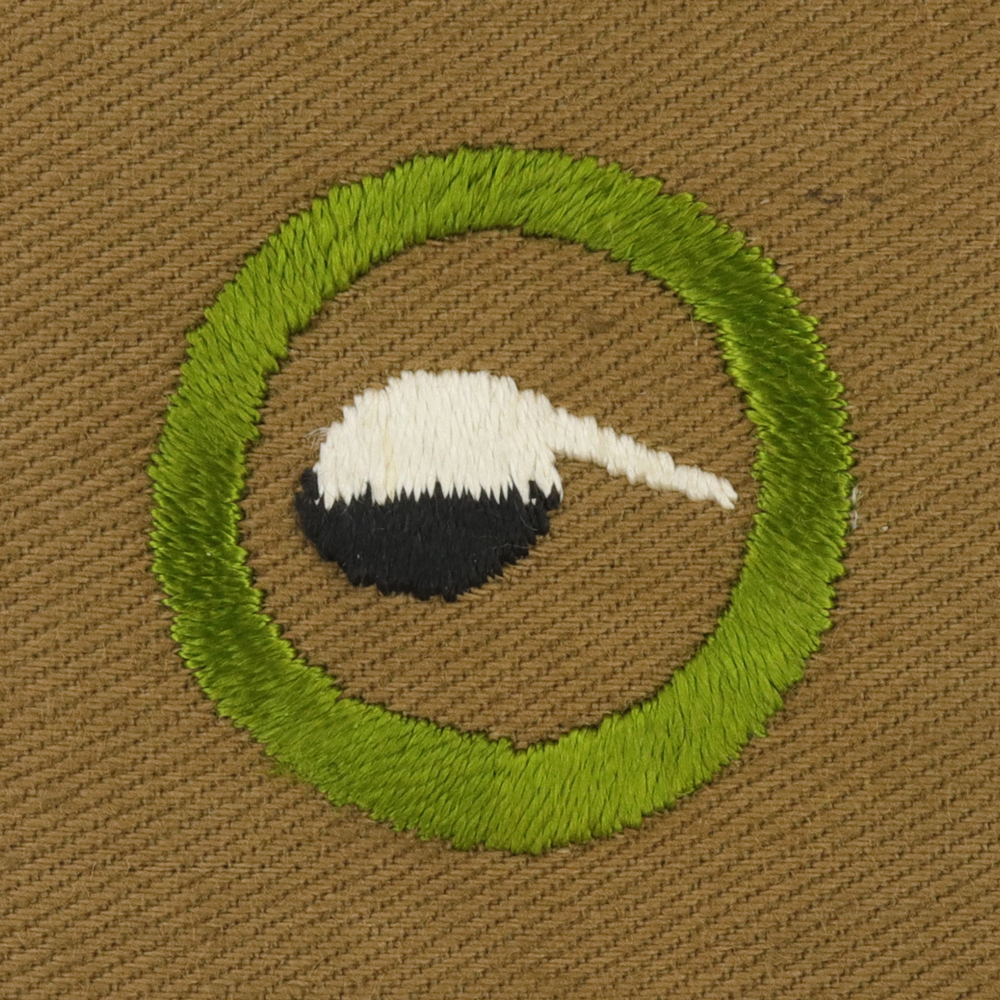
Fig. 1: Chemis-AH6-Front
- Cloth: Heavyweight tan right twill
- Embroidery: Silk continuous
- Border: Clockwise, round & dense
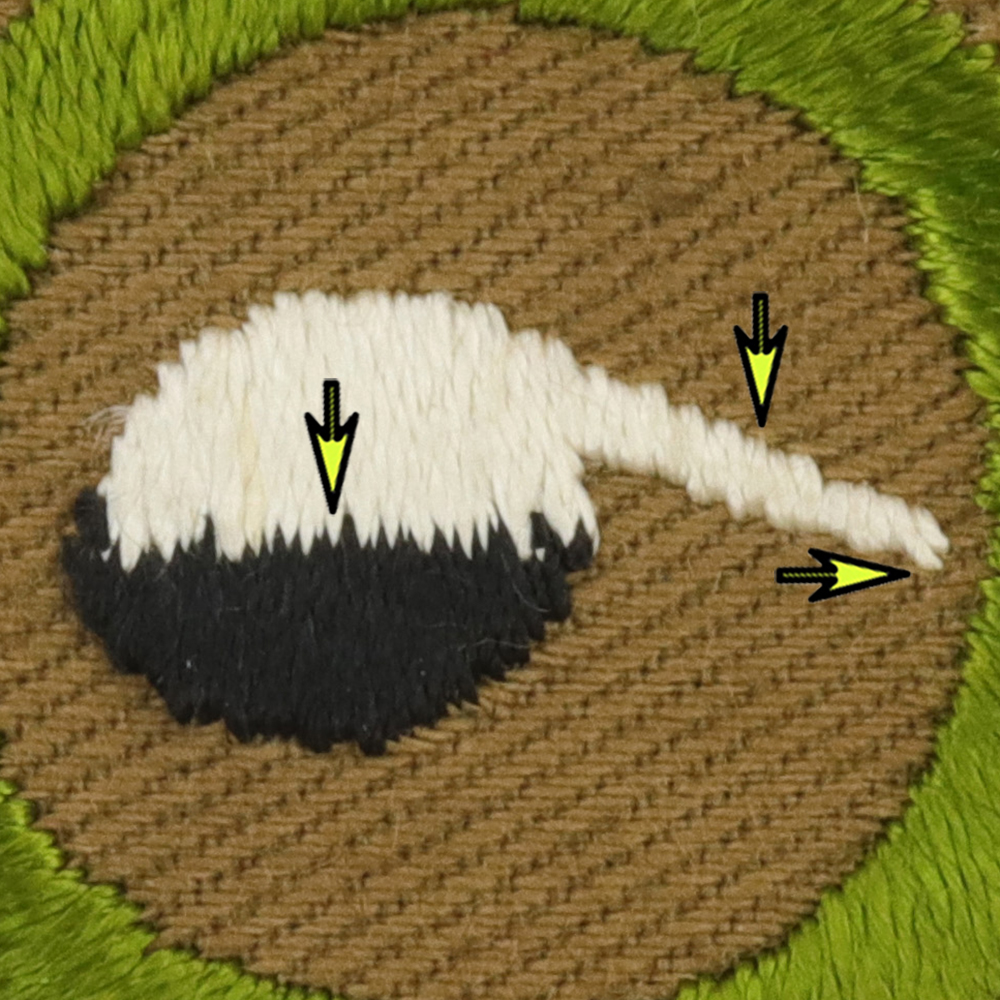
Fig. 2: Chemis-AH6-Magnified
- Design: Fluid line horizontal, ovalish bowl, long straight neck that ends just below the fluid line
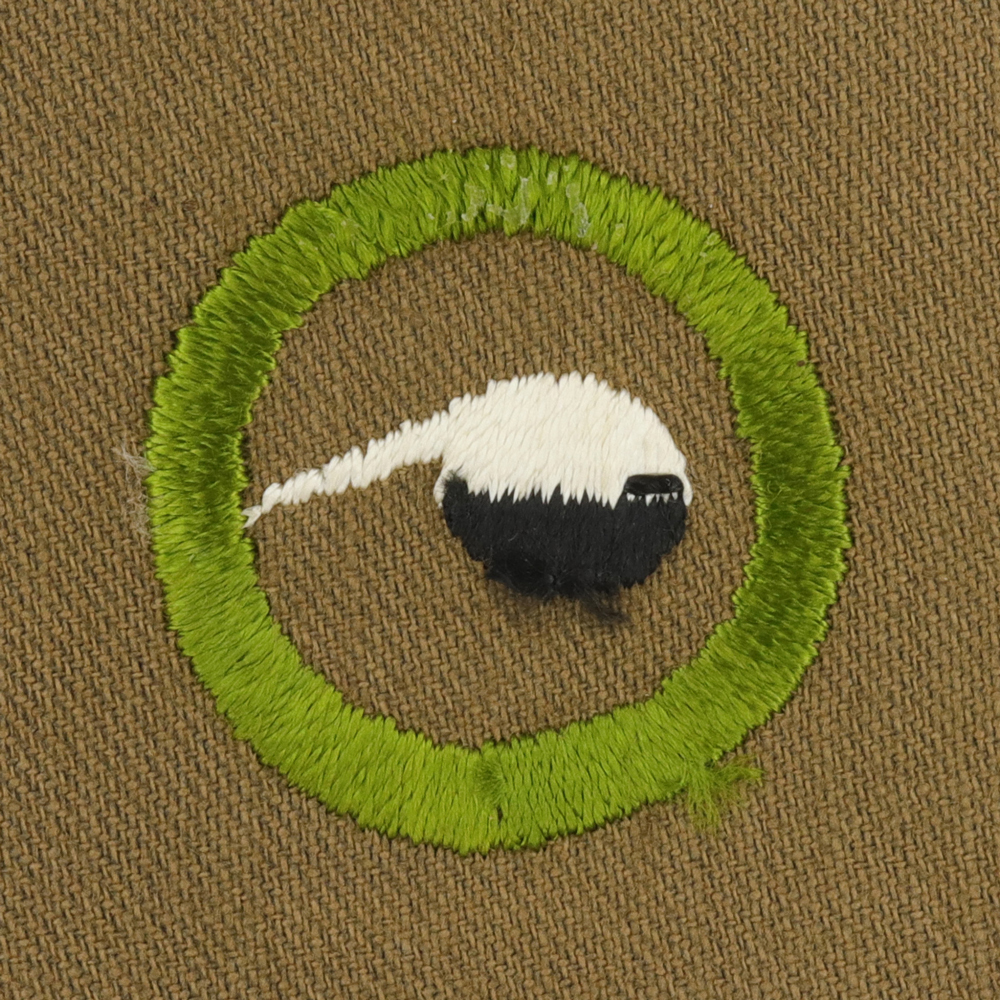
Fig. 3: Chemis-AH6-Reverse
- Back: Brown imprint
Item Name: Chemistry 1913 - 1921
Item ID: Chemis-AH6
Collector Rating: 1
Pamphlets Used to Earn this Badge
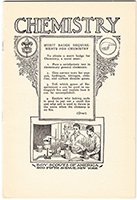
Requirements August 1911 until October 1914
1. Define physical and chemical change. Which occurs when salt is dissolved in water, milk sours, iron rusts, water boils, iron is magnetized and mercuric oxide is heated above the boiling point of mercury?
2. Give correct tests for oxygen, hydrogen, nitrogen, chlorine, and carbon dioxide gases.
3. Could you use the above gases to extinguish fire? How?
4. Why can baking soda be used to put out a small fire?
5. Give tests for a chloride, sulphide, sulphate, nitrate, and carbonate.
6. Give the names of three commercial forms of carbon. Tell how each is made and the purpose for which it is used.
7. What compound is formed when carbon is burned in air?
8. Tell process of making lime and mortar from limestone.
9. Why will fresh plaster harden quicker by burning charcoal in an open vessel near it
Requirements October 1914 until April 1929
1. Pass a satisfactory test in elementary general chemistry.
2. Give correct tests for oxygen, hydrogen, nitrogen, chlorine, and carbon dioxide gases.
3. Tell which gases of Requirement 2 can be used to extinguish fire and explain how it can be accomplished.
4. Explain why baking soda is used to put out a small fire and why salt is used to throw in the stove when the chimney is on fire.
5. Explain the use of analytical weights in chemical analysis. Tell how a quantitative analysis differs from a qualitative analysis.
6. Give three commercial forms of carbon and tell how each is obtained. State what forms, if any, have been prepared artificially and how.
7. Explain the process of making lime and mortar from limestone.
8. Explain the process of making charcoal. Tell what gas is formed by burning of any form of carbon and what becomes of it.
9. Describe from observation a manufacturing plant which employs chemical process or processes.