-
Merit Badges
- Legend to identify Merit Badges
- 1910 British Merit Badges
- Square 1911 - 33
- Wide Crimped 1934 & 35
-
Narrow Tan Crimped 1936 - 42
- Tan Heavyweight Cloth with Silk Embroidery and Printed Back 1936 - 37
- Tan Heavyweight Cloth with Silk Embroidery and Plain Back 1937 - 38
- Tan Lightweight Cloth with Silk Embroidery and Plain Back 1938 - 39
- Tan Lightweight Cloth with Cotton Continuous Loop Embroidery and Plain Back 1939 - 42
- Tan Lightweight Cloth with Cotton Lockstitch Embroidery and Plain Back 1939 - 42
- Blue Background 1942 - 46
- Wartime 1942 - 46
- Khaki Narrow Crimped 1946 - 59
- Green Twill Gauze Back 1960 - 68
- Fully Embroidered Merrowed Edge 1960 - 72
- Unprinted Plastic Back 1972 - 01
- Printed Plastic Back 2002 - Current
-
Merit Badge Paper
- Merit Badge Applications
- Merit Badge Cards
-
Merit Badge Pamphlets
- Type 1 White Cover - Rectangle Drawing On Cover
- Type 2 White Cover 5-375" x 8" Title at Top
- Type 3A Tan Cover - 200 Fifth Avenue
- Type 3B Tan Cover - 2 line address New York City
- Type 3C Tan Cover - 2 line address New York N.Y.
- Type 3D Tan Cover - 1 line address New York N.Y.
- Type 4 Standing Scout Cover
- Type 5A War Cover
- Type 5B Red and White
- Type 6 Photo-Red Cover
- Type 7 Full Photo Cover or Bulls-eye Cover
- Type 8 Full Photo - Green Stripe Cover
- Type 9 Full Photo - Red Stripe Cover
- Type 10A Blue Stripe - Logo above bottom blue stripe - FDL centered
- Type 10B - Blue Stripe in bottom of photo area. FDL to left of text
- Special Covers
- Boy Craft Helps
- Merit Badge Counselor's Guides
-
Youth Position
- Junior Assistant Scoutmaster
- Senior Patrol Leader
- Assistant Senior Patrol Leader
- Patrol Leader
- Assistant Patrol Leader
- Troop Guide
- Scribe
- Quartermaster
- Instructor
- Chaplain Aide
- Den Chief
- Librarian
- Musician
- Webmaster
- Bugler
- Troop Historian
- Troop Representative
- Unit Representative
- Leadership Corps
- Honor Guard
- Leave No Trace Trainer
- Outdoor Ethics Guide
-
Patrol Medallions
- Patrol Medallions Introduction
- Legend to identify Patrol Medallions
- Patrol Shoulder Knot-Ribbons
- Felt Handmade Patrol Medallions
- Square Felt Patrol Medallions
- Round Broadcloth Patrol Medallions
- Red Twill Patrol Medallions
- Multi-Color Cloth Patrol Medallions
- Tan Cloth Patrol Medallions
- Patrol Medallion Back Patches
- Woodbadge Patrol Medallion
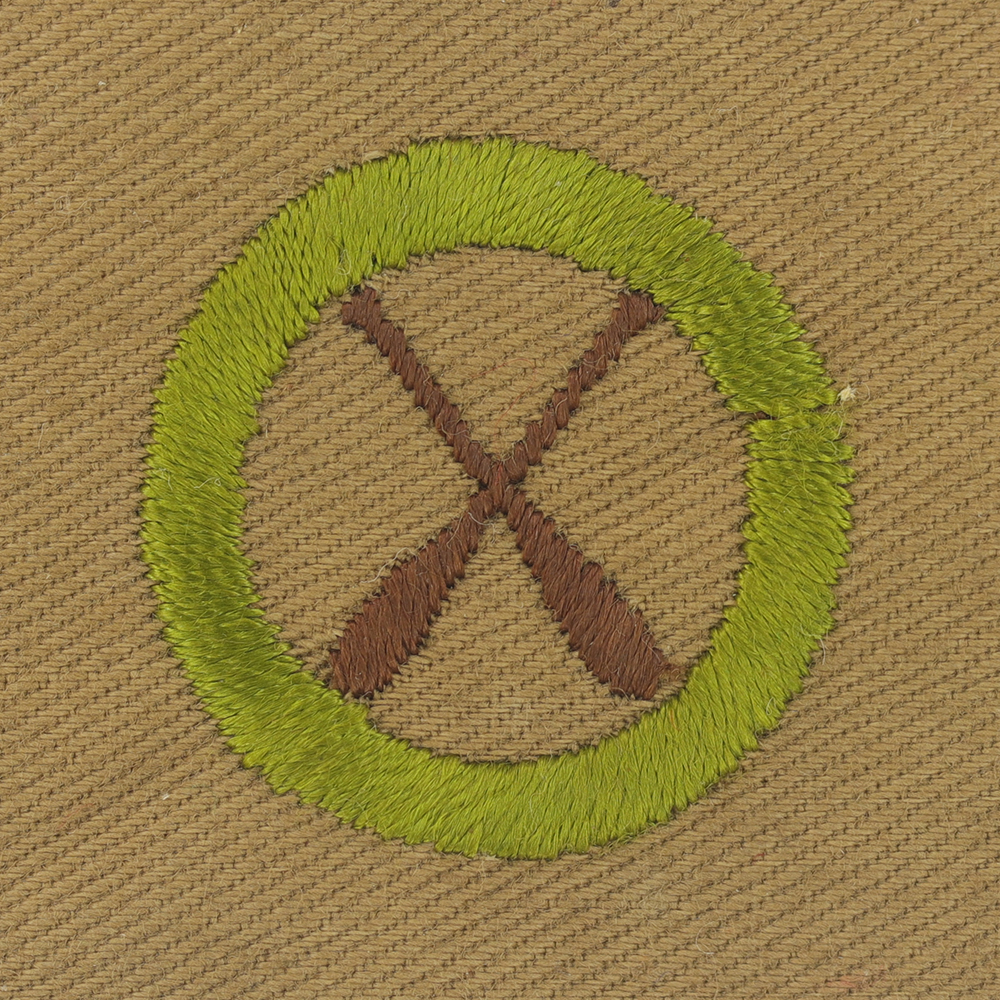
Fig. 1: Canoei-AT1-Front
- Cloth: Heavyweight tan right twill
- Embroidery: Silk continuous
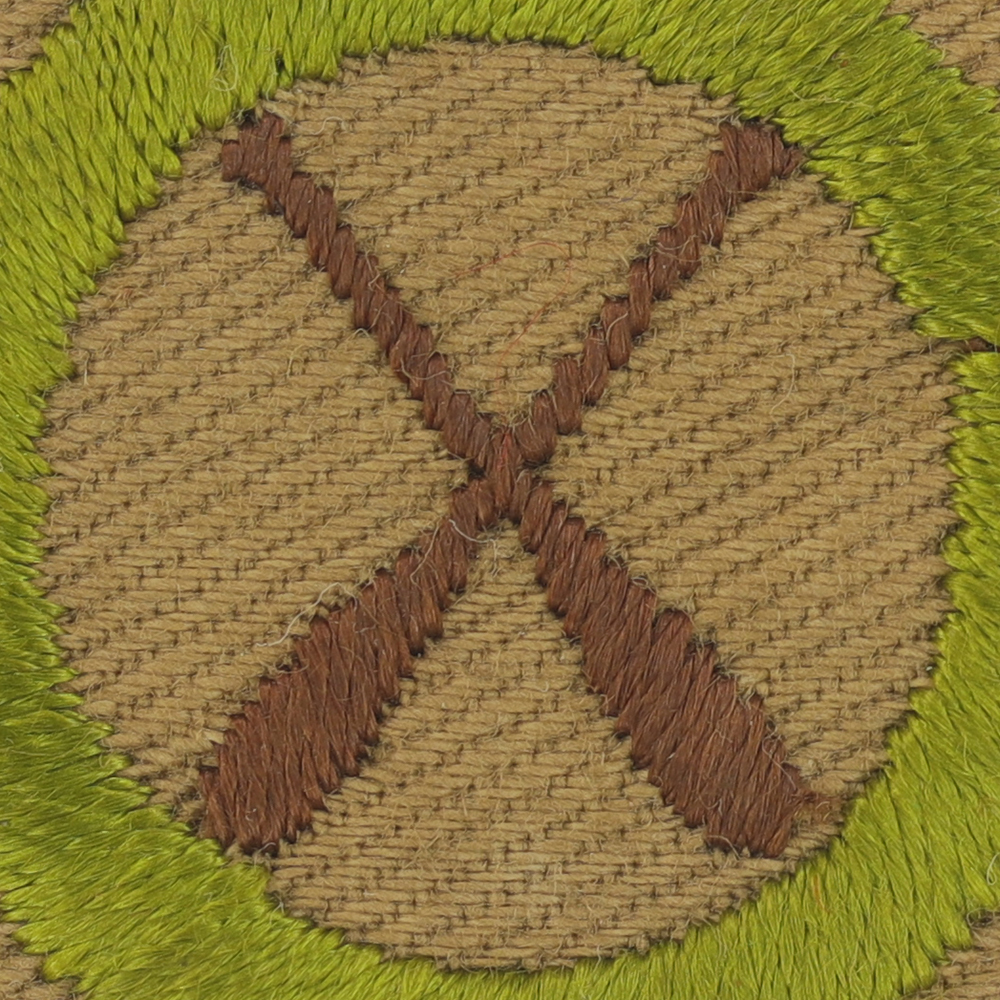
Fig. 2: Canoei-AT1-Magnified
- Design: Crossed paddles
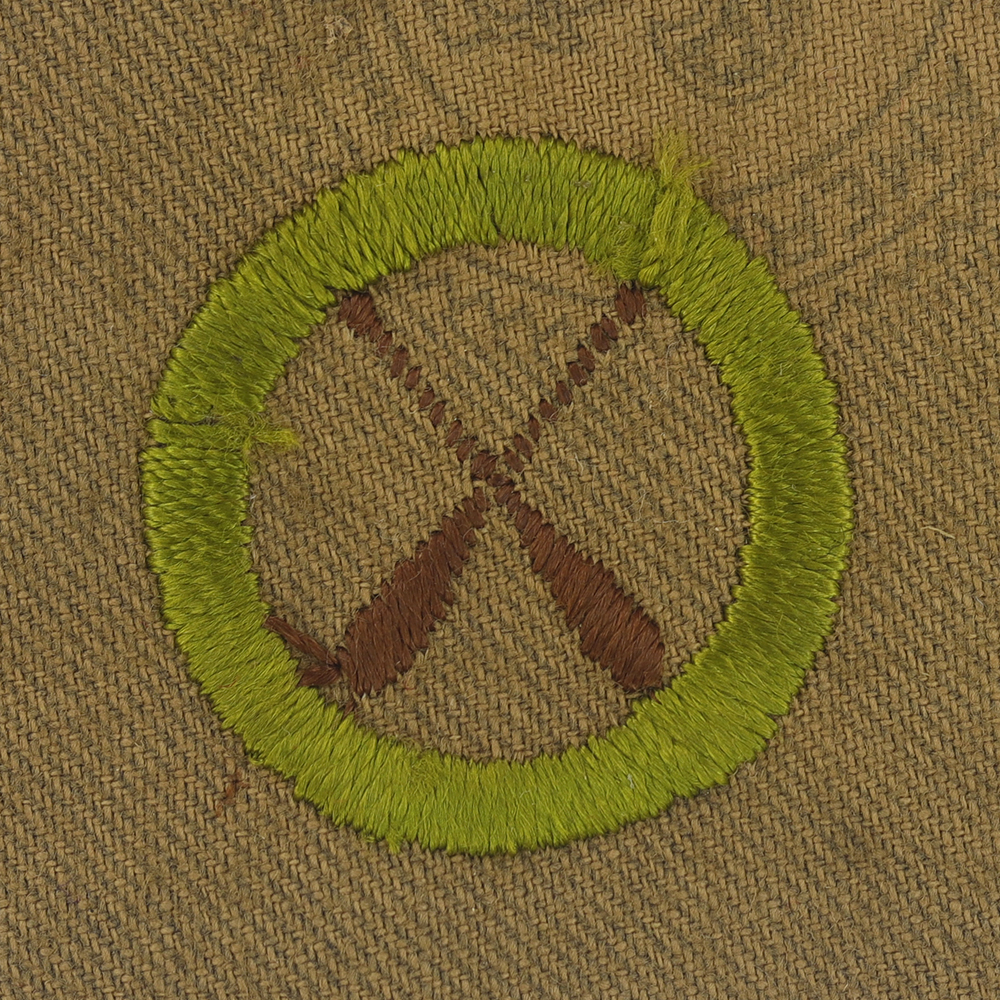
Fig. 3: Canoei-AT1-Reverse
- Back: Black imprint
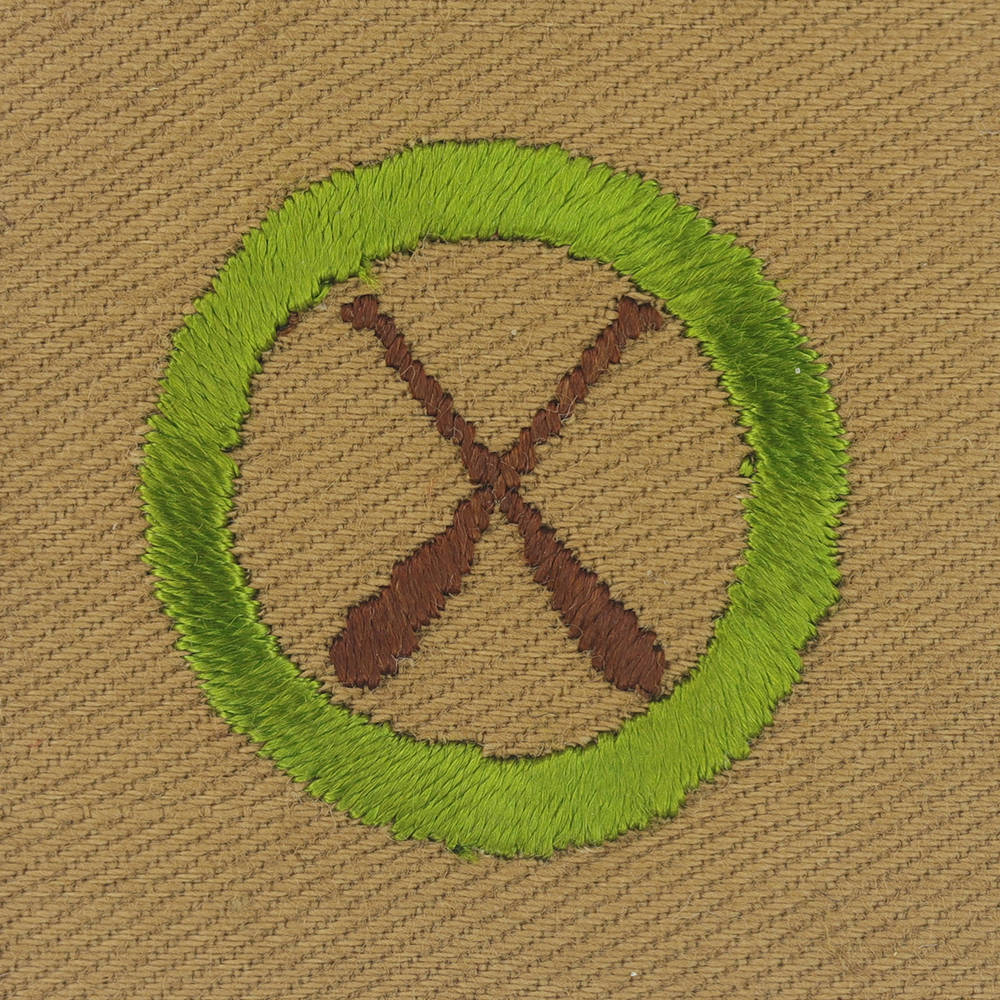
Fig. 4: Canoei-AT1-mve1-front
- Minor variation: Thin paddles
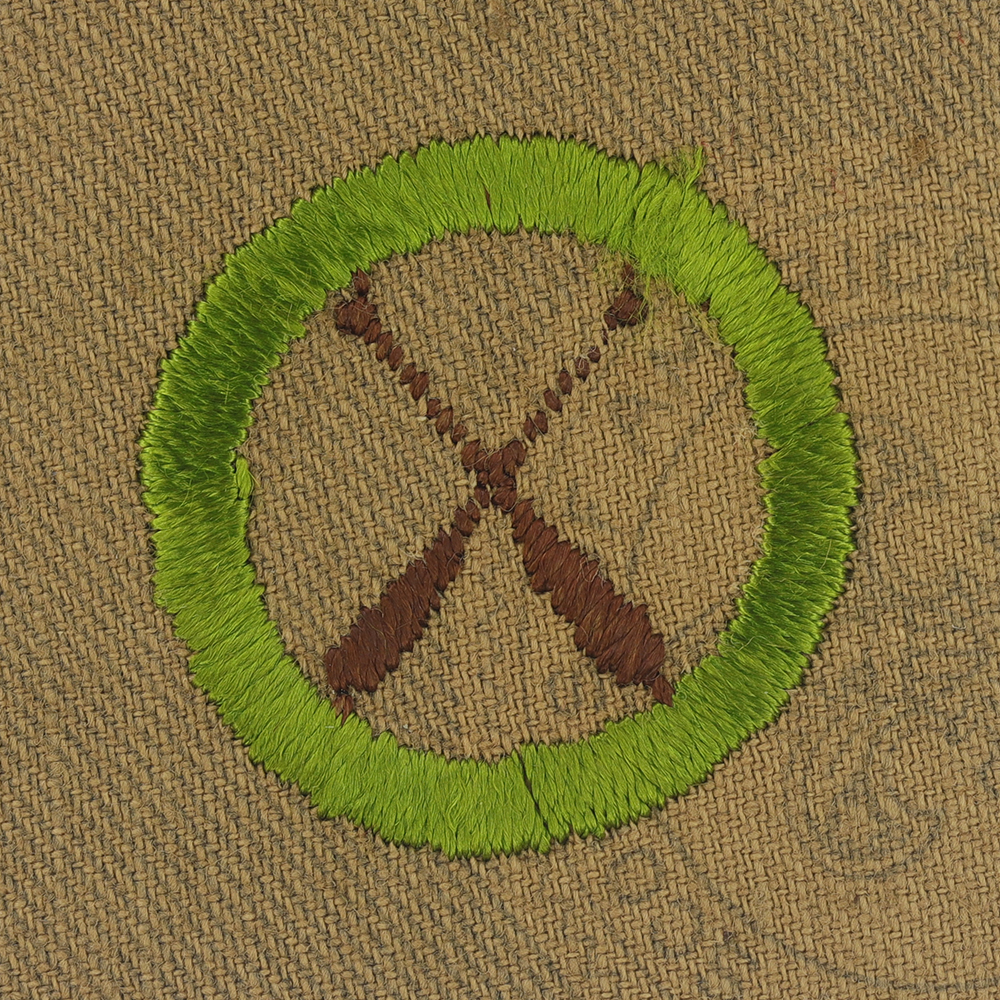
Fig. 5: Canoei-AT1-mve1-reverse
- Back: Black imprint
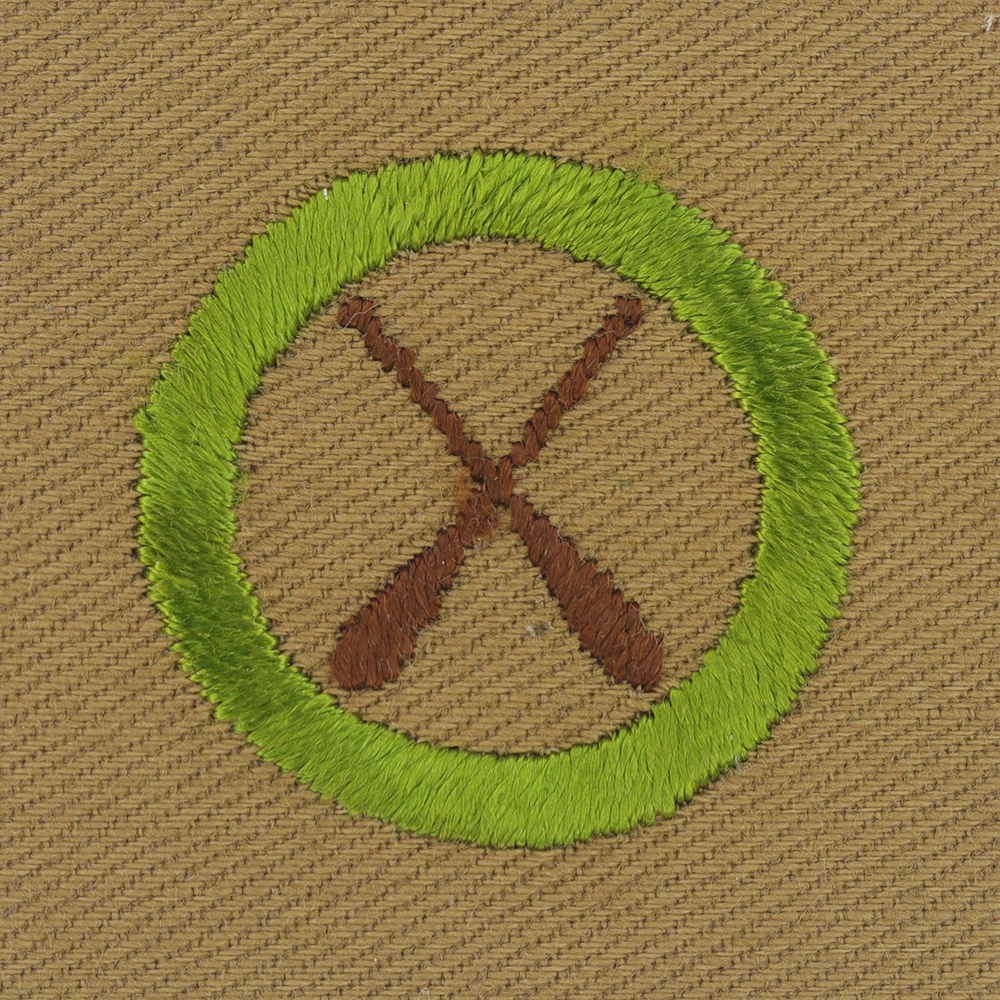
Fig. 6: Canoei-AT1-error1-front
- Minor variation: Thin paddles
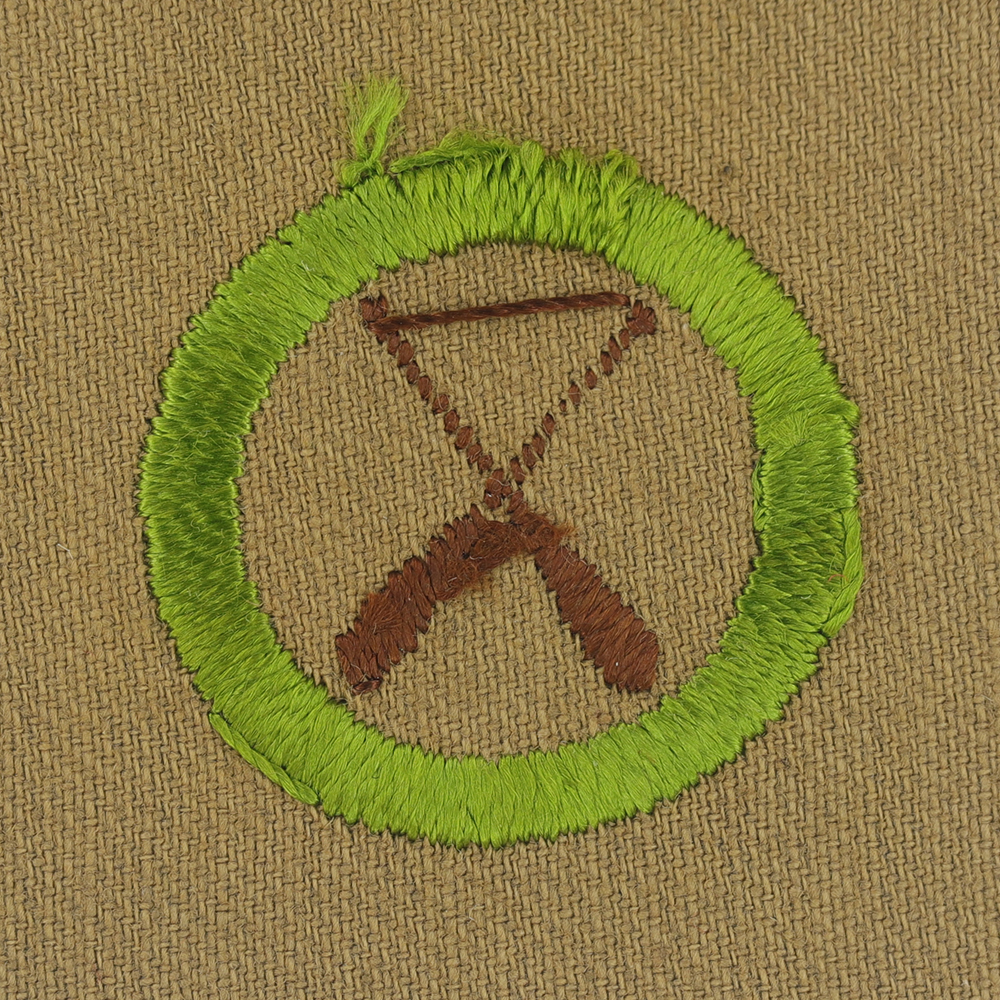
Fig. 7: Canoei-AT1-error1-reverse
- Manufacturing error: Type 1 error plain NO imprint back
Item Name: Canoeing 1927 - 1933
Item ID: Canoei-AT1
Collector Rating: 1
Pamphlets Used to Earn this Badge
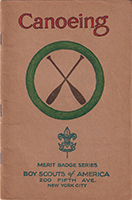
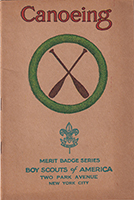
Requirements March 1927 until November 1937
To obtain a merit badge for Canoeing, a scout must first have passed the merit badge tests for Swimming and must;
1 .- With a companion who has passed the Swimming merit badge tests, demonstrate the proper method of entering and leaving a canoe, pushing off and landing
(a) From and to a pier or float in deep water.
(b) From and to a beach.
2. - With a companion, show proper form in paddling both bow and stern, on both sides of the canoe.
3. - Alone in a canoe without ballast, paddle a both bow and stern, on both sides of the canoe.
Change paddle to other side and return to starting point. If a quarter-mile straight-away course is not available, a shorter course may be used, the scout paddling back and forth on a straight line until a quarter mile has been traversed, keeping the paddle always on one side of the canoe; then making the right-about and left-about turns, afterwards shift the paddle to the other side and complete the second quarter-mile with paddle on that side.
(Applicant must be accompanied by a properly manned and equipped life boat.)
4. - Lash paddles to form a portage yoke and carry a 12-foot or longer canoe, 200 yards without stopping. A companion may assist.
5. - Jump out of a canoe in deep water and get back in proper form, without shipping water. (Applicant must be accompanied by a properly manned and equipped life boat.)
6. - Fully dressed, turn a canoe completely over in deep water one-eighth of a mile from a place of landing along shore, if possible; get in and bring the canoe to the landing, and land it high and dry without assistance. (Applicant must be accompanied by a properly manned and equipped life boat.)
7. - (a) Know and demonstrate method of repairing a rip in the canvas cover of a canoe, using such material as he would buy and take with him.
(b) Explain method used when depending on such material only as is provided by nature.
(c) Explain how to repair a rip in the canvas when plank thereunder is broken.
(d) Explain how he would repair, so that he could use it, a paddle broken three inches above the blade.
8. - With a companion, and before the examiner, load a canoe in good form with a complete outfit for two scouts for four days, properly trimmed, lashed and protected from wet. (Material of weight and bulk equal to necessary food may be substituted.) (Paddle a moderate distance, pick camp site, land, unload and make camp as if for the night. Break camp, repack outfit and return to the start.
9 .- Know at least two of the standard makes of canoes and types best adapted to trips on lakes or on rivers with quick water.
(a) Describe a birch-bark canoe, a kayak, a dug-out.
(b) Explain what woods make the best paddles, and how long a bow paddle and stern paddle should be.
10. - Demonstrate to the satisfaction of the examiner and the court of honor that he has thorough knowledge of the safety rules to be observed which will make him a safe canoeist, and that he is competent to observe the.
11. - Promise on his honor to observe these rules and do his best to teach others to observe them whenever he has an opportunity to do so.
Requirements January 1928 until January 1 1938, between September 7 1937 and January 1 1938 these requirements were optional.
To obtain a merit badge for Canoeing, a scout must first have passed the merit badge tests for Swimming and must:
1. - With a companion who has passed the Swimming merit badge tests, demonstrate the proper method of entering and leaving a canoe, pushing off and landing
(a) From and to a pier or float in deep water.
(b) From and to a beach.
2. - With a companion, show proper form in paddling both bow and stern, on both sides of the canoe.
3. - Alone in a canoe without ballast, paddle a both bow and stern, on both sides of the canoe.
Change paddle to other side and return to starting point. If a quarter-mile straight-away course is not available, a shorter course may be used, the scout paddling back and forth on a straight line until a quarter mile has been traversed, keeping the paddle always on one side of the canoe; then making the right-about and left-about turns, afterwards shift the paddle to the other side and complete the second quarter-mile with paddle on that side.
(Applicant must be accompanied by a properly manned and equipped life boat.)
4 . - Lash paddles to form a portage yoke and carry a 12-foot or longer canoe, 200 yards without stopping. A companion may assist.
5 .- Jump out of a canoe in deep water and get back in proper form, without shipping water. (Applicant must be accompanied by a properly manned and equipped life boat.)
6.-Fully dressed, turn a canoe completely over in deep water one-eighth of a mile from a place of landing along shore, if possible; get in and bring the canoe to the landing, and land it high and dry without assistance. (Applicant must be accompanied by a properly manned and equipped life boat.)
7 - (a) Know and demonstrate method of repairing a rip in the canvas cover of a canoe, using such material as he would buy and take with him.
(b) Explain method used when depending on such material only as is provided by nature.
(c) Explain how to repair a rip in the canvas when plank thereunder is broken.
(d) Explain how he would repair, so that he could use it, a paddle broken three inches above the blade.
8. - With a companion, and before the examiner, load a canoe in good form with a complete outfit for two scouts for four days, properly trimmed, lashed and protected from wet. (Material of weight and bulk equal to necessary food may be substituted.) (Paddle a moderate distance, pick camp site, land, unload and make camp as if for the night. Break camp, repack outfit and return to the start.
9. - Know at least two of the standard makes of canoes and types best adapted to trips on lakes or on rivers with quick water.
(a) Describe a birch-bark canoe, a kayak, a dug-out.
(b) Explain what woods make the best paddles, and how long a bow paddle and stern paddle should be.
10. - Demonstrate to the satisfaction of the examiner and the court of honor that he has thorough knowledge of the safety rules to be observed which will make him a safe canoeist, and that he is competent to observe the.
11. - Promise on his honor to observe these rules and do his best to teach others to observe them whenever he has an opportunity to do so.