-
Merit Badges
- Legend to identify Merit Badges
- 1910 British Merit Badges
- Square 1911 - 33
- Wide Crimped 1934 & 35
-
Narrow Tan Crimped 1936 - 42
- Tan Heavyweight Cloth with Silk Embroidery and Printed Back 1936 - 37
- Tan Heavyweight Cloth with Silk Embroidery and Plain Back 1937 - 38
- Tan Lightweight Cloth with Silk Embroidery and Plain Back 1938 - 39
- Tan Lightweight Cloth with Cotton Continuous Loop Embroidery and Plain Back 1939 - 42
- Tan Lightweight Cloth with Cotton Lockstitch Embroidery and Plain Back 1939 - 42
- Blue Background 1942 - 46
- Wartime 1942 - 46
- Khaki Narrow Crimped 1946 - 59
- Green Twill Gauze Back 1960 - 68
- Fully Embroidered Merrowed Edge 1960 - 72
- Unprinted Plastic Back 1972 - 01
- Printed Plastic Back 2002 - Current
-
Merit Badge Paper
- Merit Badge Applications
- Merit Badge Cards
-
Merit Badge Pamphlets
- Type 1 White Cover - Rectangle Drawing On Cover
- Type 2 White Cover 5-375" x 8" Title at Top
- Type 3A Tan Cover - 200 Fifth Avenue
- Type 3B Tan Cover - 2 line address New York City
- Type 3C Tan Cover - 2 line address New York N.Y.
- Type 3D Tan Cover - 1 line address New York N.Y.
- Type 4 Standing Scout Cover
- Type 5A War Cover
- Type 5B Red and White
- Type 6 Photo-Red Cover
- Type 7 Full Photo Cover or Bulls-eye Cover
- Type 8 Full Photo - Green Stripe Cover
- Type 9 Full Photo - Red Stripe Cover
- Type 10A Blue Stripe - Logo above bottom blue stripe - FDL centered
- Type 10B - Blue Stripe in bottom of photo area. FDL to left of text
- Special Covers
- Boy Craft Helps
- Merit Badge Counselor's Guides
-
Youth Position
- Junior Assistant Scoutmaster
- Senior Patrol Leader
- Assistant Senior Patrol Leader
- Patrol Leader
- Assistant Patrol Leader
- Troop Guide
- Scribe
- Quartermaster
- Instructor
- Chaplain Aide
- Den Chief
- Librarian
- Musician
- Webmaster
- Bugler
- Troop Historian
- Troop Representative
- Unit Representative
- Leadership Corps
- Honor Guard
- Leave No Trace Trainer
- Outdoor Ethics Guide
-
Patrol Medallions
- Patrol Medallions Introduction
- Legend to identify Patrol Medallions
- Patrol Shoulder Knot-Ribbons
- Felt Handmade Patrol Medallions
- Square Felt Patrol Medallions
- Round Broadcloth Patrol Medallions
- Red Twill Patrol Medallions
- Multi-Color Cloth Patrol Medallions
- Tan Cloth Patrol Medallions
- Patrol Medallion Back Patches
- Woodbadge Patrol Medallion
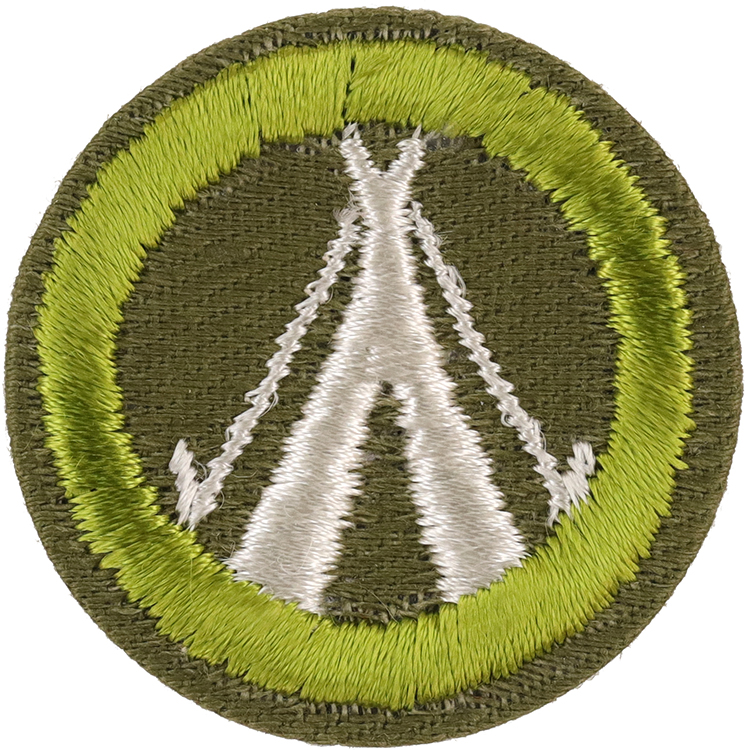
Fig. 1: Campin-E2-Front
- Cloth: Khaki right twill
- Embroidery: Cotton lock stitch
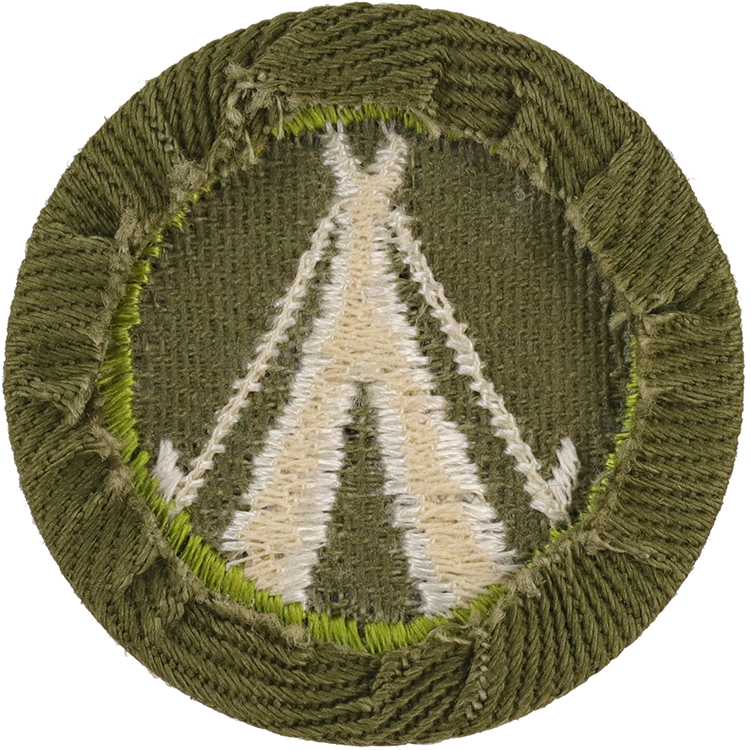
Fig. 2: Campin-E2-Reverse
- Back: Plain NO imprint with starch

Fig. 3: Campin-E2-mve1-front
- Minor variation: Wide tepee

Fig. 4: Campin-E2-mve1-reverse
- Back: Plain NO imprint with starch
Item Name: Camping 1947 - 1960
Item ID: Campin-E2
Collector Rating: 1
Pamphlets Used to Earn this Badge
Requirements June 1953 until November 1959
1. a. Prepare a check list of person equipment necessary for a three-day camp.
b. Prepare a satisfactory menu and provision list for yourself and one or more companions for such a three-day camp.
c. Using your check list, assemble and pack this equipment and food properly for comfort and protection against bad weather.*
d. Carry this pack comfortably on your back.
e. Present yourself to your Counselor for inspection, correctly clothed, wearing you pack and with your check list, menu and provision list.
f. Show proper care of the feet and discuss with your Counselor the types of footwear for various weather conditions.
2. Improvise one emergency pack, using items readily available such as your clothes or rustic materials, keeping in mind that this pack should carry all gear and supplies needed for a three-day camp and meet requirements noted in 1c and 1d.
3. Show proper method for packing your full equipment on a pack frame or pack animal, using a diamond hitch or other suitable hitch.
4. a. Lay out a campsite selected for yourself and on or more companions and give satisfactory reasons for your choice with consideration for weather, terrain and water supply. Make a sketch of the campsite.
b. On this campsite construct a field latrine suitable for you and one or more companions for a three-day camp.
c. Working alone, pitch a tent properly with consideration for weather and terrain. Strike the tent and fold it neatly for packing. Tent may be a Forester, Explorer, or any other type of trail tent.
d. Show proper ditching and explain when to ditch and when not to ditch.
e. Make a comfortable ground bed and sleep on it for at least two nights. Native materials gathered nearby may be used if not contrary to local conservation practice.
f. Demonstrate how to dispose of garbage by burning and properly dispose of food cans.
5. Using natural material and/or items readily at hand, such as your pack frame:
a. Make a camp tale or food storage container.
b. Make on of the following:
(1) Tripod for suspending camp supplies and shear legs for rigging shelter, clothes line, or other camp convenience using proper lashing technique.
OR
(2) Make a six-foot rope or line, capable of supporting 50 pounds, from natural materials.
6. Show the proper method for storing and protecting your full equipment against small animals, insects and wet weather. Demonstrate how, on a rainy day, you would secure, prepare and protect your firewood, as well as cook a meal.
7. a. Demonstrate proper use of knife and axe in securing and preparing fuel, using natural material found on the spot.
b. Build two types of cooking fires and one fire for heating a tent or other types of open shelter.**
c. Show how to extinguish a fire properly.
8. Discuss with your Counselor how you would protect yourself against cold weather and wet weather if caught out on the trail without equipment except what you are wearing and your knife and axe.
9. a. Camp out a total of at least 20 days and 20 nights, sleeping each night under the sky, under a tent you have pitched, or improvised trail shelter you have made, and cook for yourself or your Patrol at least 20 complete meals on these hikes or camps.
b. On all of these occasions leave a clean campsite with firewood neatly stacked and all rubbish disposed of properly.
10. Discuss with your Counselor the application of the experiences you have had in earning the Camping Merit Badge in relation to : personal health and safety; survival; public health; good citizenship.
Requirements November 1959 until September 1967
1. a. Prepare a check list of person equipment necessary for a three-day camp.
b. Prepare a satisfactory menu and provision list for yourself and one or more companions for such a three-day camp.
c. Using your check list, assemble and pack this equipment and food properly for comfort and protection against bad weather.*
d. Carry this pack comfortably on your back.
e. Present yourself to your Counselor for inspection, correctly clothed, wearing you pack and with your check list, menu and provision list.
f. Show proper care of the feet and discuss with your Counselor the types of footwear for various weather conditions.
2. Improvise one emergency pack, using items readily available such as your clothes or rustic materials, keeping in mind that this pack should carry all gear and supplies needed for a three-day camp and meet requirements noted in 1c and 1d.
3. Show proper method for packing your full equipment on a pack frame or pack animal, using a diamond hitch or other suitable hitch.
4. a. Lay out a campsite selected for yourself and on or more companions and give satisfactory reasons for your choice with consideration for weather, terrain and water supply. Make a sketch of the campsite.
b. On this campsite construct a field latrine suitable for you and one or more companions for a three-day camp.
c. Working alone, pitch a tent properly with consideration for weather and terrain. Strike the tent and fold it neatly for packing. Tent may be a Forester, Explorer, or any other type of trail tent.
d. Show proper ditching and explain when to ditch and when not to ditch.
e. Make a comfortable ground bed and sleep on it for at least two nights. Native materials gathered nearby may be used if not contrary to local conservation practice.
f. Demonstrate how to dispose of garbage by burning and properly dispose of food cans.
5. Using natural material and/or items readily at hand, such as your pack frame:
a. Make a camp tale or food storage container.
b. Make on of the following:
(1) Tripod for suspending camp supplies and shear legs for rigging shelter, clothes line, or other camp convenience using proper lashing technique.
OR
(2) Make a six-foot rope or line, capable of supporting 50 pounds, from natural materials.
6. Show the proper method for storing and protecting your full equipment against small animals, insects and wet weather. Demonstrate how, on a rainy day, you would secure, prepare and protect your firewood, as well as cook a meal.
7. a. Demonstrate proper use of knife and axe in securing and preparing fuel, using natural material found on the spot.
b. Build two types of cooking fires and one fire for heating a tent or other types of open shelter.**
c. Show how to extinguish a fire properly.
8. Discuss with your Counselor how you would protect yourself against cold weather and wet weather if caught out on the trail without equipment except what you are wearing and your knife and axe.
9. a. Camp out a total of at least 20 days and 20 nights, sleeping each night under the sky, under a tent you have pitched, or improvised trail shelter you have made, and cook for yourself or your Patrol at least 20 complete meals on these hikes or camps.
b. On all of these occasions leave a clean campsite with firewood neatly stacked and all rubbish disposed of properly.
10. Discuss with your Counselor the application of the experiences you have had in earning the Camping Merit Badge in relation to; personal health and safety; survival; public health; good citizenship.
First Class Test
1. PREPARE FOR SCOUT CAMPING
CLOTHING AND EQUIPMENT - Present yourself for inspection suitably clothed for the locality, season, and weather and equipped and packed for an overnight camp.
2. LAY OUT YOUR CAMP
a. CAMP SITE - Select a site suitable for a patrol camp and explain your reasons for picking it.
3. LIVE IN CAMP
a. CAMP MAKING - Sharpen an axe and use it for cutting light wood into tent pegs. Locate a tent site and pitch a tent, fastening the guy lines with taut-line hitches. Prepare a comfortable ground bed. Make a piece of camp equipment requiring lashings.
b. CAMP HEALTH - Explain methods used in camp for care of food and drinking water, fire protection, and waste disposal.
c. WOOD LORE - Find ten kinds of wild trees or shrubs. Tell what they are and explain their uses.
8. GO CAMPING
THE FIRST CLASS TEST CAMP - After you have done the above, prove yourself a Scout camper by camping, properly clothed and equipped, on a suitable camp site for not less than twenty-four hours with your patrol (or with at least one companion approved by your Scoutmaster). During this camp, cook at least one hot meal, sleep in a tent or improvised shelter or under the stars, keep camp clean and safe, and leave camp sit in good condition.