-
Merit Badges
- Legend to identify Merit Badges
- 1910 British Merit Badges
- Square 1911 - 33
- Wide Crimped 1934 & 35
-
Narrow Tan Crimped 1936 - 42
- Tan Heavyweight Cloth with Silk Embroidery and Printed Back 1936 - 37
- Tan Heavyweight Cloth with Silk Embroidery and Plain Back 1937 - 38
- Tan Lightweight Cloth with Silk Embroidery and Plain Back 1938 - 39
- Tan Lightweight Cloth with Cotton Continuous Loop Embroidery and Plain Back 1939 - 42
- Tan Lightweight Cloth with Cotton Lockstitch Embroidery and Plain Back 1939 - 42
- Blue Background 1942 - 46
- Wartime 1942 - 46
- Khaki Narrow Crimped 1946 - 59
- Green Twill Gauze Back 1960 - 68
- Fully Embroidered Merrowed Edge 1960 - 72
- Unprinted Plastic Back 1972 - 01
- Printed Plastic Back 2002 - Current
-
Merit Badge Paper
- Merit Badge Applications
- Merit Badge Cards
-
Merit Badge Pamphlets
- Type 1 White Cover - Rectangle Drawing On Cover
- Type 2 White Cover 5-375" x 8" Title at Top
- Type 3A Tan Cover - 200 Fifth Avenue
- Type 3B Tan Cover - 2 line address New York City
- Type 3C Tan Cover - 2 line address New York N.Y.
- Type 3D Tan Cover - 1 line address New York N.Y.
- Type 4 Standing Scout Cover
- Type 5A War Cover
- Type 5B Red and White
- Type 6 Photo-Red Cover
- Type 7 Full Photo Cover or Bulls-eye Cover
- Type 8 Full Photo - Green Stripe Cover
- Type 9 Full Photo - Red Stripe Cover
- Type 10A Blue Stripe - Logo above bottom blue stripe - FDL centered
- Type 10B - Blue Stripe in bottom of photo area. FDL to left of text
- Special Covers
- Boy Craft Helps
- Merit Badge Counselor's Guides
-
Youth Position
- Junior Assistant Scoutmaster
- Senior Patrol Leader
- Assistant Senior Patrol Leader
- Patrol Leader
- Assistant Patrol Leader
- Troop Guide
- Scribe
- Quartermaster
- Instructor
- Chaplain Aide
- Den Chief
- Librarian
- Musician
- Webmaster
- Bugler
- Troop Historian
- Troop Representative
- Unit Representative
- Leadership Corps
- Honor Guard
- Leave No Trace Trainer
- Outdoor Ethics Guide
-
Patrol Medallions
- Patrol Medallions Introduction
- Legend to identify Patrol Medallions
- Patrol Shoulder Knot-Ribbons
- Felt Handmade Patrol Medallions
- Square Felt Patrol Medallions
- Round Broadcloth Patrol Medallions
- Red Twill Patrol Medallions
- Multi-Color Cloth Patrol Medallions
- Tan Cloth Patrol Medallions
- Patrol Medallion Back Patches
- Woodbadge Patrol Medallion
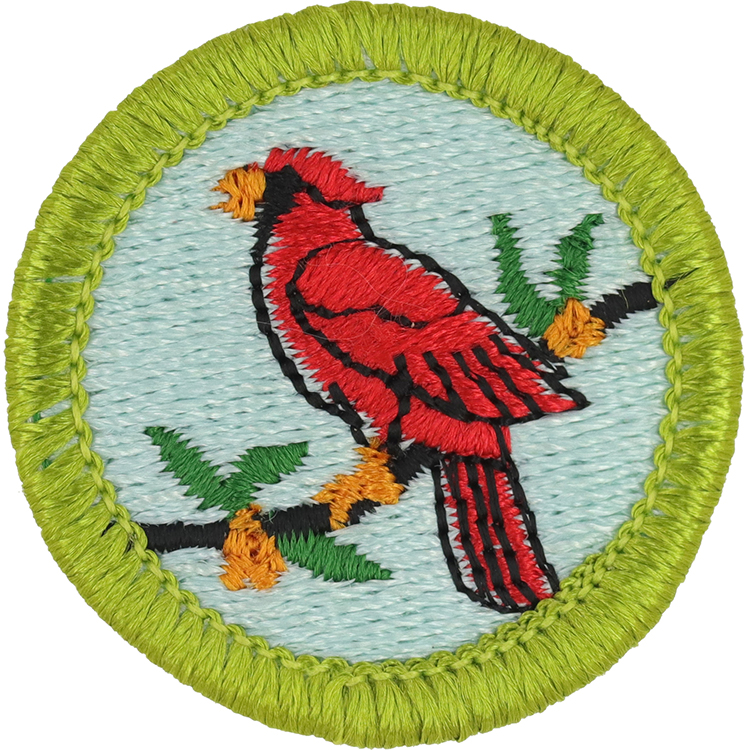
Fig. 1: BirStu-H5-Front
- Embroidery: Rayon thread
- Border: Merrowed
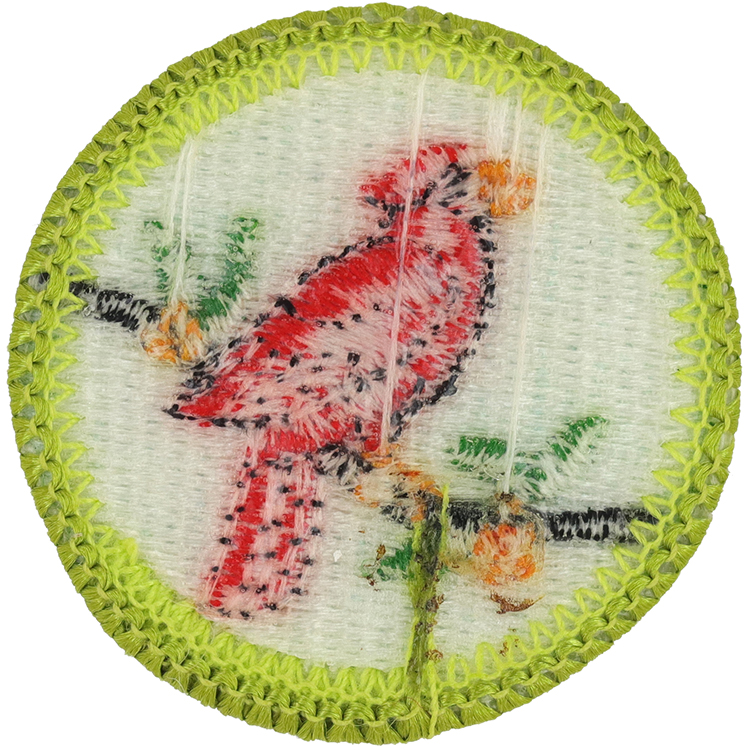
Fig. 2: BirStu-H5-Reverse
- Back: Molded plastic
Item Name: Bird Study 1990 - 2002
Item ID: BirStu-H5
Collector Rating: 1
Pamphlets Used to Earn this Badge
Requirements September 1989 until January 1998
1. Spend 3 hours in each of two different kinds of natural habitats or at two different elevations (total of 6 hours).
(a) List the different bird species you see.
(b) List the numbers of each seen.
(c) Explain why all birds do not live in the same kind of habitat.
2. Spend 3 hours of 5 days in a large area (total of 15 hours) List the bird species you can identify by sound or sight.*
3. Recognize, by sound, 10 birds usually found in your neighborhood.
4. List 8 families of birds usually found where you live.
5. Write a 500-word history about a bird of your choice. Include the following information:
(a) Description
(b) Habitat type
(c) Feeding habits
(d) Mating and nesting behavior
(e) Care of the young
(f) Migratory habits
(g) Range
(h) Any unusual characteristics or behavior you find interesting about the bird
6. Do ONE of the following:
(a) Make 8 field trips during one season, about 3 months. Keep records of all the birds you see.
(b) Carefully observe a bird for an hour a day for 10 days. Record your observations.
(c) Go on an 8-hour Christmas census with a bird club. List all the birds you can see.
(d) Go on an 8-hour May bird census with a bird club. List all the birds you see.
(e) Visit a bird refuge. Describe its purpose and give the management techniques used.
(f) Attend a meeting of a bird club such as the local chapter of the National Audubon Society. Report on what you learned.
(g) Write a 300-word paper on bird behavior.
7. Do ONE of the following:
(a) Build a backyard sanctuary by planting trees and shrubs for food and cover. Describe what birds you hope to attract and why.
(b) Build 3 bird feeders of different kinds. Keep them stocked with food for 3 months in winter. Describe what birds are attracted to them. Indicate what kinds of foods were liked best.
(c) Take twelve clear, sharp, recognizable pictures of twelve species of birds.
(d) Build a watering device for birds. Keep it filled for 3 months. Tell what kinds of birds used it. Describe any interesting things you saw.
(e) Build a birdhouse or nesting box. Study the nesting habits of birds that use the structure. Provide nesting materials for the birds.
8. Do ONE of the following:
(a) Select one species of bird that eats other animals. Indicate its place in nature and briefly discuss its importance.
(b) Make a migration (flyway) map of the United States. Name some of the birds that use each flyway or migration route. Tell where they nest. Tell where they winter. Describe birdbanding.
(c) Make a list of the extinct or declining birds of the United States. Describe some of the chief causes for this decline.
*Requirements 1 and 2 must be done at different times.
Requirements January 1998 until April 1999
1. Spend 3 hours in each of two different kinds of natural habitats or at two different.
(a) List the different bird species you see.
(b) List the numbers of each seen.
(c) Explain why all birds do not live in the same kind of habitat.
2. Spend 3 hours of 5 days in a large area. List the bird species you can identify by sound or sight.
3. Recognize, by sound, 10 birds usually found in your neighborhood.
4. List 8 families of birds usually found where you live.
5. Write a 500-word history about a bird of your choice. Include the following information if available:
(a) Nesting habits
(b) Behavior and territory
(c) Food habits and diet
(d) Description and size of the young and adult birds
(e) Migratory habits, if it is not a permanent resident
(f) Any unusual characteristics about the bird you find interesting
6. Do ONE of the following:
(a) Make 8 field trips during one season, about 3 months. Keep records of all the birds you see.
(b) Carefully observe a bird for an hour a day for 10 days. Record your observations.
(c) Go on an 8-hour Christmas census with a bird club. List all the birds you can see.
(d) Go on an 8-hour May bird census with a bird club. List all the birds you see.
(e) Visit a bird refuge. Describe its purpose and give the management techniques used.
(f) Attend a meeting of a bird club such as the local chapter of the National Audubon Society. Report on what you learned.
(g) Write a 300-word paper on bird behavior.
7. Do ONE of the following:
(a) Build a backyard sanctuary by planting trees and shrubs for food and cover. Describe what birds you hope to attract and why.
(b) Build 3 bird feeders of different kinds. Keep them stocked with food for 3 months in winter. Describe what birds are attracted to them. Indicate what kinds of foods were liked best.
(c) Take twelve clear, sharp, recognizable pictures of twelve species of birds.
(d) Build a watering device for birds. Keep it filled for 3 months. Tell what kinds of birds used it. Describe any interesting things you saw.
8. Do ONE of the following:
(a) Select one species of bird that eats other animals. Indicate its place in nature and briefly discuss its importance.
(b) Make a migration (flyway) map of the United States. Name some of the birds that use each flyway or migration route. Tell where they nest. Tell where they winter. Describe birdbanding.
(c) Make a list of 20 species of extinct birds of the United States.
Requirements April 1999 until January 2006
1. Explain the need for bird study and why birds are useful indicators of the quality of the environment.
2. Show that you are familiar with the terms used to describe birds by sketching or tracing a purched bird and then labeling 15 different parts of the bird. Sketch or trace an extended wing and label six types of wing feathers.
3. Demonstrate that you know how to properly use and care for binoculars.
(a) Explain what the specification numbers on the binoculars mean.
(b) Show how to adjust the eyepiece and how to focus for proper viewing.
(c) Show how to properly care for and clean the lenses.
4. Demonstrate that you know how to use a bird field guide. Show your counselor that you are able to understand a range map by locating in the book and pointing out the wintering range, the breeding range, and /or the year-round range of one species of each of the following types of birds:
(a) Petrel
(b) Plover
(c) Falcon
(d) Warbler or vireo
(e) Heron or egret
(f) Sparrow
(g) Nonnative bird (introduced to North America from a foreign country since 1980)
5. Observe and be able to identify at least 20 species of wild birds. Prepare a field notebook, making a separate entry for each species, and record the following information from your field observations and other references.
(a) Note the date and time.
(b) Note the location and habitat.
(c) Describe the birds mean feeding habitat and list two types of food that the bird is likely to eat.
(d) Note whether the bird is a migrant or a summer, winter, or a year-round resident of your area.
6. Be able to identify five of the 20 species in your field notebook by song or call alone. For each of these five species enter a description of the song or call and note the behavior of the bird making the sound. Know why you think the bird was making the call or song that you heard.
7. Do ONE of the following:
(a) Go on a field trip with a local club or with others who are knowledgeable about birds in your area.
(1) Keep a list or fill out a check-list of all the birds group observed during the field trip.
(2) Tell your counselor which birds your group saw and why some species were common and some were present in small numbers.
(3) Tell your counselor what makes the area you visited good for finding birds.
(b) By using a public library or contacting the national Audubon society, find the name and location of the Christmas Bird Count nearest your home and obtain the results of a recent count.
(1) Explain what kinds of information are collected during the annual event.
(2) Tell your counselor which species are most common, and explain why these birds are abundant.
(3) Tell your counselor which species are uncommon, and explain why these were present in small numbers. If the number of birds of the species is decreasing, explain why, and what, if anything, could be done to reverse their decline.
8. Do ONE of the following:
(a) Build a bird feeder and put it in an appropriate place in your yard or another location.
(b) Build a birdbath and put it in an appropriate place.
(c) Build a backyard sanctuary for birds by planting trees and shrubs for food and cover.