-
Merit Badges
- Legend to identify Merit Badges
- 1910 British Merit Badges
- Square 1911 - 33
- Wide Crimped 1934 & 35
-
Narrow Tan Crimped 1936 - 42
- Tan Heavyweight Cloth with Silk Embroidery and Printed Back 1936 - 37
- Tan Heavyweight Cloth with Silk Embroidery and Plain Back 1937 - 38
- Tan Lightweight Cloth with Silk Embroidery and Plain Back 1938 - 39
- Tan Lightweight Cloth with Cotton Continuous Loop Embroidery and Plain Back 1939 - 42
- Tan Lightweight Cloth with Cotton Lockstitch Embroidery and Plain Back 1939 - 42
- Blue Background 1942 - 46
- Wartime 1942 - 46
- Khaki Narrow Crimped 1946 - 59
- Green Twill Gauze Back 1960 - 68
- Fully Embroidered Merrowed Edge 1960 - 72
- Unprinted Plastic Back 1972 - 01
- Printed Plastic Back 2002 - Current
-
Merit Badge Paper
- Merit Badge Applications
- Merit Badge Cards
-
Merit Badge Pamphlets
- Type 1 White Cover - Rectangle Drawing On Cover
- Type 2 White Cover 5-375" x 8" Title at Top
- Type 3A Tan Cover - 200 Fifth Avenue
- Type 3B Tan Cover - 2 line address New York City
- Type 3C Tan Cover - 2 line address New York N.Y.
- Type 3D Tan Cover - 1 line address New York N.Y.
- Type 4 Standing Scout Cover
- Type 5A War Cover
- Type 5B Red and White
- Type 6 Photo-Red Cover
- Type 7 Full Photo Cover or Bulls-eye Cover
- Type 8 Full Photo - Green Stripe Cover
- Type 9 Full Photo - Red Stripe Cover
- Type 10A Blue Stripe - Logo above bottom blue stripe - FDL centered
- Type 10B - Blue Stripe in bottom of photo area. FDL to left of text
- Special Covers
- Boy Craft Helps
- Merit Badge Counselor's Guides
-
Youth Position
- Junior Assistant Scoutmaster
- Senior Patrol Leader
- Assistant Senior Patrol Leader
- Patrol Leader
- Assistant Patrol Leader
- Troop Guide
- Scribe
- Quartermaster
- Instructor
- Chaplain Aide
- Den Chief
- Librarian
- Musician
- Webmaster
- Bugler
- Troop Historian
- Troop Representative
- Unit Representative
- Leadership Corps
- Honor Guard
- Leave No Trace Trainer
- Outdoor Ethics Guide
-
Patrol Medallions
- Patrol Medallions Introduction
- Legend to identify Patrol Medallions
- Patrol Shoulder Knot-Ribbons
- Felt Handmade Patrol Medallions
- Square Felt Patrol Medallions
- Round Broadcloth Patrol Medallions
- Red Twill Patrol Medallions
- Multi-Color Cloth Patrol Medallions
- Tan Cloth Patrol Medallions
- Patrol Medallion Back Patches
- Woodbadge Patrol Medallion
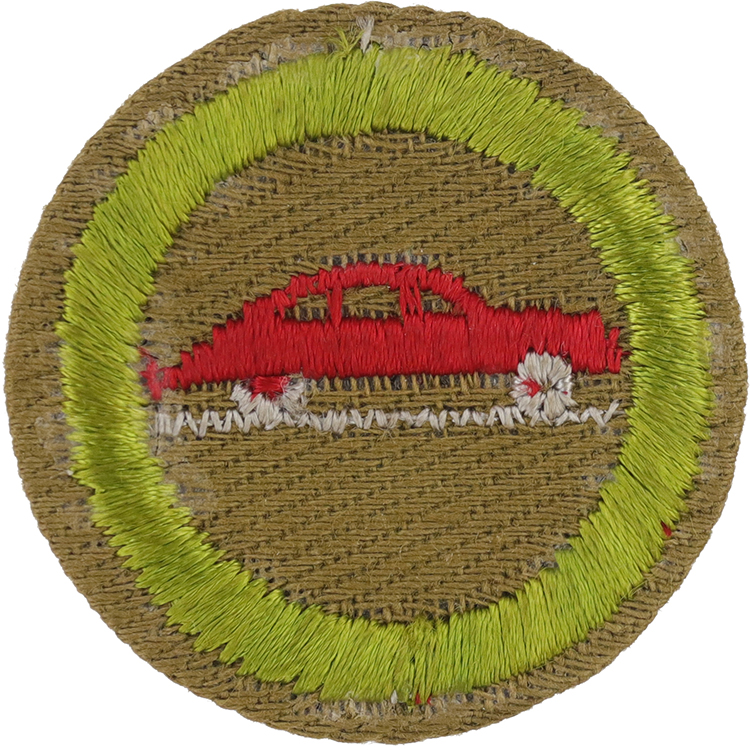
Fig. 1: Automo-C5-Front
- Cloth: Lightweight tan right twill
- Embroidery: Cotton lock stitch

Fig. 2: Automo-C5-Reverse
- Back: Plain NO imprint with starch
Item Name: Automobiling 1939 - 1943
Item ID: Automo-C5
Collector Rating: 1
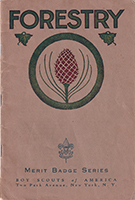
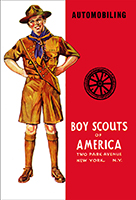
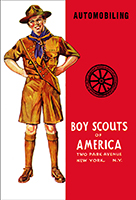
Pamphlets Used to Earn this Badge
Requirements November 1938 until December 1940
To obtain a Merit Badge for Automobiling a Scout must be of legal age to drive a car and must:
1. Carefully examine and check the conditions of the following safety features:
(a) Windshield wiper.
(b) Adjustment of rear view mirror.
(c) Highlights for all headlight switch positions. Reflector surfaces. Cleanliness of lenses and that bulbs are free from blackening.
(d) Elevation and focus of headlight beams.
(e) Tail and stop lights.
(f) Windshield and rear window visibility.
(g) “Play” in steering wheel.
(h) Adjustment of brakes.
(I) Tires.
2. (a) List ten important things in his local or state Motor Vehicle Regulations.
(b) Give the necessary qualifications (including age) before a person can legally drive a car in his state.
3. Explain how the use of intoxicating liquor increases motor accidents, as, for example, in its effect on the driver’s vision, judgment and coordination.
4. A driver on dry road, with brakes in good condition, sees danger ahead. Tell how many feet he requires to stop his car going 20 miles an hour; 40 miles; 60 miles.
5. Visit a traffic court (or traffic session of court) or interview a highway traffic officer, and make a report on at least two accident cases. Tell from evidence what driving and safety rules were violated, and how accidents could have been prevented.
6. (a) List at least six sound driving practices which make for safety and courtesy on the road.
(b) List at least four important characteristics of a good driver.
(c) Demonstrate hand signals, using both single hand position and three position systems; explaining their meaning.
7. Explain:
(a) Purpose of clutch, gear shift, accelerator, choke, and brakes; describe briefly how each works.
(b) How to stop a car on wet or icy road.
(c) What to do when end skids to right; to left.
(d) What to do when stop light on rear of car ahead blinks
8. Change a tire.
9. (a) Start a motor; put car in gear; shift gears.
(b) Come smoothly to a full stop from a speed of 30 miles an hour.
(c) Make right and left turns from proper lanes, giving proper signals at proper time.
(d) Park in a 20 foot space.
(e) Start a car after stopping on an up-grade (away from curb); park on an up-grade and on a down-grade. Show how to drive down a steep hill OR show how to get out of sand, mud or snow.
(f) Turn around in order to go in opposite direction between lines or markers 25 feet apart.
10. Show ability to stop a car going at a speed of 20 miles per hour so that nose of car fits into a chalk marked U-shaped box 5 feet wide. Bumpers should be over front line of the box and tires inside of side lines.
Requirements December 1940 until January 1957
To obtain this Merit Badge a Scout must be of legal age to drive a car and meet all other legal requirements of his state and must:
1. Carefully examine and check the conditions of the following safety features:
(a) Windshield wiper.
(b) Adjustment of rear view mirror.
(c) Highlights for all headlight switch positions. Reflector surfaces. Cleanliness of lenses and that bulbs are free from blackening.
(d) Elevation and focus of headlight beams.
(e) Tail and stop lights.
(f) Windshield and rear window visibility.
(g) “Play” in steering wheel.
(h) Adjustment of brakes.
(I) Tires.
2. (a) List ten important things in his local or state Motor Vehicle Regulations.
(b) Give the necessary qualifications (including age) before a person can legally drive a car in his state.
3. Explain how the use of intoxicating liquor increases motor accidents, as, for example, in its effect on the driver’s vision, judgment and coordination.
4. A driver on dry road, with brakes in good condition, sees danger ahead. Tell how many feet he requires to stop his car going 20 miles an hour; 40 miles; 60 miles.
5. Visit a traffic court (or traffic session of court) or interview a highway traffic officer, and make a report on at least two accident cases. Tell from evidence what driving and safety rules were violated, and how accidents could have been prevented.
6. (a) List at least six sound driving practices which make for safety and courtesy on the road.
(b) List at least four important characteristics of a good driver.
(c) Demonstrate hand signals, using both single hand position and three position systems; explaining their meaning.
7. Explain:
(a) Purpose of clutch, gear shift, accelerator, choke, and brakes; describe briefly how each works.
(b) How to stop a car on wet or icy road.
(c) What to do when end skids to right; to left.
(d) What to do when stop light on rear of car ahead blinks
8. Change a tire.
9. (a) Start a motor; put car in gear; shift gears.
(b) Come smoothly to a full stop from a speed of 30 miles an hour.
(c) Make right and left turns from proper lanes, giving proper signals at proper time.
(d) Park in a 20 foot space.
(e) Start a car after stopping on an up-grade (away from curb); park on an up-grade and on a down-grade. Show how to drive down a steep hill OR show how to get out of sand, mud or snow.
(f) Turn around in order to go in opposite direction between lines or markers 25 feet apart.
10. Show ability to stop a car going at a speed of 20 miles per hour so that nose of car fits into a chalk marked U-shaped box 5 feet wide. Bumpers should be over front line of the box and tires inside of side lines.