-
Merit Badges
- Legend to identify Merit Badges
- 1910 British Merit Badges
- Square 1911 - 33
- Wide Crimped 1934 & 35
-
Narrow Tan Crimped 1936 - 42
- Tan Heavyweight Cloth with Silk Embroidery and Printed Back 1936 - 37
- Tan Heavyweight Cloth with Silk Embroidery and Plain Back 1937 - 38
- Tan Lightweight Cloth with Silk Embroidery and Plain Back 1938 - 39
- Tan Lightweight Cloth with Cotton Continuous Loop Embroidery and Plain Back 1939 - 42
- Tan Lightweight Cloth with Cotton Lockstitch Embroidery and Plain Back 1939 - 42
- Blue Background 1942 - 46
- Wartime 1942 - 46
- Khaki Narrow Crimped 1946 - 59
- Green Twill Gauze Back 1960 - 68
- Fully Embroidered Merrowed Edge 1960 - 72
- Unprinted Plastic Back 1972 - 01
- Printed Plastic Back 2002 - Current
-
Merit Badge Paper
- Merit Badge Applications
- Merit Badge Cards
-
Merit Badge Pamphlets
- Type 1 White Cover - Rectangle Drawing On Cover
- Type 2 White Cover 5-375" x 8" Title at Top
- Type 3A Tan Cover - 200 Fifth Avenue
- Type 3B Tan Cover - 2 line address New York City
- Type 3C Tan Cover - 2 line address New York N.Y.
- Type 3D Tan Cover - 1 line address New York N.Y.
- Type 4 Standing Scout Cover
- Type 5A War Cover
- Type 5B Red and White
- Type 6 Photo-Red Cover
- Type 7 Full Photo Cover or Bulls-eye Cover
- Type 8 Full Photo - Green Stripe Cover
- Type 9 Full Photo - Red Stripe Cover
- Type 10A Blue Stripe - Logo above bottom blue stripe - FDL centered
- Type 10B - Blue Stripe in bottom of photo area. FDL to left of text
- Special Covers
- Boy Craft Helps
- Merit Badge Counselor's Guides
-
Youth Position
- Junior Assistant Scoutmaster
- Senior Patrol Leader
- Assistant Senior Patrol Leader
- Patrol Leader
- Assistant Patrol Leader
- Troop Guide
- Scribe
- Quartermaster
- Instructor
- Chaplain Aide
- Den Chief
- Librarian
- Musician
- Webmaster
- Bugler
- Troop Historian
- Troop Representative
- Unit Representative
- Leadership Corps
- Honor Guard
- Leave No Trace Trainer
- Outdoor Ethics Guide
-
Patrol Medallions
- Patrol Medallions Introduction
- Legend to identify Patrol Medallions
- Patrol Shoulder Knot-Ribbons
- Felt Handmade Patrol Medallions
- Square Felt Patrol Medallions
- Round Broadcloth Patrol Medallions
- Red Twill Patrol Medallions
- Multi-Color Cloth Patrol Medallions
- Tan Cloth Patrol Medallions
- Patrol Medallion Back Patches
- Woodbadge Patrol Medallion
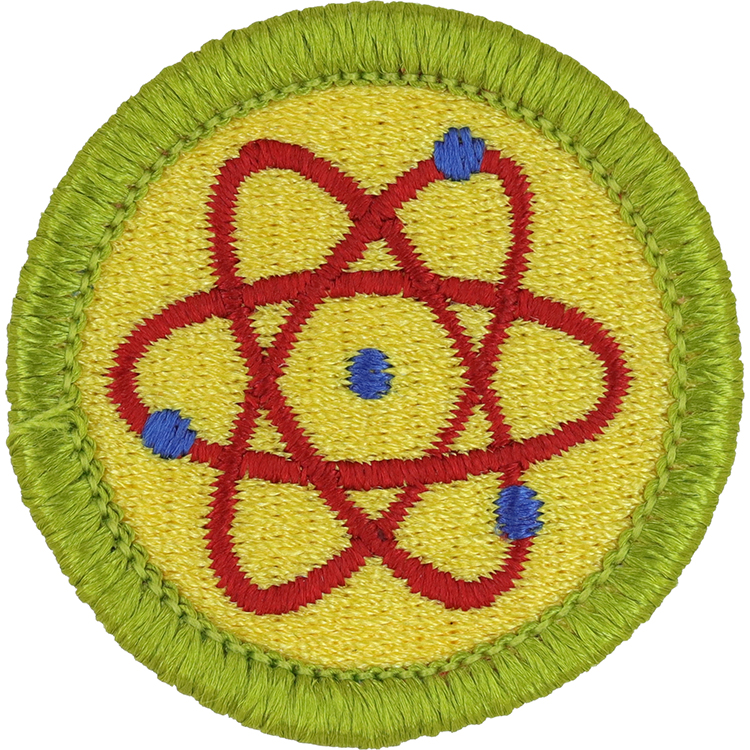
Fig. 1: AtoEne-J1-Front
- Embroidery: Rayon thread
- Border: Merrowed
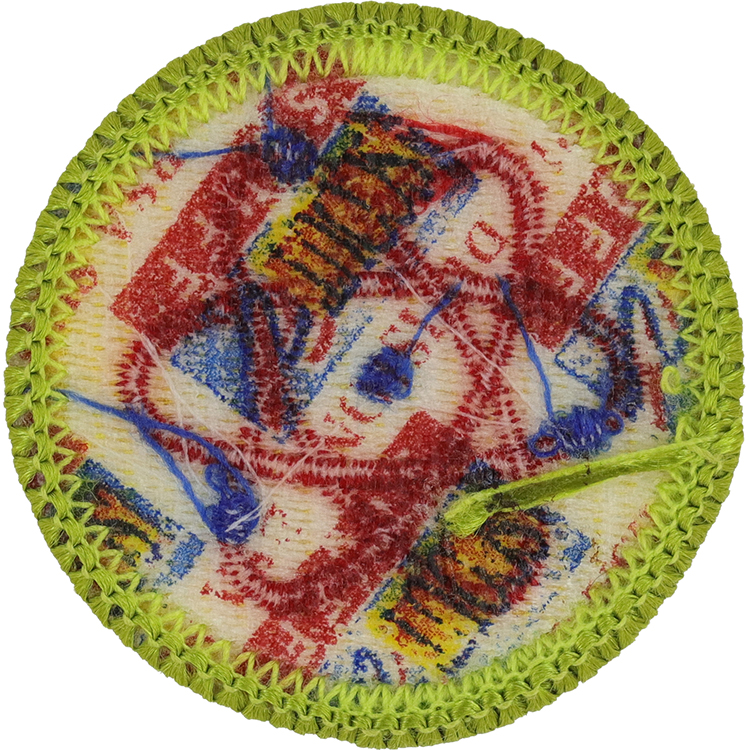
Fig. 2: AtoEne-J1-Reverse
- Back: Scout Stuff imprint
Item Name: Atomic Energy 2002 - 2005
Item ID: AtoEne-J1
Collector Rating: 1
Pamphlets Used to Earn this Badge

Requirements August 1982 until January 2005
1. Tell the meaning of the following: alpha particle, atom, background radiation, beta particle, curie, fallout, half-life, ionization, isotope, neutron, neutron activation, nuclear energy, nuclear reactor, particle accelerator, radiation, radioactivity, roentgen, and X ray.
2. Make three-dimensional models of the atoms of the three isotopes of hydrogen. Show neutrons, protons, and electrons. Use these models to explain the difference between atomic weight and number.
3. Make a drawing showing how nuclear fission happens. Label all details. Draw a second picture showing how a chain reaction could be started. Also show how it could be stopped. Show what is meant by a “critical mass.”
4. Tell who five of the following people were. Explain what each of the five discovered in the field of atomic energy: Henri Becquerel, Niels Bohr, Marie Curie, Albert Einstein, Enrico Fermi, Otto Hahn, Ernest Orlando Lawrence, Lise Meitner, William Conrad Rontgen, and Sir Ernest Rutherford. Explain how any one person’s discovery was related to one other person’s work.
5. Draw and color the radiation hazard symbol. Explain where it should be used and not used. Tell why and how people must use radiation or radioactive materials carefully.
6. Do any THREE of the following:
(a) Build an electroscope. Show how it works. Put a radiation source inside it. Explain any difference seen.
(b) Make a simple Geiger counter. Tell the parts. Tell which types of radiation the counter can spot. Tell how many counts per minute of what radiation you have found in your home.
(c) Build a model of a reactor. Show the fuel, the control rods, the shielding, the moderator, and any cooling material. Explain how a reactor could be used to change nuclear into electrical energy or make things radioactive.
(d) Use a Geiger counter and a radiation source. Show how the counts per minute change as the source gets closer. Put three different kinds of material between the source and the detector. Explain any differences in the counts per minute. Tell which is the best to shield people from radiation and why.
(e) Use fast-speed film and a radiation source. Show the principles of autoradiography and radiography. Explain what happens to the films. Tell how someone could use this in medicine, research, or industry.
(f) Using a Geiger counter (that you have built or borrowed), find a radiation source that has been hidden under a covering. Find it in at least three other places under the cover. Explain how someone could use this in medicine, research, agriculture, or industry.
(g) Visit a place where X ray is used. Draw a fool plan of the room in which it is used. Show where the unit, the person who runs it, and the patient would be when it is used. Describe the radiation dangers from X ray.
(h) Make a cloud camber. Show how it can be used to see the tracks caused by radiation. Explain what is happening.
(I) Visit a place where radioisotopes are being used. Explain by a drawing how and why it is used.
(j) Get samples of irradiated seeds. Plant them. Plant a group of nonirradiated seeds of the same kind. Grow both groups. List any differences. Discuss what irradiation does to seed