-
Merit Badges
- Legend to identify Merit Badges
- 1910 British Merit Badges
- Square 1911 - 33
- Wide Crimped 1934 & 35
-
Narrow Tan Crimped 1936 - 42
- Tan Heavyweight Cloth with Silk Embroidery and Printed Back 1936 - 37
- Tan Heavyweight Cloth with Silk Embroidery and Plain Back 1937 - 38
- Tan Lightweight Cloth with Silk Embroidery and Plain Back 1938 - 39
- Tan Lightweight Cloth with Cotton Continuous Loop Embroidery and Plain Back 1939 - 42
- Tan Lightweight Cloth with Cotton Lockstitch Embroidery and Plain Back 1939 - 42
- Blue Background 1942 - 46
- Wartime 1942 - 46
- Khaki Narrow Crimped 1946 - 59
- Green Twill Gauze Back 1960 - 68
- Fully Embroidered Merrowed Edge 1960 - 72
- Unprinted Plastic Back 1972 - 01
- Printed Plastic Back 2002 - Current
-
Merit Badge Paper
- Merit Badge Applications
- Merit Badge Cards
-
Merit Badge Pamphlets
- Type 1 White Cover - Rectangle Drawing On Cover
- Type 2 White Cover 5-375" x 8" Title at Top
- Type 3A Tan Cover - 200 Fifth Avenue
- Type 3B Tan Cover - 2 line address New York City
- Type 3C Tan Cover - 2 line address New York N.Y.
- Type 3D Tan Cover - 1 line address New York N.Y.
- Type 4 Standing Scout Cover
- Type 5A War Cover
- Type 5B Red and White
- Type 6 Photo-Red Cover
- Type 7 Full Photo Cover or Bulls-eye Cover
- Type 8 Full Photo - Green Stripe Cover
- Type 9 Full Photo - Red Stripe Cover
- Type 10A Blue Stripe - Logo above bottom blue stripe - FDL centered
- Type 10B - Blue Stripe in bottom of photo area. FDL to left of text
- Special Covers
- Boy Craft Helps
- Merit Badge Counselor's Guides
-
Youth Position
- Junior Assistant Scoutmaster
- Senior Patrol Leader
- Assistant Senior Patrol Leader
- Patrol Leader
- Assistant Patrol Leader
- Troop Guide
- Scribe
- Quartermaster
- Instructor
- Chaplain Aide
- Den Chief
- Librarian
- Musician
- Webmaster
- Bugler
- Troop Historian
- Troop Representative
- Unit Representative
- Leadership Corps
- Honor Guard
- Leave No Trace Trainer
- Outdoor Ethics Guide
-
Patrol Medallions
- Patrol Medallions Introduction
- Legend to identify Patrol Medallions
- Patrol Shoulder Knot-Ribbons
- Felt Handmade Patrol Medallions
- Square Felt Patrol Medallions
- Round Broadcloth Patrol Medallions
- Red Twill Patrol Medallions
- Multi-Color Cloth Patrol Medallions
- Tan Cloth Patrol Medallions
- Patrol Medallion Back Patches
- Woodbadge Patrol Medallion
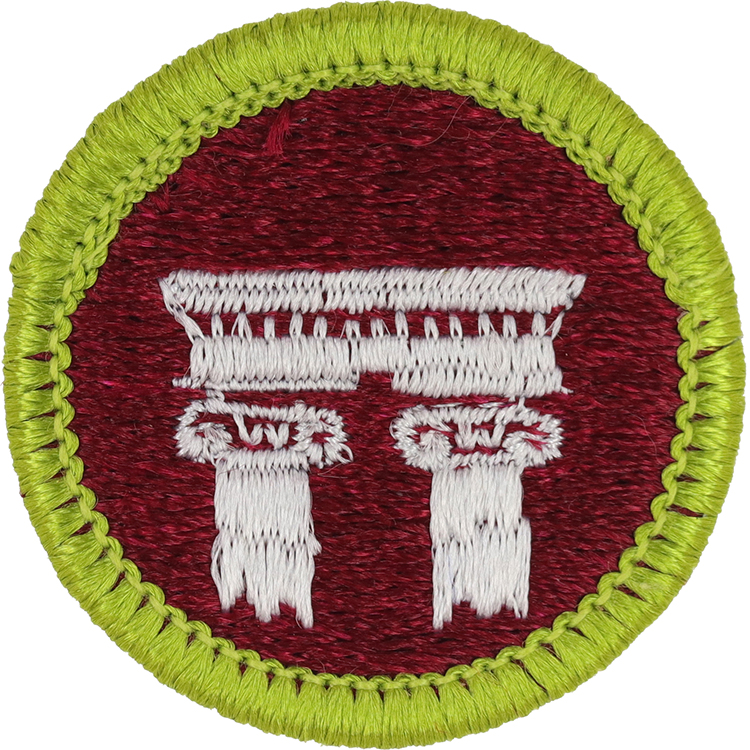
Fig. 1: Archit-H5-Front
- Embroidery: Rayon thread
- Border: Merrowed
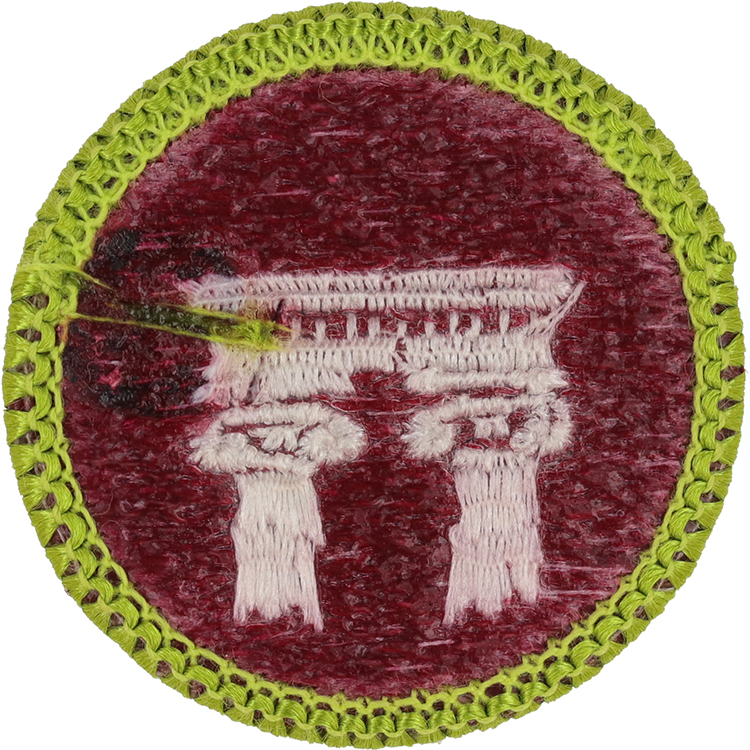
Fig. 2: Archit-H5-Reverse
- Back: Molded plastic
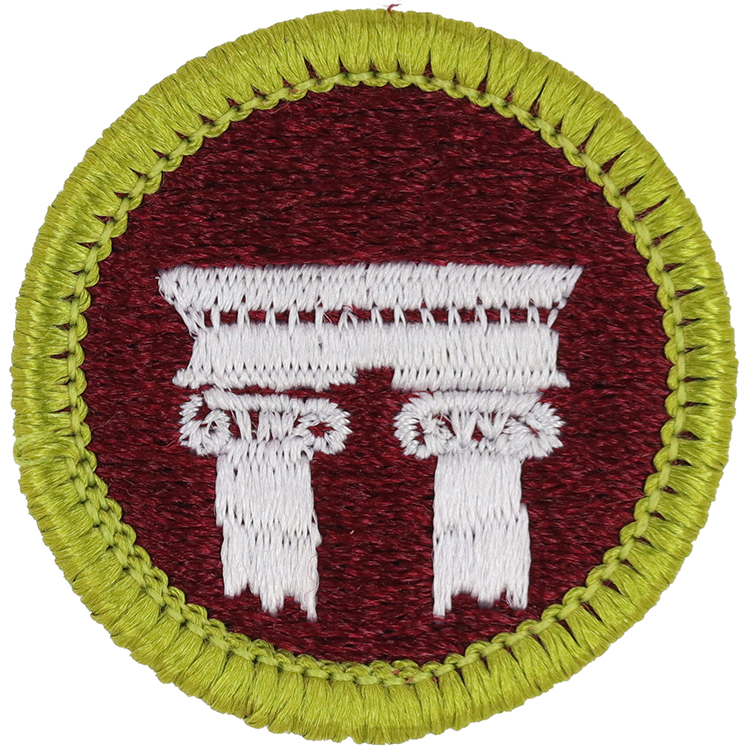
Fig. 3: Archit-H5-mve1-front
- Minor variation: Yellow border
Fig. 4: Archit-H5-mve1-reverse
- Back: Molded plastic
Item Name: Architecture 1990 - 2002
Item ID: Archit-H5
Collector Rating: 1
Pamphlets Used to Earn this Badge


Requirements June 1972 until January 1995
1. Write about a period of history that influenced architecture. Compare the buildings of that time with those in the United States today.
2. Write about a building you admire. Describe its arrangement, exterior, interior, and surroundings. Give the function for which the building was designed.
3. Make a sketch of a building you admire (other than the one in No. 2)
4. Measure a building. Make a drawing of it at a scale of 1/4 inch equal to 1 foot. Make one plan and one detail such as a doorway or window. It may be in pencil on tracing or drawing paper. Use simple architectural letters
Requirements September 1995 until January 2009
1. Tour your community and list the different building types you see. Try to identify buildings that can be associated with a specific period of history. Make a sketch of the buildings you most admire.
2. rrange to meet with an architect. Ask to see the architect’s office and to talk about the following:
(a) Careers in architecture
(b) Educational requirements
(c) Tools and architect uses
(d) Processes involved in a building project
3. Arrange to visit a construction project with the project’s architect. Ask to see the construction drawings so that you can compare how the project is drawn on paper to how it is actually built. Notice the different building materials. Find out how they are to be used, why they were selected, and what determines how they are being put together.
4. Interview the owner or occupant of a home or other building (your “client”). Find out what your client’s requirements would be for designing a new home or business facility. Write down all of your client’s requirements that you think would affect the layout or design of the new facility.
5. Please scale drawing of the floor plan indicating walls, doors, windows, and furniture. Neatly label your drawing including your name and the date. (Drawing scale: ¼ inch = 1 foot)