-
Merit Badges
- Legend to identify Merit Badges
- 1910 British Merit Badges
- Square 1911 - 33
- Wide Crimped 1934 & 35
-
Narrow Tan Crimped 1936 - 42
- Tan Heavyweight Cloth with Silk Embroidery and Printed Back 1936 - 37
- Tan Heavyweight Cloth with Silk Embroidery and Plain Back 1937 - 38
- Tan Lightweight Cloth with Silk Embroidery and Plain Back 1938 - 39
- Tan Lightweight Cloth with Cotton Continuous Loop Embroidery and Plain Back 1939 - 42
- Tan Lightweight Cloth with Cotton Lockstitch Embroidery and Plain Back 1939 - 42
- Blue Background 1942 - 46
- Wartime 1942 - 46
- Khaki Narrow Crimped 1946 - 59
- Green Twill Gauze Back 1960 - 68
- Fully Embroidered Merrowed Edge 1960 - 72
- Unprinted Plastic Back 1972 - 01
- Printed Plastic Back 2002 - Current
-
Merit Badge Paper
- Merit Badge Applications
- Merit Badge Cards
-
Merit Badge Pamphlets
- Type 1 White Cover - Rectangle Drawing On Cover
- Type 2 White Cover 5-375" x 8" Title at Top
- Type 3A Tan Cover - 200 Fifth Avenue
- Type 3B Tan Cover - 2 line address New York City
- Type 3C Tan Cover - 2 line address New York N.Y.
- Type 3D Tan Cover - 1 line address New York N.Y.
- Type 4 Standing Scout Cover
- Type 5A War Cover
- Type 5B Red and White
- Type 6 Photo-Red Cover
- Type 7 Full Photo Cover or Bulls-eye Cover
- Type 8 Full Photo - Green Stripe Cover
- Type 9 Full Photo - Red Stripe Cover
- Type 10A Blue Stripe - Logo above bottom blue stripe - FDL centered
- Type 10B - Blue Stripe in bottom of photo area. FDL to left of text
- Special Covers
- Boy Craft Helps
- Merit Badge Counselor's Guides
-
Youth Position
- Junior Assistant Scoutmaster
- Senior Patrol Leader
- Assistant Senior Patrol Leader
- Patrol Leader
- Assistant Patrol Leader
- Troop Guide
- Scribe
- Quartermaster
- Instructor
- Chaplain Aide
- Den Chief
- Librarian
- Musician
- Webmaster
- Bugler
- Troop Historian
- Troop Representative
- Unit Representative
- Leadership Corps
- Honor Guard
- Leave No Trace Trainer
- Outdoor Ethics Guide
-
Patrol Medallions
- Patrol Medallions Introduction
- Legend to identify Patrol Medallions
- Patrol Shoulder Knot-Ribbons
- Felt Handmade Patrol Medallions
- Square Felt Patrol Medallions
- Round Broadcloth Patrol Medallions
- Red Twill Patrol Medallions
- Multi-Color Cloth Patrol Medallions
- Tan Cloth Patrol Medallions
- Patrol Medallion Back Patches
- Woodbadge Patrol Medallion
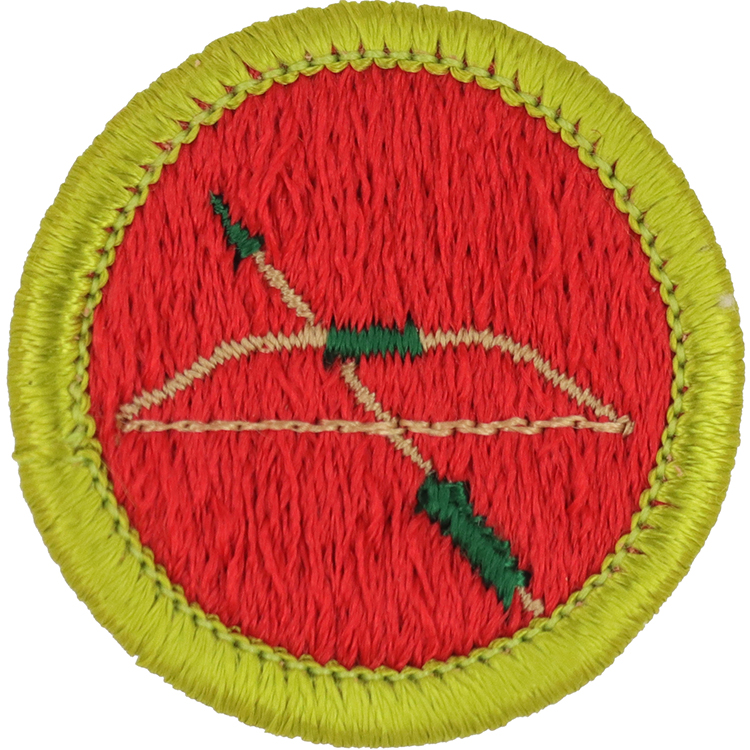
Fig. 1: Archer-H4-Front
- Embroidery: Cotton thread, dull sheen
- Border: Lt green merrowed
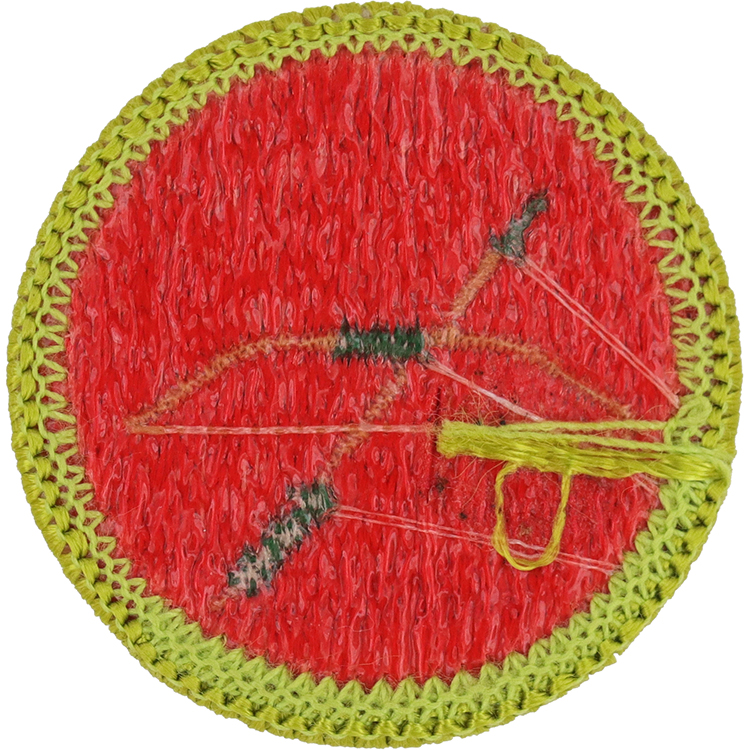
Fig. 2: Archer-H4-Reverse
- Back: Lt green lock stitch, molded plastic
Item Name: Archery 1978 - 1990
Item ID: Archer-H4
Collector Rating: 1
Pamphlets Used to Earn this Badge
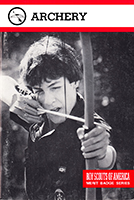
Requirements July 1976 until September 1987
1. Do the following:
(a) Name and explain the archery safety rules.
(b) Tell about the local and state laws on ownership, use, and registration of archery tackle.
2. Do the following:
(a) Name and point out the parts of an arrow.
(b) Name and point out the parts of a bow.
(c) Describe and show how to use an arm guard, shooting glove, finger tab, and quiver.
3. Do the following:
(a) Explain proper care of and how to store the bow, bowstring, arrows, and leather items.
(b) Make a bowstring and use it.
(c) Make six complete arrows from bare shafts and use them.
(d) Explain the following terms: cast, bow weight, string height (fistmele), aiming, spine, mechanical release, freestyle, and bare bow.
(e) Describe the different types of arrows.
(f) Show the seven basic steps of a good shooting method.
4. Shoot with bow and arrows, using a finger release:
(a) One round from any one of the following 11 NFAA field rounds and indoor rounds:
(1) A field round of 14 targets and make a score of 60 points.
(2) A club field round of 14 targets and make a score of 70 points.
(3) An 18.3 meter (20-yard) Flint round (indoor) of seven targets and make a score of 80 points.
(4) An NFAA indoor round and make a score of 50 points.
(5) An NFAA Freeman round and make a score of 70 points.
(6) * An Easton round and make a score of 150 points.
(7) + A junior Easton round and make a score of 160 points.
(8) * A 900 round and make a score of 225 points.
(9) + A junior 900 round and make a score 250 points.
(10) + An indoor FITA (international federation) round I and make a score of 80 points.
(11) * An indoor FITA round II and make a score of 90 points.
OR
(b) As a member of a National Archery Association (NAA) Junior Olympic Archery Development Club, qualify as a Yeoman, Junior Bowman, and Junior Archer.
OR
(c) As a member of the NFAA Junior Division qualify as a Club of Youth by earning 100-score Progression Patches.
5. Explain the following:
(a) The difference between field and target archery.
(b) Field round, hunter round, and animal round.
(c) Scout field round.
(d) Indoor field rounds.
(e) 900, junior 900, Easton, and junior Easton rounds.
(f) Indoor FITA rounds I and II.
(g) FITA and junior FITA rounds.
(h) Junior Olympic qualification rounds.
(I) The importance of obedience to a rangemaster or other person in charge of a range.
* Intermediates 15-17 years old.
+ Juniors up to 14 years old.
Requirements September 1987 until August 1992
1. Do the following:
(a) Name and explain the archery safety rules.
(b) Tell about the local and state laws on ownership, use, and registration of archery tackle.
2. Do the following:
(a) Name and point out the parts of an arrow.
(b) Name and point out the parts of a bow.
(c) Describe and show how to use an arm guard, shooting glove, finger tab, and quiver.
3. Do the following:
(a) Explain proper care of and how to store the bow, bowstring, arrows, and leather items.
(b) Make a bowstring and use it.
(c) Make one complete arrow from a bare shaft.
(d) Explain the following terms: cast, bow weight, string height (fistmele), aiming, spine, mechanical release, freestyle, and bare bow.
(e) Describe the different types of arrows.
(f) Show the nine basic steps of a good shooting method.
(g) Locate and mark with dental floss, crimp on, or other method the nocking point on a bow string.
4. Shoot with bow and arrows, using a finger release:
(a) One indoor round from any of the following NFAA field rounds and indoor rounds:
(1) A field round of 14 targets and make a score of 60 points
(2) An indoor round and make a score of 50 points
(3) A 900 round and make a score of 225 points*
(4) An indoor FITA round I and make a score of 80 points+
OR
(b) As a member of the NAA Junior Olympic Archery Development Club, qualify as a Yeoman, Junior Bowman, and Bowman.
OR
(c) As a member of the NFAA Junior Division, qualify as a Club of Youth by earning 100-score progression Patches.
5. Explain the following:
(a) The difference between field and target archery.
(b) Field round, hunter round, and animal round.
(c) Scout field round.
(d) Indoor field rounds.
(e) 900, junior 900, Easton, and junior Easton rounds.
(f) Indoor FITA rounds I and II.
(g) FITA and junior FITA rounds.
(h) Junior Olympic qualification rounds.
(I) The importance of obedience to a rangemaster or other person in charge of a range.
* Intermediates 15-17 years old.
+ Juniors up to 14 years old.