-
Merit Badges
- Legend to identify Merit Badges
- 1910 British Merit Badges
- Square 1911 - 33
- Wide Crimped 1934 & 35
-
Narrow Tan Crimped 1936 - 42
- Tan Heavyweight Cloth with Silk Embroidery and Printed Back 1936 - 37
- Tan Heavyweight Cloth with Silk Embroidery and Plain Back 1937 - 38
- Tan Lightweight Cloth with Silk Embroidery and Plain Back 1938 - 39
- Tan Lightweight Cloth with Cotton Continuous Loop Embroidery and Plain Back 1939 - 42
- Tan Lightweight Cloth with Cotton Lockstitch Embroidery and Plain Back 1939 - 42
- Blue Background 1942 - 46
- Wartime 1942 - 46
- Khaki Narrow Crimped 1946 - 59
- Green Twill Gauze Back 1960 - 68
- Fully Embroidered Merrowed Edge 1960 - 72
- Unprinted Plastic Back 1972 - 01
- Printed Plastic Back 2002 - Current
-
Merit Badge Paper
- Merit Badge Applications
- Merit Badge Cards
-
Merit Badge Pamphlets
- Type 1 White Cover - Rectangle Drawing On Cover
- Type 2 White Cover 5-375" x 8" Title at Top
- Type 3A Tan Cover - 200 Fifth Avenue
- Type 3B Tan Cover - 2 line address New York City
- Type 3C Tan Cover - 2 line address New York N.Y.
- Type 3D Tan Cover - 1 line address New York N.Y.
- Type 4 Standing Scout Cover
- Type 5A War Cover
- Type 5B Red and White
- Type 6 Photo-Red Cover
- Type 7 Full Photo Cover or Bulls-eye Cover
- Type 8 Full Photo - Green Stripe Cover
- Type 9 Full Photo - Red Stripe Cover
- Type 10A Blue Stripe - Logo above bottom blue stripe - FDL centered
- Type 10B - Blue Stripe in bottom of photo area. FDL to left of text
- Special Covers
- Boy Craft Helps
- Merit Badge Counselor's Guides
-
Youth Position
- Junior Assistant Scoutmaster
- Senior Patrol Leader
- Assistant Senior Patrol Leader
- Patrol Leader
- Assistant Patrol Leader
- Troop Guide
- Scribe
- Quartermaster
- Instructor
- Chaplain Aide
- Den Chief
- Librarian
- Musician
- Webmaster
- Bugler
- Troop Historian
- Troop Representative
- Unit Representative
- Leadership Corps
- Honor Guard
- Leave No Trace Trainer
- Outdoor Ethics Guide
-
Patrol Medallions
- Patrol Medallions Introduction
- Legend to identify Patrol Medallions
- Patrol Shoulder Knot-Ribbons
- Felt Handmade Patrol Medallions
- Square Felt Patrol Medallions
- Round Broadcloth Patrol Medallions
- Red Twill Patrol Medallions
- Multi-Color Cloth Patrol Medallions
- Tan Cloth Patrol Medallions
- Patrol Medallion Back Patches
- Woodbadge Patrol Medallion
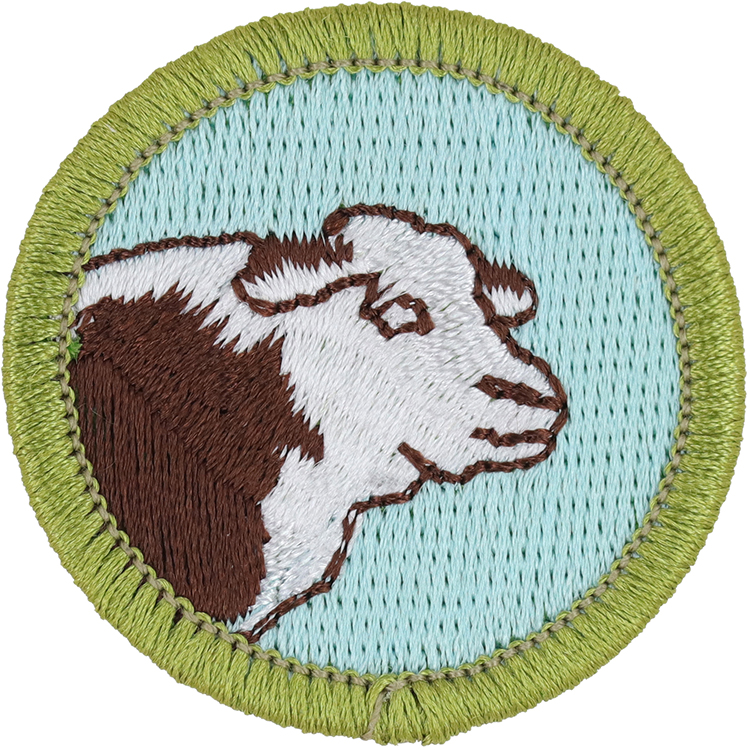
Fig. 1: AniSci-L1a-Front
- Embroidery: Rayon thread
- Design: Vertical stitch background
- Border: Merrowed
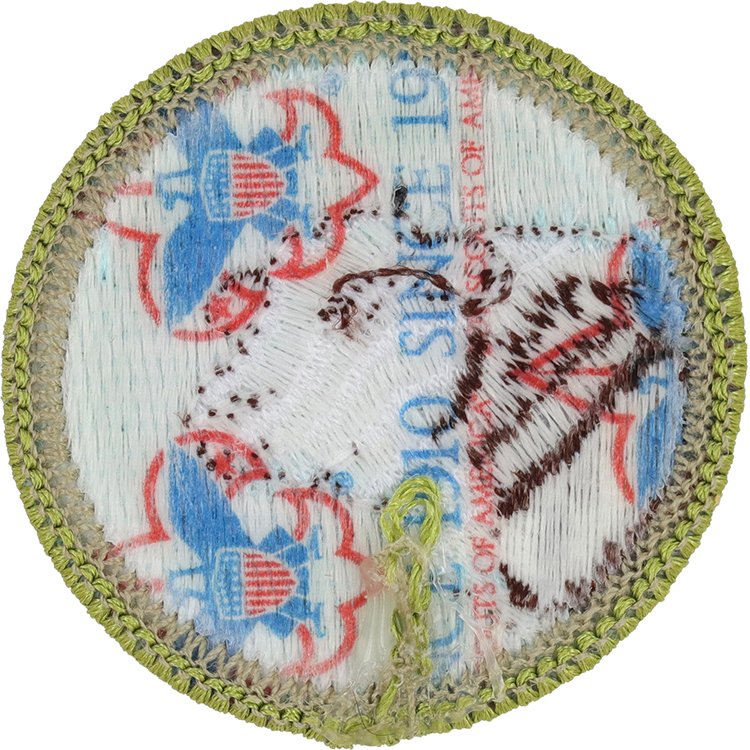
Fig. 2: AniSci-L1a-Reverse
- Back: Since 1910 imprint with large Tenderfoot image
Item Name: Animal Science 2014 - Current
Item ID: AniSci-L1a
Collector Rating: 1
Pamphlets Used to Earn this Badge

Requirements January 2006 until Current
1. Name four breeds of livestock in each of the following classifications: horses, dairy cattle, beef cattle, sheep, hogs. Tell their principal uses and merits. Tell where the breeds originated.
2. List five diseases that afflict the animals in each of the classifications in requirement 1. Also list five diseases of poultry. Describe the symptoms of each disease and explain how each is contracted and how it could be prevented.
3. Explain the major differences in digestive systems of ruminant, horses, pigs, and poultry. Explain how the differences in structure and function among these four types of digestive tracts affect the nutritional management of these species.
4. Select one type of animal – beef cow, dairy cow, horse, sheep, goat, or hog, or a poultry flock – and tell how you would properly manage it. Include in your discussion nutritional (feeding) concerns, housing, disease prevention, waste control/removal, and breeding programs if appropriate.
5. Explain the importance of setting clear goals for any breeding program. Tell how purebred lines of animals are produced. Explain the practice of crossbreeding and the value of this practice.
6. Complete ONE of the following options:
Beef Cattle Option
(a) Visit a farm or ranch where beef cattle are produced under any of these systems:
(1) Feeding market cattle for slaughter
(2) Cow/calf operation, producing cattle for sale to commercial feeders
(3) Producing purebred cattle for sale as breeding stock to others
Talk with the operator to learn how the cattle were handled, fed, weighed, and shipped. Describe what you saw and explain what you learned. If you cannot visit a cattle ranch or farm, view a video from a breed association, or research the Internet (with your parent’s permission) for information on beef cattle production. Tell about your findings.
(b) Sketch a plan of a feedlot to include its forage and grain storage facilities, and loading chute for 30 or more fattening steers; or sketch a corral plan with cutting and loading chutes for handling 50 or more beef cows and their calves at one time.
(c) Make a sketch showing the principal wholesale and retail cuts of beef. Tell about U.S. Department of Agriculture (USDA) dual grading system of beef. Tell the basis of each grade in each system.
(d) Defined the following terms: pull, steer, bullock, cow, heifer, freemartin, heiferette, calf.
Dairying Option
(a) Tell how a cow or goat converts forage and grain into milk. Explain the differences in feeds typically used for dairy cows versus those fed to beef cows.
(b) Make a chart showing the components in cow’s milk or goat’s milk. Chart the amount of each.
(c) Explain the requirements for producing grade A milk. Tell how and why milk is pasteurized.
(d) Tell about the kinds of equipment used for milking and the sanitation standards that must be met on dairy farms.
(e) Defined the following terms: bull, cow, steer, heifer, springer, buck, doe, kid.
(f) Visit a dairy farm or milk processing plant. Describe what you saw and explain what you learned. If you cannot visit a dairy farm or processing plant, view a video from a breed or dairy association, or research the Internet (with your parent’s permission) for information on dairying. Tell about your findings.
Horse Option
(a) Make a sketch of a useful saddle horse barn and exercise yard.
(b) Tell about the history of the horse and the benefits it has brought to people. Using the four breeds of horses you chose in requirement 1, discuss the different special uses of each breed.
(c) Define the following terms; mare, stallion, gelding, foal, colt, filly, mustang, quarter horse, draft horse, pacer, trotter; pinto, calico, palomino, overo, tobiano.
(d) Visit a horse farm. Describe what you saw and explain what you learned. If you cannot visit a horse farm, view a video from a breed association, or research the Internet (with your parent’s permission) for information on horses. Tell about your findings.
(e) Outline the proper feeding of a horse doing light work. Explain why the amount and kind of feed will change according to the kind of horse and the work it does. Describe what colic is, what can cause it, and its symptoms.
Sheep Option
(a) Make a sketch of a live lamb. Show the location of the various wholesale and retail cuts.
(b) Discuss how wools are sorted and graded.
(c) Do ONE of the following:
(1) Raise a lamb from weaning to market weight. Keep records of feed intake, weight gains, medication, vaccination, and mortality. Present your records for review by your counselor.
(2) Visit a farm or ranch where sheep are raised. Describe what you saw and explain what your learned. If you cannot visit a sheep farm or ranch, view a video from a breed association, or research the Internet (with your parent’s permission) for information sheep production. Tell about your findings.
(d) Describe some differences between the production of purebred and commercial lambs. Then select two breeds that would be appropriate for the production of crossbred market lambs in your region. Identify which breed the ram should be.
(e) Defined the following terms: wether, ewe, ram, lamb.
Hog Option
(a) Make a sketch showing the principle wholesale and retail cuts of pork. Tell about the recommended USDA grades of pork.
(b) Outline in writing the proper feeding programs used from the breeding of gilt or sow through the weaning of the litter. Discuss the feeding programs for the growth and finishing periods.
(c) Do ONE of the following
(1) Raise a feeder pig from weaning to market weight. Keep records of feed intake, weight gains, medication, vaccination, and mortality. Present your records for review by your counselor.
(2) Visit a farm where hogs are produced, or visit a packing plant handling hogs. Describe what you saw and explain what you learned. If you cannot visit a hog production unit or packing plant, view a video from a packer or processor, or research the Internet (with your parent’s permission) for information on hogs. Tell about your findings
(d) Define the following terms: gilt, sow, barrow, boar.
Avian Option
(a) Make a sketch of a layer or broiler house showing nests, roosts, feeders, waters, and means of ventilation. Explain how insulation, ventilation, temperature controls, automatic lights, and other environmental controls are used to protect birds from heat, cold, and bad weather.
(b) Explain why overcrowding is dangerous for poultry flocks.
(c) Tell about the grading of eggs. Tell how broilers (fryers) are graded. Describe the classes of chicken meat.
(d) Do ONE of the following:
(1) Manage an egg-producing flock for five months. Keep records of feed purchased, eggs sold, medication, vaccination, and mortality. Present your records for review by your counselor.
(2) Raise 20 chicks from hatchings. Keep records of feed intake, weight gains, medication, vaccination and mortality. Present your records for review by your counselor.
(3) Visit a commercial avian production facility. Describe what you saw and what you learned. If you cannot visit a commercial facility, view a video from a poultry association or research the Internet (with your parent’s permission) for information on poultry production. Tell about your findings.
(4) Define the following terms: hen, rooster, chick, capon, tom, poult.
7. Find out about three career opportunities in animal science. Pick one and find out the education, training, and experience required for this profession. Discuss this with your counselor, and explain why this profession might interest you.