-
Merit Badges
- Legend to identify Merit Badges
- 1910 British Merit Badges
- Square 1911 - 33
- Wide Crimped 1934 & 35
-
Narrow Tan Crimped 1936 - 42
- Tan Heavyweight Cloth with Silk Embroidery and Printed Back 1936 - 37
- Tan Heavyweight Cloth with Silk Embroidery and Plain Back 1937 - 38
- Tan Lightweight Cloth with Silk Embroidery and Plain Back 1938 - 39
- Tan Lightweight Cloth with Cotton Continuous Loop Embroidery and Plain Back 1939 - 42
- Tan Lightweight Cloth with Cotton Lockstitch Embroidery and Plain Back 1939 - 42
- Blue Background 1942 - 46
- Wartime 1942 - 46
- Khaki Narrow Crimped 1946 - 59
- Green Twill Gauze Back 1960 - 68
- Fully Embroidered Merrowed Edge 1960 - 72
- Unprinted Plastic Back 1972 - 01
- Printed Plastic Back 2002 - Current
-
Merit Badge Paper
- Merit Badge Applications
- Merit Badge Cards
-
Merit Badge Pamphlets
- Type 1 White Cover - Rectangle Drawing On Cover
- Type 2 White Cover 5-375" x 8" Title at Top
- Type 3A Tan Cover - 200 Fifth Avenue
- Type 3B Tan Cover - 2 line address New York City
- Type 3C Tan Cover - 2 line address New York N.Y.
- Type 3D Tan Cover - 1 line address New York N.Y.
- Type 4 Standing Scout Cover
- Type 5A War Cover
- Type 5B Red and White
- Type 6 Photo-Red Cover
- Type 7 Full Photo Cover or Bulls-eye Cover
- Type 8 Full Photo - Green Stripe Cover
- Type 9 Full Photo - Red Stripe Cover
- Type 10A Blue Stripe - Logo above bottom blue stripe - FDL centered
- Type 10B - Blue Stripe in bottom of photo area. FDL to left of text
- Special Covers
- Boy Craft Helps
- Merit Badge Counselor's Guides
-
Youth Position
- Junior Assistant Scoutmaster
- Senior Patrol Leader
- Assistant Senior Patrol Leader
- Patrol Leader
- Assistant Patrol Leader
- Troop Guide
- Scribe
- Quartermaster
- Instructor
- Chaplain Aide
- Den Chief
- Librarian
- Musician
- Webmaster
- Bugler
- Troop Historian
- Troop Representative
- Unit Representative
- Leadership Corps
- Honor Guard
- Leave No Trace Trainer
- Outdoor Ethics Guide
-
Patrol Medallions
- Patrol Medallions Introduction
- Legend to identify Patrol Medallions
- Patrol Shoulder Knot-Ribbons
- Felt Handmade Patrol Medallions
- Square Felt Patrol Medallions
- Round Broadcloth Patrol Medallions
- Red Twill Patrol Medallions
- Multi-Color Cloth Patrol Medallions
- Tan Cloth Patrol Medallions
- Patrol Medallion Back Patches
- Woodbadge Patrol Medallion
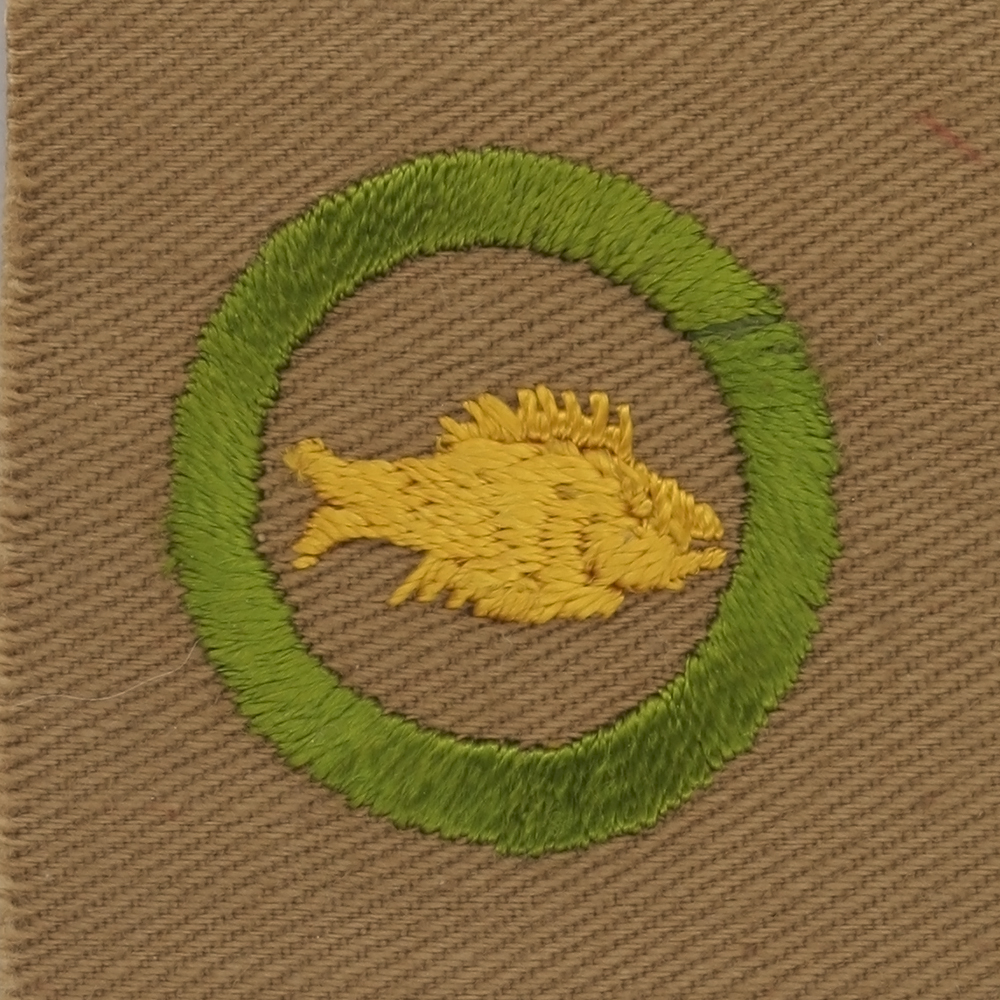
Fig. 1: Anglin-AT3-Front
- Cloth: Heavyweight tan right twill
- Embroidery: Silk continuous
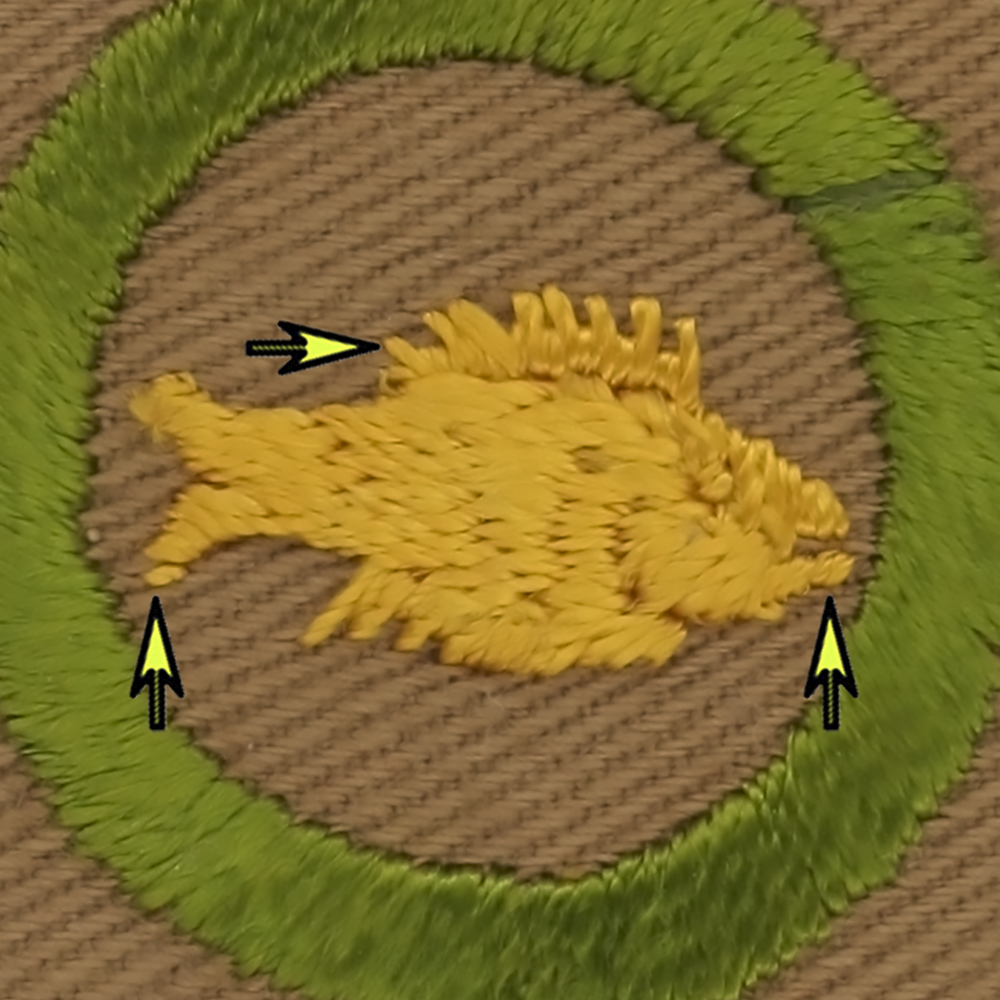
Fig. 2: Anglin-AT3-Magnified
- Design: Short spines in dorsal fin, forked tail, terminal mouth shape, streamlined body
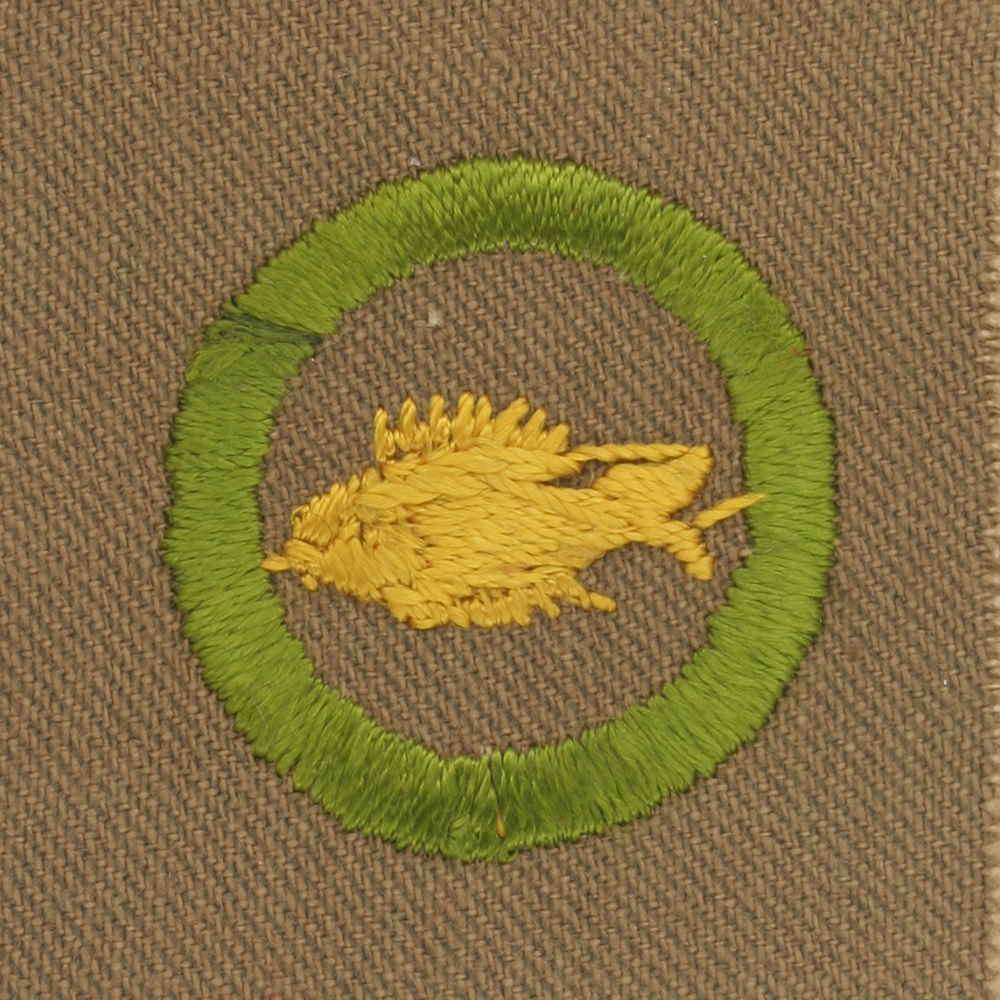
Fig. 3: Anglin-AT3-Reverse
- Back: Black imprint
Item Name: Angling 1920 - 1933
Item ID: Anglin-AT3
Collector Rating: 1
Pamphlets Used to Earn this Badge


Requirements October 1914 until April 1923
1. Catch and name seven different species of fish by the usual angling methods (fly-casting, bait-casting, trolling, and bait fishing). At least one species must be taken by fly-casting and one by bait casting. In single-handed fly-casting the rod must not exceed seven ounces in weight; in double-handed fly-casting one ounce in weight may be allowed for each foot in length; in bait-fishing and trolling the rod must not exceed ten feet in length nor twelve ounces in weight
2. Show proficiency in accurate single handed casting with the fly for distances of 30, 40, and 50 feet, and in bait-casting for distances of 40, 60, and 70 feet.
3. Make three artificial flies (either after three standard patterns, or in imitation of different natural flies) and take fish with at least two of them. Make a neat single gut leader at least four feet long, or a twisted or braided leader at least three feet long. Splice the broken joint of a rod neatly.
4. Give the open season for the game fishes in his vicinity, and explain how and why they are protected by law.
Requirements April 1923 until January 1924
1. Catch and name seven different species of fishes by the usual angling methods (fly-casting, bait-casting, trolling, and bait fishing). At least one species must be taken by fly-casting or by bait casting.
2. Show proficiency in fly-casting with the fly for distances of 30, 40, and 50 feet, or in bait-casting for distances of 40, 60, and 70 feet.
3. Name and describe at least five standard fly patterns, and tie one fly to conform with these patterns, or make a spoon troll. plug or any other form of artificial bait, and prove its worth by catching fish with it. Make out of gut a neat single leader at least four feet long. Splice the broken joint of a rod or in some other way show proficiency in repairing broken tackle.
4. Give the open season for the game fishes in his vicinity, and explain how and why they are protected by law.
Requirements January 1924 until January 1925
1. Catch and name seven different species of fishes by the usual angling methods (fly-casting, bait-casting, trolling, and bait-fishing). At least one species must be taken by fly-casting or one by bait-casting.
2. Show proficiency in fly-casting with the fly for distances of 30 to 50 feet, or in bait-casting for distances of 40, 60, and 70 feet.
3. Name and describe at least five standard fly patterns, or make spoon troll, plug or any other form of artificial bait, and prove its worth by catching fish with it. Make out of gut a neat single leader at least four feet long. Splice the broken joint of a rod or in some other way show proficiency in repairing broken tackle.
4. Give the open season for the game fishes in his vicinity, and explain how and why they are protected by law.
Requirements January 1925 until May 1925
1. Catch and identify at least one specimen from each of three local species of fish by the usual angling methods (fly-casting, bait-casting, trolling, and bait-fishing). At least one species must be taken by fly-casting or one by bait-casting
2. Show proficiency in fly-casting with the fly for distances of 30 or 40 feet, or in bait-casting for distances of 40, 60, and 70 feet.
3. Name and describe at least five standard fly patterns, or make a fly, spoon troll, plug or any other form of artificial bait lure and prove its worth by catching fish with it. Make a neat single gut leader at least four feet long. Splice the broken joint of a rod or in some other way show proficiency in repairing broken tackle.
4. Give the open season for the game fishes in his vicinity, and explain how and why they are protected by law.
Requirements May 1925 until June 1952
1. Catch and identify at least one specimen from each of three local species of fish by the usual angling methods (fly-casting, bait-casting, trolling, and bait-fishing). At least one species must be taken by fly-casting or one by bait-casting
2. Show proficiency and accuracy in fly-casting with the fly for distances of 30 or 40 feet, or in bait-casting for distances of 40, 60, and 70 feet.
3. Name and describe at least five standard fly patterns, or make a fly, spoon troll, plug or any other form of artificial bait lure and prove its worth by catching fish with it. Make a neat single gut leader at least four feet long. Splice the broken joint of a rod or in some other way show proficiency in repairing broken tackle.
4. Give the open season for the game fishes in his vicinity, and explain how and why they are protected by law.