-
Merit Badges
- Legend to identify Merit Badges
- 1910 British Merit Badges
- Square 1911 - 33
- Wide Crimped 1934 & 35
-
Narrow Tan Crimped 1936 - 42
- Tan Heavyweight Cloth with Silk Embroidery and Printed Back 1936 - 37
- Tan Heavyweight Cloth with Silk Embroidery and Plain Back 1937 - 38
- Tan Lightweight Cloth with Silk Embroidery and Plain Back 1938 - 39
- Tan Lightweight Cloth with Cotton Continuous Loop Embroidery and Plain Back 1939 - 42
- Tan Lightweight Cloth with Cotton Lockstitch Embroidery and Plain Back 1939 - 42
- Blue Background 1942 - 46
- Wartime 1942 - 46
- Khaki Narrow Crimped 1946 - 59
- Green Twill Gauze Back 1960 - 68
- Fully Embroidered Merrowed Edge 1960 - 72
- Unprinted Plastic Back 1972 - 01
- Printed Plastic Back 2002 - Current
-
Merit Badge Paper
- Merit Badge Applications
- Merit Badge Cards
-
Merit Badge Pamphlets
- Type 1 White Cover - Rectangle Drawing On Cover
- Type 2 White Cover 5-375" x 8" Title at Top
- Type 3A Tan Cover - 200 Fifth Avenue
- Type 3B Tan Cover - 2 line address New York City
- Type 3C Tan Cover - 2 line address New York N.Y.
- Type 3D Tan Cover - 1 line address New York N.Y.
- Type 4 Standing Scout Cover
- Type 5A War Cover
- Type 5B Red and White
- Type 6 Photo-Red Cover
- Type 7 Full Photo Cover or Bulls-eye Cover
- Type 8 Full Photo - Green Stripe Cover
- Type 9 Full Photo - Red Stripe Cover
- Type 10A Blue Stripe - Logo above bottom blue stripe - FDL centered
- Type 10B - Blue Stripe in bottom of photo area. FDL to left of text
- Special Covers
- Boy Craft Helps
- Merit Badge Counselor's Guides
-
Youth Position
- Junior Assistant Scoutmaster
- Senior Patrol Leader
- Assistant Senior Patrol Leader
- Patrol Leader
- Assistant Patrol Leader
- Troop Guide
- Scribe
- Quartermaster
- Instructor
- Chaplain Aide
- Den Chief
- Librarian
- Musician
- Webmaster
- Bugler
- Troop Historian
- Troop Representative
- Unit Representative
- Leadership Corps
- Honor Guard
- Leave No Trace Trainer
- Outdoor Ethics Guide
-
Patrol Medallions
- Patrol Medallions Introduction
- Legend to identify Patrol Medallions
- Patrol Shoulder Knot-Ribbons
- Felt Handmade Patrol Medallions
- Square Felt Patrol Medallions
- Round Broadcloth Patrol Medallions
- Red Twill Patrol Medallions
- Multi-Color Cloth Patrol Medallions
- Tan Cloth Patrol Medallions
- Patrol Medallion Back Patches
- Woodbadge Patrol Medallion

Fig. 1: AmeLab-J1-Front
- Embroidery: Rayon thread
- Border: Merrowed
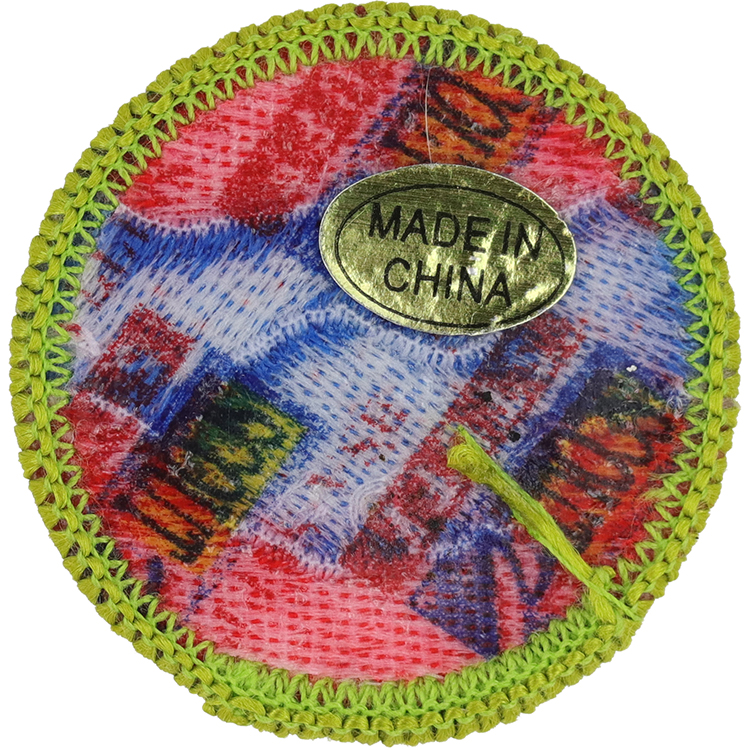
Fig. 2: AmeLab-J1-Reverse
- Back: Scout Stuff imprint
Item Name: American Labor 2002 - 2009
Item ID: AmeLab-J1
Collector Rating: 1
Pamphlets Used to Earn this Badge

Requirements September 1987 until January 2006
1. Do ONE of the following:
(a) Develop a time line of significant history of the American labor movement from the 1770’s to today.
(b) Prepare an exhibit or a scrapbook illustrating three major achievements of the American labor movement.
(c) In 500 words or more, write about one of the founders of organized labor in the United States.
(d) In 500 words or more, write how the work force fits into the economic system of the United States.
2. Check with some news sources where you live-public library; federal, state, county, or municipal employment office; labor union office-for information about working people and their concerns. Discuss your findings with your counselor.
3. Discuss with your counselor how you would lead a discussion on the subject of worker concerns about job-related issues. Issues should be related to the workplace (safety, job assignments, seniority, wages, child care, etc.)
4. With help from your counselor, prepare an exhibit or a scrapbook illustrating ONE of the following:
(a) Issues that concern American Workers
(b) Federal and state labor laws showing how these laws affect American workers
(c) Current issues you have learned about from a national union or employee group
5. Visit the office or attend a meeting of a local union, an AFL-CIO labor council, or an independent employee organization. Talk with some people there and find out what the organization does. Draw a diagram of the organizational structure of the association you visited from the local to the national level, if applicable.
6. Be prepared to define and discuss some of the key terms used in labor relations.
7. With help from your counselor, determine some of the basic rights and responsibilities that members of unions, employee organizations, and those not belonging to a collective association have.
8. With help from your counselor, chart a comparison of wages, benefits, and working conditions in a union shop and a nonunion shop in the same industry.
9. Discuss why it is important to maintain good relationships among business, labor, and government. Describe to your counselor what can happen when these relationships get out of balance.
10. Discuss with your counselor the different goals that may exist with the owners of a business, its stockholders, its customers, its employees, the employees’ representatives, the community, and public officials. Explain why agreements and compromises are made and how they affect each group in attaining its goals.
Requirements January 2006 until January 2016
1. Using resources available to you, learn about working people and work-related concerns. List and briefly describe or give examples of at least EIGHT concerns of American workers. These may include, but are not limited to, working conditions, workplace safety, hours, wages, seniority, job security, equal opportunity employment and discrimination, guest workers, automation, and technologies that replace workers, unemployment, layoffs, outsourcing, and employee benefits such as health care, profit sharing, and retirement benefits.
2. With your counselor’s and parent’s approval and permission, visit the office or attend a meeting of a local union, a central labor council, or an employee organization, or contact one of these organizations via the Internet, Then do EACH of the following:
(a) Find out what the organization does.
(b) Share the list of issues and concerns you made for requirement 1. Ask the people you communicate with which issues are of greatest interest or concern to them and why.
(c) Draw a diagram showing how the organization is structured, from the local to the national level, if applicable.
3. Explain to your counselor what labor unions are, what they do, and what services they provide to members. In your discussion, show that you understand the concepts of labor, management, collective bargaining, negotiation, union shops, open (nonunion) shops, grievance procedures, mediation, arbitration, works stoppages, strikes, and lockouts.
4. Explain what is meant by the adversarial model of labor-management relations, compared with a cooperative-bargaining style.
5. Do ONE of the following:
(a) Develop a time line of significant events in the history of the American labor movement from the 1770s to the present.
(b) Prepare an exhibit, a scrapbook, or a computer presentation, such as a slide show, illustrating three major achievements of the American labor movement and how those achievements affect American workers.
(c) With your counselor’s and parent’s approval and permission, watch a movie that addresses organized labor in the United States. Afterword, discuss the movie with your counselor and explain what you learned.
(d) Read a biography (with your counselor’s approval) of someone who has made a contribution to the American labor movement. Explain what contribution this person has made to the American labor movement.
6. Explain the term globalization. Discuss with your counselor some effects of globalization on the workforce in the United States. Explain how this global workforce fits into the economic system of this country.
7. Choose a labor issue of widespread interest to American workers – an issue in the news currently or known to you from your work on this merit badge. Before your counselor, or in writing, argue, both sides of the issue, first taking management’s side, then presenting labor’s or the employee’s point of view. In your presentation, summarize the basic rights and responsibilities of employers and employees, including union members and nonunion members.
8. Discuss with your counselor the different goals that may motivate the owners of a business, its stockholders, its customers, its employees, the employees’ representatives, the community, and the public officials. Explain why agreements and compromises are made and how they affect each group in achieving its goal.
9. Learn about opportunities in the field of labor relations. Choose one career in which you are interested and discuss with your counselor the major responsibilities of that position and the qualifications, education, and training such a position requires.