-
Merit Badges
- Legend to identify Merit Badges
- 1910 British Merit Badges
- Square 1911 - 33
- Wide Crimped 1934 & 35
-
Narrow Tan Crimped 1936 - 42
- Tan Heavyweight Cloth with Silk Embroidery and Printed Back 1936 - 37
- Tan Heavyweight Cloth with Silk Embroidery and Plain Back 1937 - 38
- Tan Lightweight Cloth with Silk Embroidery and Plain Back 1938 - 39
- Tan Lightweight Cloth with Cotton Continuous Loop Embroidery and Plain Back 1939 - 42
- Tan Lightweight Cloth with Cotton Lockstitch Embroidery and Plain Back 1939 - 42
- Blue Background 1942 - 46
- Wartime 1942 - 46
- Khaki Narrow Crimped 1946 - 59
- Green Twill Gauze Back 1960 - 68
- Fully Embroidered Merrowed Edge 1960 - 72
- Unprinted Plastic Back 1972 - 01
- Printed Plastic Back 2002 - Current
-
Merit Badge Paper
- Merit Badge Applications
- Merit Badge Cards
-
Merit Badge Pamphlets
- Type 1 White Cover - Rectangle Drawing On Cover
- Type 2 White Cover 5-375" x 8" Title at Top
- Type 3A Tan Cover - 200 Fifth Avenue
- Type 3B Tan Cover - 2 line address New York City
- Type 3C Tan Cover - 2 line address New York N.Y.
- Type 3D Tan Cover - 1 line address New York N.Y.
- Type 4 Standing Scout Cover
- Type 5A War Cover
- Type 5B Red and White
- Type 6 Photo-Red Cover
- Type 7 Full Photo Cover or Bulls-eye Cover
- Type 8 Full Photo - Green Stripe Cover
- Type 9 Full Photo - Red Stripe Cover
- Type 10A Blue Stripe - Logo above bottom blue stripe - FDL centered
- Type 10B - Blue Stripe in bottom of photo area. FDL to left of text
- Special Covers
- Boy Craft Helps
- Merit Badge Counselor's Guides
-
Youth Position
- Junior Assistant Scoutmaster
- Senior Patrol Leader
- Assistant Senior Patrol Leader
- Patrol Leader
- Assistant Patrol Leader
- Troop Guide
- Scribe
- Quartermaster
- Instructor
- Chaplain Aide
- Den Chief
- Librarian
- Musician
- Webmaster
- Bugler
- Troop Historian
- Troop Representative
- Unit Representative
- Leadership Corps
- Honor Guard
- Leave No Trace Trainer
- Outdoor Ethics Guide
-
Patrol Medallions
- Patrol Medallions Introduction
- Legend to identify Patrol Medallions
- Patrol Shoulder Knot-Ribbons
- Felt Handmade Patrol Medallions
- Square Felt Patrol Medallions
- Round Broadcloth Patrol Medallions
- Red Twill Patrol Medallions
- Multi-Color Cloth Patrol Medallions
- Tan Cloth Patrol Medallions
- Patrol Medallion Back Patches
- Woodbadge Patrol Medallion
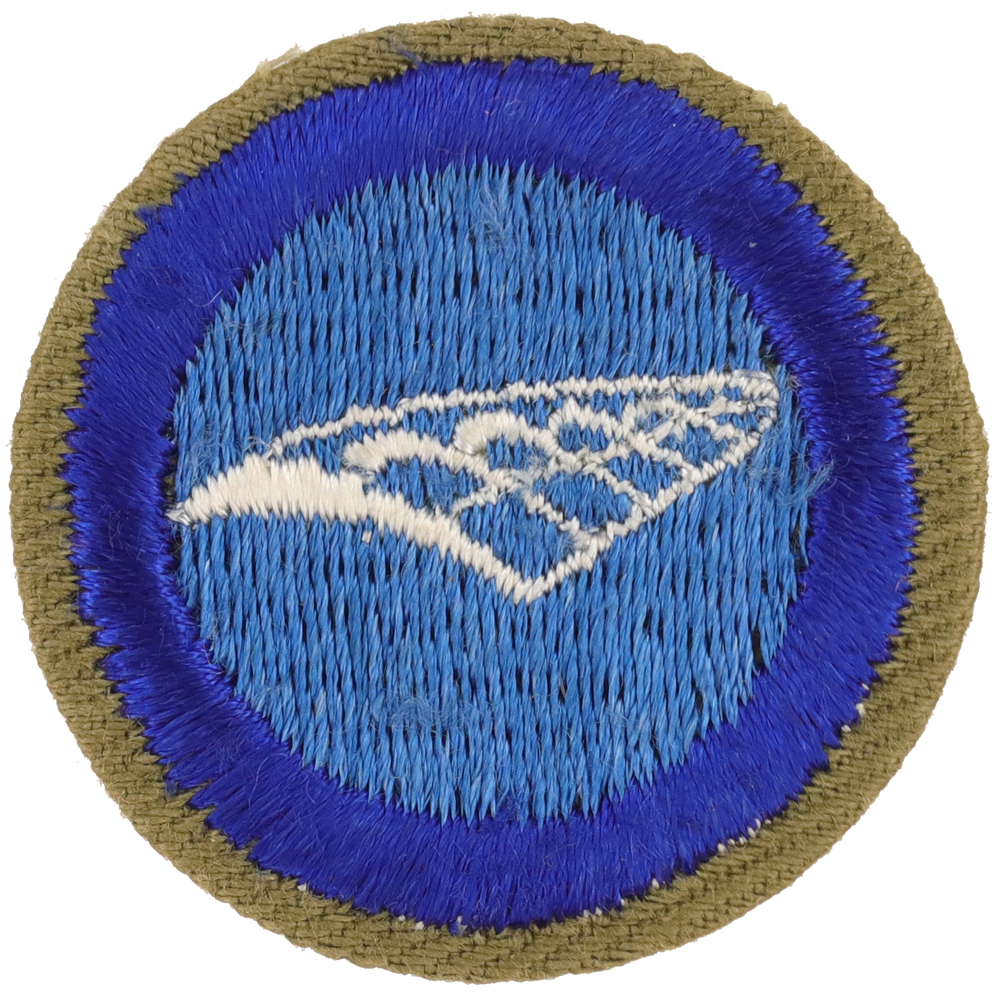
Fig. 1: AirStr-C-Front
- Cloth: Heavyweight tan right twill
- Embroidery: Cotton
- Special: Blue border
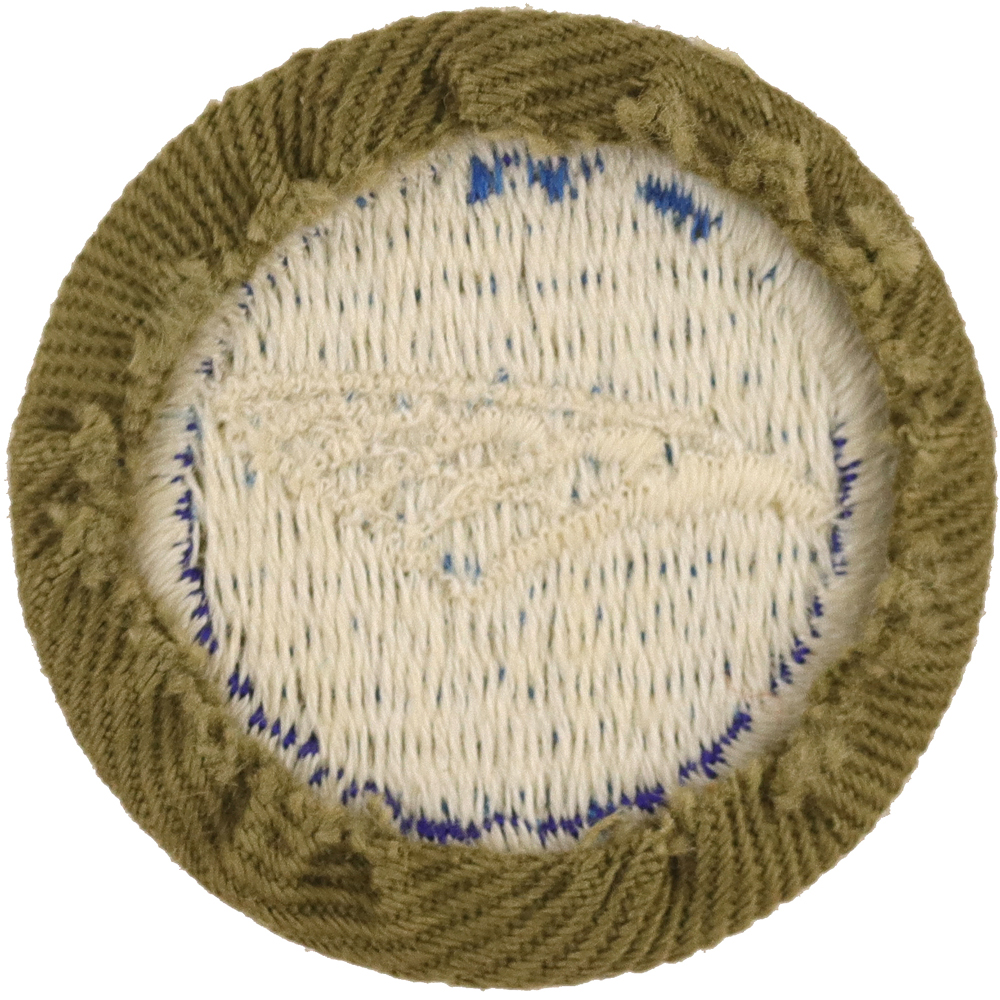
Fig. 2: AirStr-C-Reverse
- White lockstitch/li>
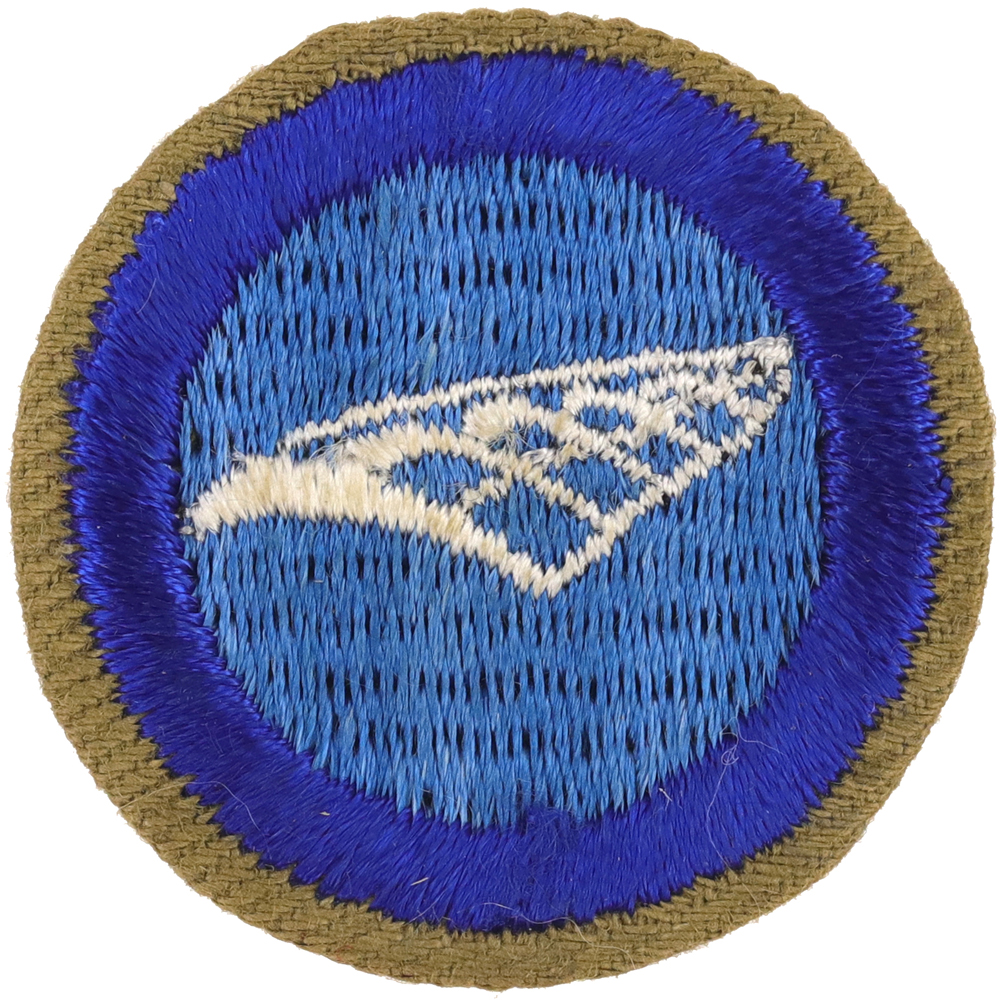
Fig. 3: AirStr-C-mve1-front
- Cloth: Heavyweight tan right twill
- Embroidery: Cotton
- Special: Blue border
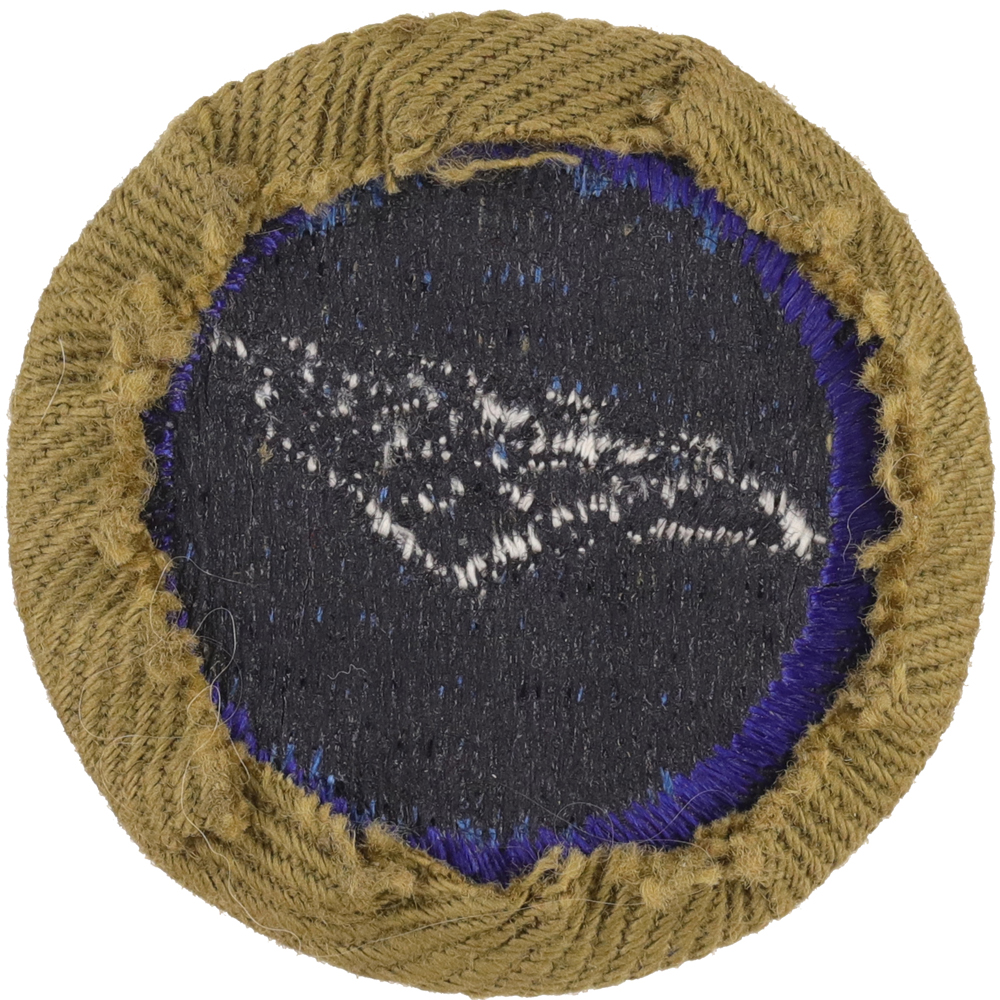
Fig. 4: AirStr-C-mve1-reverse
- Black lockstitch/li>
Item Name: Airplane Structure 1942 - 1947
Item ID: AirStr-C
Collector Rating: 5
Pamphlet Used to Earn this Badge
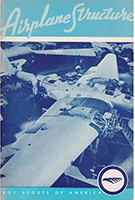
Requirements Aprip 1942 until 1947
- Identify on a sketch, a model or a plane, the major parts of an airplane and explain the purpose of each:
Fuselage—cabin, cockpit.
Landing gear—struts, wheels, wheel pants, brakes.
Engine—cowling, spinner, propeller.
Wings—leading and trailing edges, ailerons, flaps, slots.
Empennage—fin, rudder, tabs, elevator, stabilizer - Identify, in the fewest possible words, an airplane from its three standard silhouettes, or as seen in flight 7
- Show by sketch or small model how light weight reinforcement is used in wing, and body or tail assembly
- Explain with rough diagrams the rigging of a plane to secure symmetry and balance
- Demonstrate with sketches, or simple working model (not part of model airplane), the operation of the control system—stick or wheel—pedals—rudder—ailerons—elevator. If satisfactory open working model is made, that may be substituted for Requirement No. 8 belowuild a rubber
- Build a rubber-band powered flying model airplane having built-up fuselage and cambered wings (at least one surface). (Kit may be used.)
- Reduce this flying model (No. 6 above or No. 9 below) to a fairly accurate scale drawing, showing three projections - lateral, front, and horizontal.
- Carve a balanced single-blade propeller and fly
the above model with it, reporting relative effectiveness; OR make a free-wheeling propeller at- tachment for one of these model planes; OR make a scale shelf model of a plane. (Kit may be used.) - Build a simple triangular kite to ascend vertically, using a rubber band powered propeller.
- Fly the model made in requirement No. 6, in com- petition with at least two models