-
Merit Badges
- Legend to identify Merit Badges
- 1910 British Merit Badges
- Square 1911 - 33
- Wide Crimped 1934 & 35
-
Narrow Tan Crimped 1936 - 42
- Tan Heavyweight Cloth with Silk Embroidery and Printed Back 1936 - 37
- Tan Heavyweight Cloth with Silk Embroidery and Plain Back 1937 - 38
- Tan Lightweight Cloth with Silk Embroidery and Plain Back 1938 - 39
- Tan Lightweight Cloth with Cotton Continuous Loop Embroidery and Plain Back 1939 - 42
- Tan Lightweight Cloth with Cotton Lockstitch Embroidery and Plain Back 1939 - 42
- Blue Background 1942 - 46
- Wartime 1942 - 46
- Khaki Narrow Crimped 1946 - 59
- Green Twill Gauze Back 1960 - 68
- Fully Embroidered Merrowed Edge 1960 - 72
- Unprinted Plastic Back 1972 - 01
- Printed Plastic Back 2002 - Current
-
Merit Badge Paper
- Merit Badge Applications
- Merit Badge Cards
-
Merit Badge Pamphlets
- Type 1 White Cover - Rectangle Drawing On Cover
- Type 2 White Cover 5-375" x 8" Title at Top
- Type 3A Tan Cover - 200 Fifth Avenue
- Type 3B Tan Cover - 2 line address New York City
- Type 3C Tan Cover - 2 line address New York N.Y.
- Type 3D Tan Cover - 1 line address New York N.Y.
- Type 4 Standing Scout Cover
- Type 5A War Cover
- Type 5B Red and White
- Type 6 Photo-Red Cover
- Type 7 Full Photo Cover or Bulls-eye Cover
- Type 8 Full Photo - Green Stripe Cover
- Type 9 Full Photo - Red Stripe Cover
- Type 10A Blue Stripe - Logo above bottom blue stripe - FDL centered
- Type 10B - Blue Stripe in bottom of photo area. FDL to left of text
- Special Covers
- Boy Craft Helps
- Merit Badge Counselor's Guides
-
Youth Position
- Junior Assistant Scoutmaster
- Senior Patrol Leader
- Assistant Senior Patrol Leader
- Patrol Leader
- Assistant Patrol Leader
- Troop Guide
- Scribe
- Quartermaster
- Instructor
- Chaplain Aide
- Den Chief
- Librarian
- Musician
- Webmaster
- Bugler
- Troop Historian
- Troop Representative
- Unit Representative
- Leadership Corps
- Honor Guard
- Leave No Trace Trainer
- Outdoor Ethics Guide
-
Patrol Medallions
- Patrol Medallions Introduction
- Legend to identify Patrol Medallions
- Patrol Shoulder Knot-Ribbons
- Felt Handmade Patrol Medallions
- Square Felt Patrol Medallions
- Round Broadcloth Patrol Medallions
- Red Twill Patrol Medallions
- Multi-Color Cloth Patrol Medallions
- Tan Cloth Patrol Medallions
- Patrol Medallion Back Patches
- Woodbadge Patrol Medallion
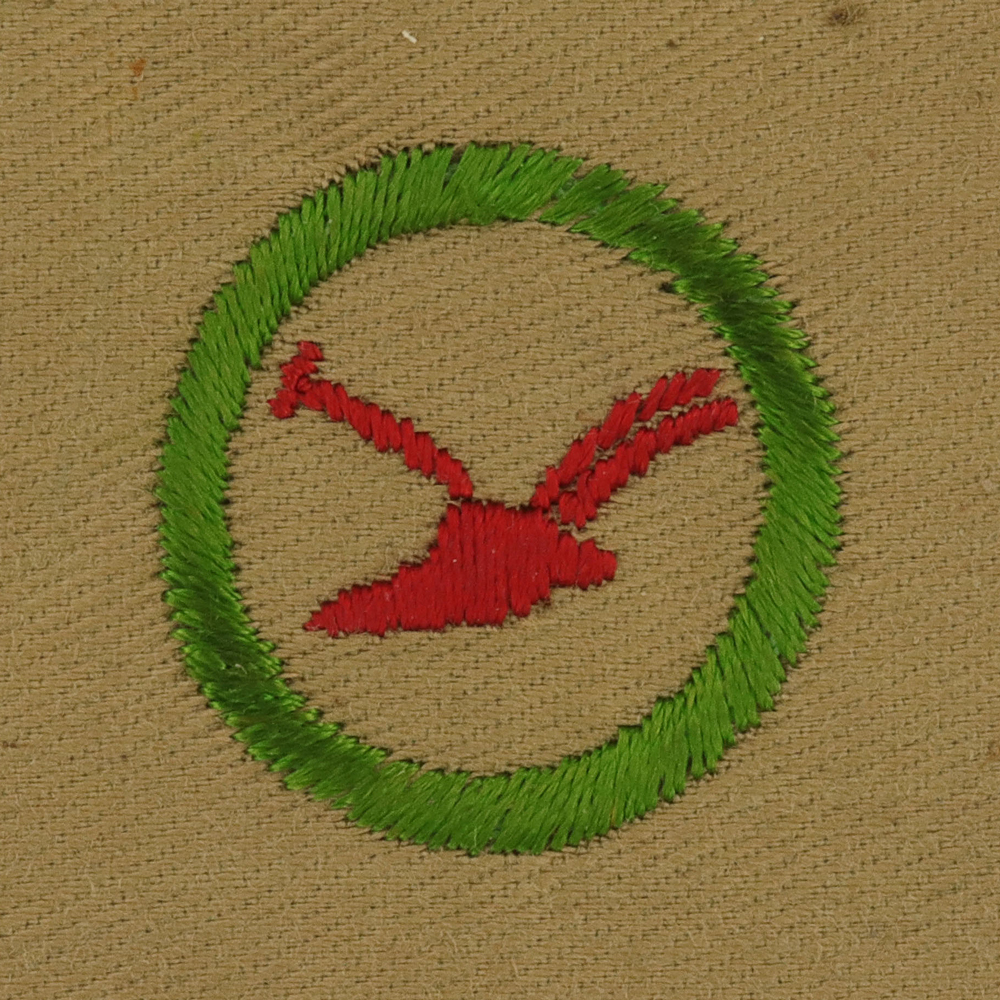
Fig. 1: Agricu-AH5-Front
- Cloth: Heavyweight tan right twill
- Embroidery: Silk continuous
- Border: Clockwise, ovalish loose
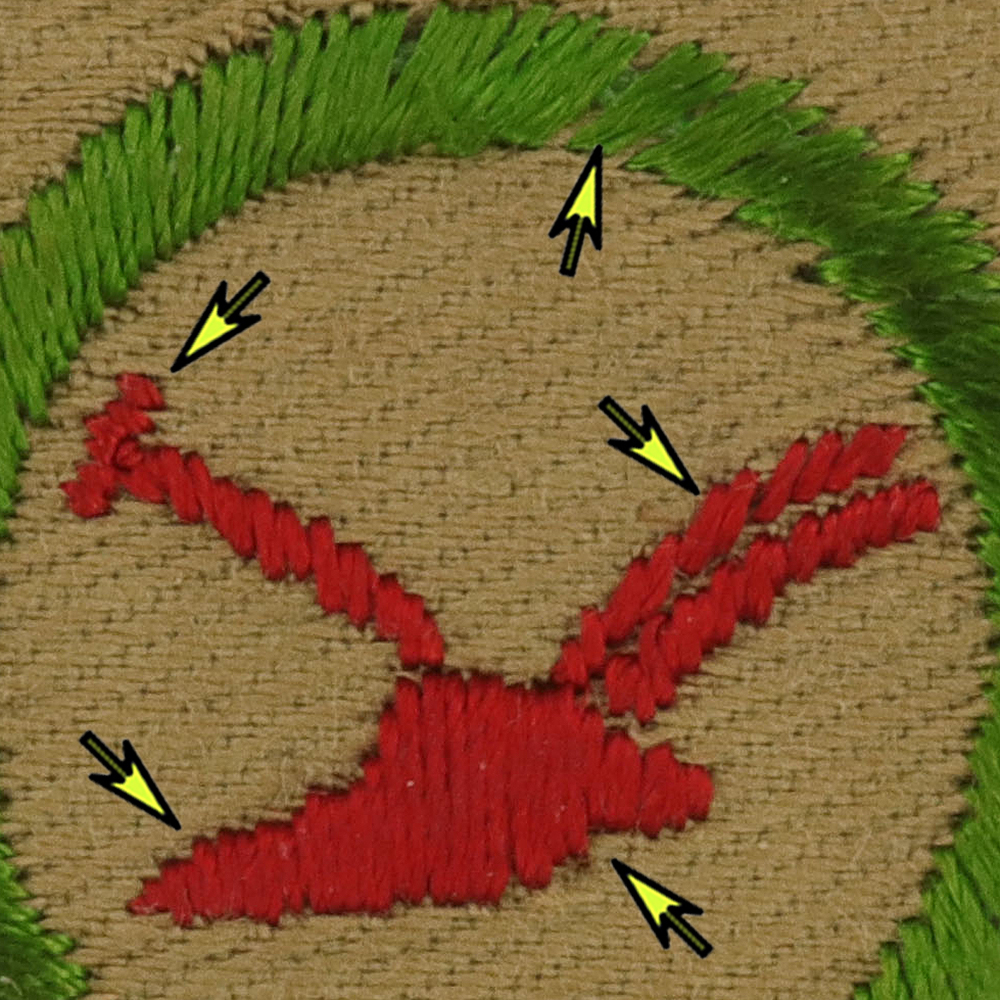
Fig. 2: Agricu-AH5-Magnified
- Design: Short perpendicular buckhead at end of beam, beam does not extend beyond buckhead, handles close together with crossbar, narrow shaped share and small moldboard, No point where share and moldboard meet at bottom, top of moldboard flat, loose embroidery border
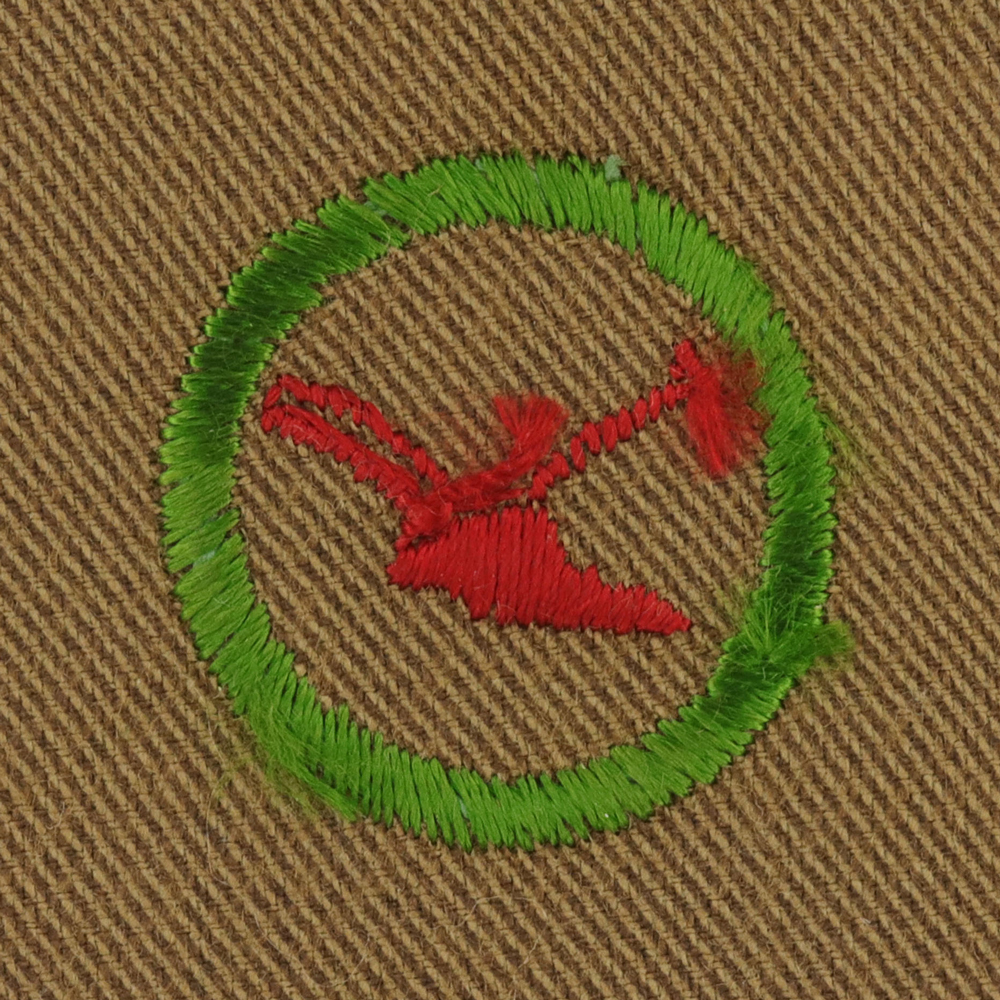
Fig. 3: Agricu-AH5-Reverse
- Back: Brown imprint
Item Name: Agriculture 1913 - 1921
Item ID: Agricu-AH5
Collector Rating: 1
Pamphlets Used to Earn this Badge
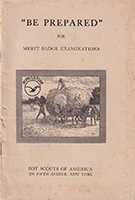
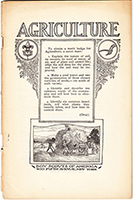
Requirements August 1911 until October 1914
1. State different tests with grains.
2. Grow at least an acre of corn with products 25 per cent. better that the general average.
3. Be able to identify and describe common weeds of the community, and tell how best to eliminate them.
4. Be able to identify the common insects and tell how best how to handle them.
5. Have a practical knowledge of plowing, cultivating, drilling, hedging, and draining.
6. Have a working knowledge of farm machinery, haymaking reaping loading and stacking.
7. Have a general acquaintance of the routine seasonal work on the farm, including the care of cattle, horses, sheep, and pigs.
8. Have a knowledge of Campbell's Soil Culture principle, and a knowledge of dry farming and of irrigation farming.
Requirements October 1914 until November 1927
1. Explain the nature of soil, its texture, its need of water, of air, and of plant and animal life; what the soil does for the plant, and how the soil may
be improved.
2. Make a seed tester and test the germination of three chosen varieties of seeds,--100 seeds of each variety.
3. Identify and describe ten common weeds of the community and tell how best to eliminate them.
4. Identify six common insect pests, tell what plants they usually infest, and how best to control them.
5. Have a practical knowledge, for his locality, of plowing, cultivating, harrowing, disking, draining, and harvesting, and the purposes of each. Describe
also the farm implements used in each case.
6. Tell how plants are propagated,--by seeds, roots, cuttings, tubers, buds, and grafts. Explain where plants get their food and how they grow.
7. Explain how to read a weather map, know weather signals, and the making of local observations.
8. Name and distinguish ten common birds of his locality, and state their value to the farmer.