-
Merit Badges
- Legend to identify Merit Badges
- 1910 British Merit Badges
- Square 1911 - 33
- Wide Crimped 1934 & 35
-
Narrow Tan Crimped 1936 - 42
- Tan Heavyweight Cloth with Silk Embroidery and Printed Back 1936 - 37
- Tan Heavyweight Cloth with Silk Embroidery and Plain Back 1937 - 38
- Tan Lightweight Cloth with Silk Embroidery and Plain Back 1938 - 39
- Tan Lightweight Cloth with Cotton Continuous Loop Embroidery and Plain Back 1939 - 42
- Tan Lightweight Cloth with Cotton Lockstitch Embroidery and Plain Back 1939 - 42
- Blue Background 1942 - 46
- Wartime 1942 - 46
- Khaki Narrow Crimped 1946 - 59
- Green Twill Gauze Back 1960 - 68
- Fully Embroidered Merrowed Edge 1960 - 72
- Unprinted Plastic Back 1972 - 01
- Printed Plastic Back 2002 - Current
-
Merit Badge Paper
- Merit Badge Applications
- Merit Badge Cards
-
Merit Badge Pamphlets
- Type 1 White Cover - Rectangle Drawing On Cover
- Type 2 White Cover 5-375" x 8" Title at Top
- Type 3A Tan Cover - 200 Fifth Avenue
- Type 3B Tan Cover - 2 line address New York City
- Type 3C Tan Cover - 2 line address New York N.Y.
- Type 3D Tan Cover - 1 line address New York N.Y.
- Type 4 Standing Scout Cover
- Type 5A War Cover
- Type 5B Red and White
- Type 6 Photo-Red Cover
- Type 7 Full Photo Cover or Bulls-eye Cover
- Type 8 Full Photo - Green Stripe Cover
- Type 9 Full Photo - Red Stripe Cover
- Type 10A Blue Stripe - Logo above bottom blue stripe - FDL centered
- Type 10B - Blue Stripe in bottom of photo area. FDL to left of text
- Special Covers
- Boy Craft Helps
- Merit Badge Counselor's Guides
-
Youth Position
- Junior Assistant Scoutmaster
- Senior Patrol Leader
- Assistant Senior Patrol Leader
- Patrol Leader
- Assistant Patrol Leader
- Troop Guide
- Scribe
- Quartermaster
- Instructor
- Chaplain Aide
- Den Chief
- Librarian
- Musician
- Webmaster
- Bugler
- Troop Historian
- Troop Representative
- Unit Representative
- Leadership Corps
- Honor Guard
- Leave No Trace Trainer
- Outdoor Ethics Guide
-
Patrol Medallions
- Patrol Medallions Introduction
- Legend to identify Patrol Medallions
- Patrol Shoulder Knot-Ribbons
- Felt Handmade Patrol Medallions
- Square Felt Patrol Medallions
- Round Broadcloth Patrol Medallions
- Red Twill Patrol Medallions
- Multi-Color Cloth Patrol Medallions
- Tan Cloth Patrol Medallions
- Patrol Medallion Back Patches
- Woodbadge Patrol Medallion

Fig. 1: Agribu-H4-Front
- Embroidery: Cotton thread, dull sheen
- Border: Lt green merrowed
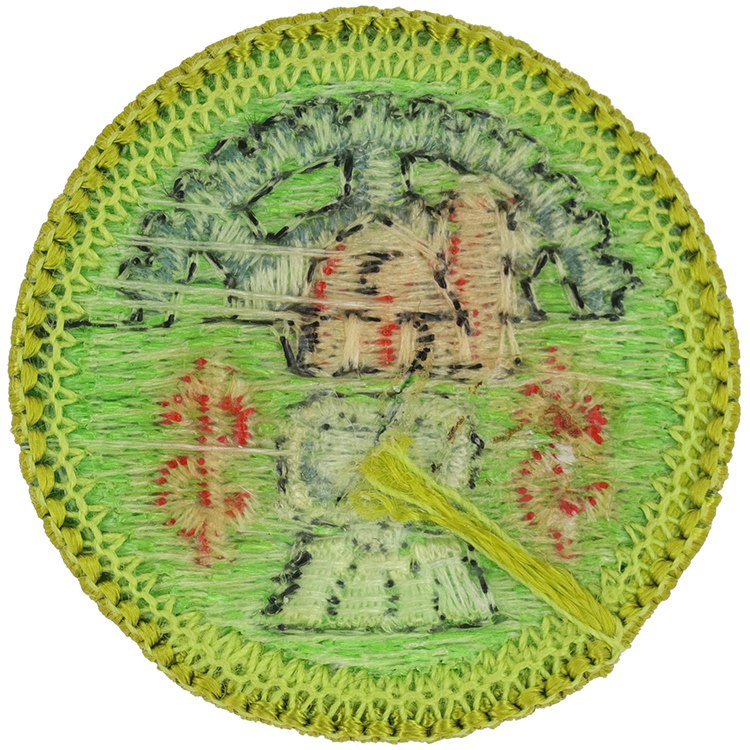
Fig. 2: Agribu-H4-Reverse
- Back: Lt green lock stitch, molded plastic
Item Name: Agribusiness 1987 - 1990
Item ID: Agribu-H4
Collector Rating: 1
Pamphlets Used to Earn this Badge

Requirements September 1987 until January 1995
1. Briefly describe the work done by professionals in each of these agribusiness areas: production agriculture (farming and ranching), agricultural education, soil and water conservation, agricultural economics, agricultural engineering, animal science, entomology, agronomy, food technology.
2. Make a list of at least 10 different kinds of agribusinesses in your community, or other businesses that are involved with agriculture in some way.
3. Visit at least one of the following:
(a) A farm, ranch, of feedlot
(b) A high school or community college agriculture class
(c) The local office of the Cooperation Extension Service
(d) The local Soil Conservation Service office
Have a list of questions ready. Ask what the farmer, rancher, agricultural science teacher, county agent, or conservationist does. Find out how the work of the person visited relates to the production of food and fiber.
4. Visit at least one of the following:
(a) Agricultural experiment station field test plot
(c) The animal science, plant science, or entomology department of a local university
(d) A floriculture/horticulture test garden, field laboratory, or greenhouse
Have a list of questions ready. Find out how agricultural research contributes to farm productivity. Ask the scientists and technicians you meet about their work.
5. Visit at least one of the following:
(a) Federal land bank, production credit association, or other financial institution involved in financial institution involved in financing agricultural
(b) Agricultural equipment and supply dealer
(c) Farmer’s cooperative
(d) Grain elevator or cotton gin
(e) Livestock auction barn
(f) Foreign market developer or exporter
Have a list of questions ready. Find out how the products or services offered by the business help farmers and ranchers grow or market food and fiber. Ask the people you meet how they got started in the business.
6. Visit at least one of the following:
(a) Food processing or manufacturing plant
(b) Textile factory
(c) Food warehouse or distribution center
(d) Food transportation company
(e) Retail food store
(f) Restaurant
Have a list of questions ready. Ask the owner or manager to describe the movement of agricultural products to and from the facility. Find out what form the products are in when they arrive and how they are handled at the facility.
7. Do the following:
(a) Choose a food or fiber of animal origin such as meat, milk, or wool. Draw a chart showing how the product gets from the farm or ranch to the consumer or foreign export market. Trace the steps required to produce, market, process, and distribute the product. Briefly tell how agribusiness workers are involved at each step.
(b) Do the same for a food or fiber of plant origin such as a grain, a fruit or vegetable, or cotton.
8. Choose a profession in agribusiness that interest you. Do ONE of the following:
(a) Write a report of a least 500 words on how you would prepare for the job and what kind of work you would do.
(b) Tell your troop or team about the area of agribusiness that interests you. Describe the training required and the work done by professionals in that field.